

 GMA Brandtalk
 Tracking
 Archives

4 steps to financial stability while adulting
This is the inaugural article of our Money 101 series. Illustrations by Jessica Bartolome
Y
ou're young, you're getting a regular paycheck, and you are thinking about making some big adulting moves! Are you thinking of moving out of your family home and striking out on your own or with friends? Whatever it is, you know that the first step has to be knowing how to handle your money better. Budget, expenses, savings: where do you start?
Before moving out from his family’s house, 25-year-old Chase Jimenez said one of the things that he examined was his level of maturity.
Working as a freelance virtual assistant, he moved to Makati from Cainta, Rizal to be closer to his job at the time.
“I had to consider carefully if I was mature enough to know that I can be responsible for myself and taking care of the household,” Jimenez told GMA News Online.
Now living with three other roommates, 30% to 40% of his salary goes to basic necessities like paying rent and other bills and groceries, with the four of them splitting expenses equally.
Graphic designer Gayle Caspe, 24, said it had not been her immediate plan to live independently. But since she needed to attend face-to-face classes in 2023, she opted to rent a condo unit in Quezon City.
“Originally, my lease was just for six months, but I extended it after graduation since I realized that this [living independently] is what I want to continue doing,” she said.
Adulting is about making big moves—and every move is made up of little steps that should move you further down the road of financial stability. Here are a few things to keep in mind to help you manage your budget.

1.
Allocate, allocate, allocate!
Among the things that a person can do to budget their money is to allot a set percentage to different expenditures.
One popular proportioning is the 50-30-20 rule. According to the Massachusetts Institute of Technology, 50% of your monthly income should go to fixed expenses, such as housing needs, transportation, and monthly subscriptions you can afford without draining your wallet.
Meanwhile, 30% of your money should be allotted to flexible spending—optional expenses like shopping and other leisure activities.
The remaining 20% of your income should be saved for financial goals, or a cushion in times of emergencies.
However, this budgeting strategy can be modified depending on one’s goals and responsibilities.
Financial adviser Roselle Marie Mirandan said 60% of one’s income should be allotted to basic expenses such as food, shelter, electric bills, and water bills.
“Dito rin yung pangbigay kila mama, kila papa o di kaya sa pagpapaaral sa kapatid,” Mirandan told GMA News Online
(This is also where you get the money to give to your parents or to provide for your siblings’ education.)
She added that emergency funds should take 30% of one’s budget, which would be then split into half: 15% to go towards insurance and the other 15% to be kept in a savings account.
The remaining 10% is for leisure spending.
“If kaya mo siyang ibaba ng 5% [If you can decrease your spending leisure to 5%], why not? At least 5% to 10% of your income is set aside for your leisure and then the rest for savings,” Miranda said.
She added that leisure spending can be important too. “For our sanity natin kasi yun eh, so hindi mo siya tatanggalin [It’s for our sanity, so you do not remove it],” she added.
.2
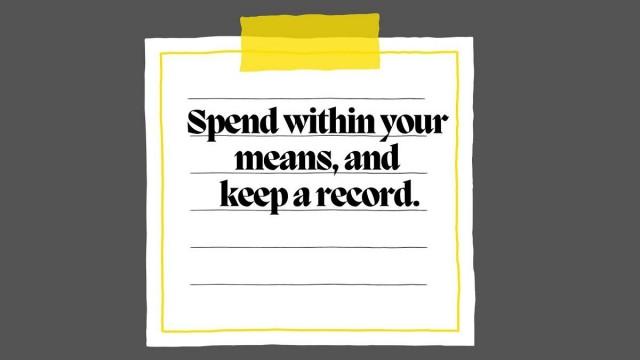
Keep track of your spending!
Taking note of where your money goes will help keep you from exceeding your budget.
Caspe also said having a bank account without online access helped her maintain her savings since she has to go to the bank to withdraw or deposit money, unlike with online banking, where she has access to her money in just a few clicks.
She believes having six months to one year's worth of savings is an ideal amount to determine whether one is ready to live independently.
“I think siguro mas maganda naman talaga yun like may one year worth of savings ka na ng rent para at least may backup ka, pero siguro kahit six months worth of savings before moving out, alam mo [kung] talagang financially ready ka,” Caspe said.
(I think it's better if you have one year's worth of savings to at least have a backup, but six months' worth of savings could also be enough for you to determine whether you are financially ready to move out.)
Francis Rafael, a market risk officer in a bank, said that before making any major moves you should should check if you can afford the cost of living, including obligations, and suggests it would be advisable to have at least P100,000 in savings first.
“Ang basis kasi noon is, in case of a stress event, for example, nawalan ka ng work, for the very least, meron kang enough time frame para makahanap ka. O kung nawalan ka na isang stream of income, ito yung buffer mo,” Rafael told GMA News.
(The basis for that is, in case of a severe event like losing a job, at the very least it will give you time to look for another job. If you lose one stream of income, your savings will be your buffer.)
In order to maintain one’s savings, Rafael said one should identify their objectives in earning money.
“Sa Excel, meron akong target saving versus the actual. Maganda na pagtapat mo sila [On an Excel spreadsheet, I have a column for target savings and actual savings. That way I can compare them],” Rafael said.
“Sa credit card, as much as possible, ang treatment ko sa kanya is extension ng cash lang [I treat my credit card as just an extension of my cash],” he added.
Mirandan also advised making a cash flow statement—a list that tracks in inflow and the outflow of your money—where you can list your income and your expenses, from bills and necessities to even small things you buy online.
3.
Start a contingency fund.
You've heard the phrase before: save for a rainy day.
The experts recommend allocating a certain percentage of your paycheck to savings, to keep in banks of in investments, to allow interest to grow.
“Pag kasi na sa banks, may sense of security. Then, aside from that, accessible at meron na rin silang mga option to invest,” Rafael said.
(You have a sense of security if your money is in the bank. Aside from that, it is accessible and you have the option to invest.)
One of the resources Rafael suggests is the Unit Investment Trust Fund, an open-ended pooled trust fund denominated in pesos or other accepted currency. It is considered a medium- to long-term investment that is operated and administered by a trust entity and made available by participation.
As always, do your research and consult an expert if you can before making any decision. Both Caspe and Jimenez say they are looking into making investments in the future.
“Realistically, bini-build up ko pa rin siya na hindi pa talaga like buo 'yung emergency funds ko,” Caspe said. “Wala akong sineset na limit basta na bi-build up ko siya.”
(Realistically, I’m still building up my emergency funds. I’m not setting a limit as long as I’m building up my savings.)
“I planned to allocate a budget for insurance policies at the start of this year, but that didn't pan out well. So I think for me it's quite normal that your expectations won't be met,” Jimenez said.
Mirandan, who is also a unit manager of an insurance company, described insurance as a “tool” to help a person protect their income.
“There are so many uncertainties like sickness, accident, and disability,” Mirandan said. “So darating sa point na lahat ng inipon mo, kailangan mong gastusin for hospitalization [there will come to a point that all your savings could end up being spent on hospital expenses].”
Investments will be there for you later in life, in your retirement.
“Is P2,500 or P4,500 [social pension] per month enough to sustain your lifestyle na meron ka ngayon [that you have now]? Kasi kung hindi [if not], you have to prepare independently privately on your own without depending on the government,” Mirandan said.
There are two types of insurance plans: Traditional and Variable Unit-Link Life (VUL) insurances.
The Philippine Institute for Development Studies defines VUL as a life insurance policy with an investment component.
Miranda said that traditional insurance plans are standalone insurance that need to be renewed yearly.
She added the contribution for VUL insurance is 40% to 50% higher than the traditional insurance.

4.
Think twice before spending big.
Thinking of making a major purchase? If it is not a long-term necessity, Jimenez said he’d rather save up for it than take out a loan.
“I like to try and ground myself. Do I need it? If so, I think the right time for me to get those would be for really long-term investments,” he said.
Both he and Caspe said they would go for a loan for major adulting moves such as getting their own house or car.
“It's okay to treat yourself pero importante talaga mo nang i-build yung savings [but it is really important to build up your savings],” Caspe said.
Rafael shared the same sentiments, saying that one should not be guilty of treating oneself since it’s the “fruit of their labor.”
Mirandan suggested that for a person earning P20,000 a month, P2,500 can go to their emergency funds while another P2,500 can be allotted to leisure expenses.
“It's not about the income or how much your income is. It's how you manage your income,” she said. — BM, GMA Integrated News

