

 GMA Brandtalk
 Tracking
 Archives

Brigada Blogs: Confessions of a Cyberbullying Victim
Bullying is no longer something that happens only in schools or on playgrounds. Recent studies have shown that social media networks like Facebook and Twitter have become a new breeding grounds for cyberbullies. In a recent episode, the GMA News TV program "Brigada" spoke with cyberbullying victim Raymond Malinay Lopez. Twenty-seven-year-old Raymond used to live a quiet life as an ordinary college junior at Far Eastern University (FEU). But last July 4, his world was turned upside down when an online poster falsely accusing him of purposely spreading the HIV virus began to spread like wildfire on Facebook. “We have reason to believe that he has been intentionally spreading the HIV virus by promiscuous sexual acts … Please share this picture for the safety of the community,” read the poster, which also showed a picture of Raymond in his school uniform.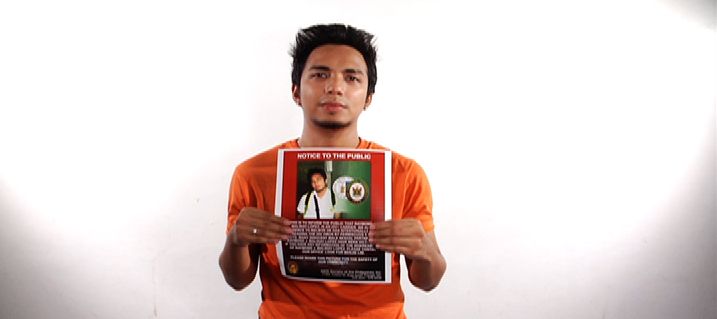 Raymond Malinay-Lopez is shown here holding a printed copy of the online poster that falsely accused him of purposely spreading the HIV virus. The poster was shared widely on Facebook. When Raymond discovered the image, he was shocked and humiliated. “What a strong accusation! I was so shocked. Everyone is calling on my mobile, hundreds of Facebook messages, phone messages, [asking] me if that's true,” said Raymond in a YouTube video that he later posted to tell his side of the story. To prove that he does not have HIV, Raymond had himself tested for at the Bernardo Social Hygiene Clinic in Quezon City and posted a copy of the negative results online. The AIDS Society of the Philippines and FEU, whose logos appeared on the original poster, also denied responsibility for the image. Raymond has since asked the Philippine National Police to investigate the incident. There are still no laws against cyberbullying in the Philippines, but this doesn't mean that victims are necessarily helpless. In an interview with Kara David for "News To Go" last March 24, social media specialist Janette Toral gave this advice to victims of cyberbullying. “Kailangan maging matapang sila at ‘wag nilang pepersonalin nang husto. Pero ‘wag pumatol. I think kapag nakaranas ka ng cyberbullying, pinaka-una mong magagawa ay i-correct yung unang misinformation,” she said. Raymond recently spoke to the GMA News TV news feature program “Brigada” about what it's like to be the target of cyberbullying and his determination to fight back: Q: Before the rumor, how active were you on Facebook? How did this change when the rumors started? I used to be very active on social media. I wanted to stay in the loop and maintain my social relationships. I was addicted to it. When the rumors started, I had to be more active because so many people were sending me messages, asking me if the rumors were true, and I had to answer them. But because of the rumors, I learned to control my activity on Facebook. Before, everything was public. Now, I made my profile private and I am more discerning when adding friends. I don’t add people unless I really know them. What was your initial reaction when the rumor first broke out? How did this affect your life at home? In school? What surprised me was that my picture had the logo of my school and the AIDS Society of the Philippines. The "posters" said that I have HIV and that I was intentionally spreading it to other people. It was a strong accusation. I was so shocked, and everyone who knew me was calling on my mobile. I received hundreds of Facebook messages and phone messages asking me if it was true. But I’m a strong person. I know that I'm innocent and I'm just a victim. It didn't affect my studies and me as a person. How did your parents and friends take the rumor? My parents and friends were disappointed, of course. They couldn’t believe that this was happening to me. They’ve always believed that I am a good person so I just kept on denying the rumors since they really are not true. They kept on reminding me to be strong. I also tried to look for a solution to my problem. How did you try to solve this problem? I decided to forward to the CIDG Cybercrime in PNP-Camp Crame copies of the images and screen grabs from those who posted and shared the false accusations, so the authorities could look into this incident and possibly file appropriate charges. I was able to give the CIDG names of those who uploaded and shared the “posters” but they told me that they can’t just file charges against them since there was no way for us to be sure if the original “posters” did come from them. It was possible that they simply shared it. But there was someone who uploaded the most number of posters. Ang magagawa na lang daw ng CIDG ay i-report itong account na ito sa Facebook. Facebook deleted the posters but those that have already been shared are actually still going around. To finally clear the issue, last July 10, I also posted a photo of a document from the Bernardo Social Hygiene Clinic in Quezon City proving that I don’t have HIV. The staff of the clinic also gamely posed for a photo with me. I also posted a statement on my Facebook account and a video on YouTube titled “Raymond J. Malinay-Lopez in False Accusation” to set things straight.
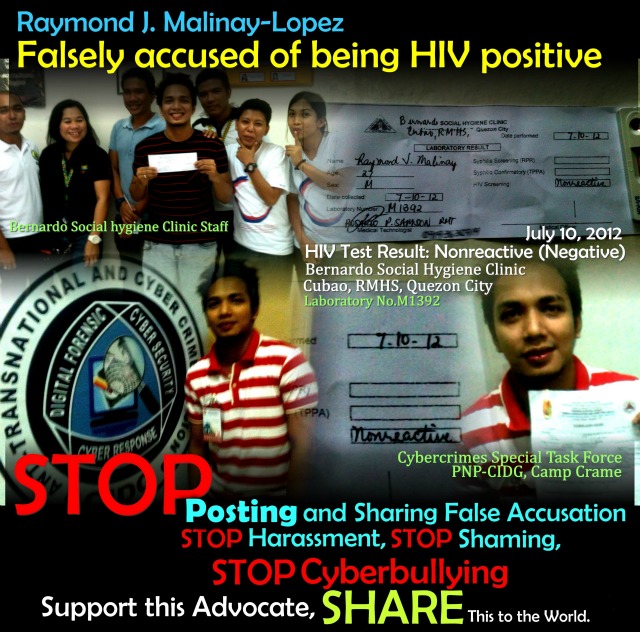 To clear his name, Raymond posted the negative results of his HIV test on Facebook. What will you do if ever you get the chance to meet the person who started all these rumors? I’ll tell him, “Sana maisip mo ang nagawang pagkakamali mo na maaaring mangyari rin sa iyong pamilya, at alam kong mabigat at mahirap na kutyain ka ng mundo. Alam kong kahit ikaw matindi ang pagdadaanan mo.” No one deserves to have their name slandered over social media. I understand that there is no legislation yet against cyberbullying in the Philippines. I’m hoping for a public apology. Sana mapagbayaran niya ang ginawa nya. For me, hating someone is a waste of time. Minsan lang tayo mabuhay sa mundo. Pinatawad ko na sila. Sana lang wala ng sumunod sa nangyari sa akin. What advice would you give other Internet users who experience cyberbullying? First, do not immediately believe anything you read or see on social media without trying to verify the facts. Second, respect the rights of people living with HIV. Exercise more caution and responsibility over what you post and share on your Facebook profile. To people who are being bullied, just be strong, and it helps to pray. If you have friends who have been in your situation before, talk to them. They will understand how you feel, and should be able to help you. It may be hard at first, but once your family and friends surround you with love and support, you will be grateful. How are you now, a more than a month after the incident? Hanggang ngayon, kumakalat pa rin siya. Hindi na talaga siguro matatapos. May nagtatanong pa rin. Noong una, medyo mabigat talaga. Tinatanong ko ‘yung sarili ko, bakit naman? Ngayon, ayoko na lang magtanong pa. I’m continuing on with my life. I’m really okay now. —Angel Bombarda, PF/GMA News
