

 GMA Brandtalk
 Tracking
 Archives

Philippine Consulate in New York confirms some Filipinos denied entry at US borders
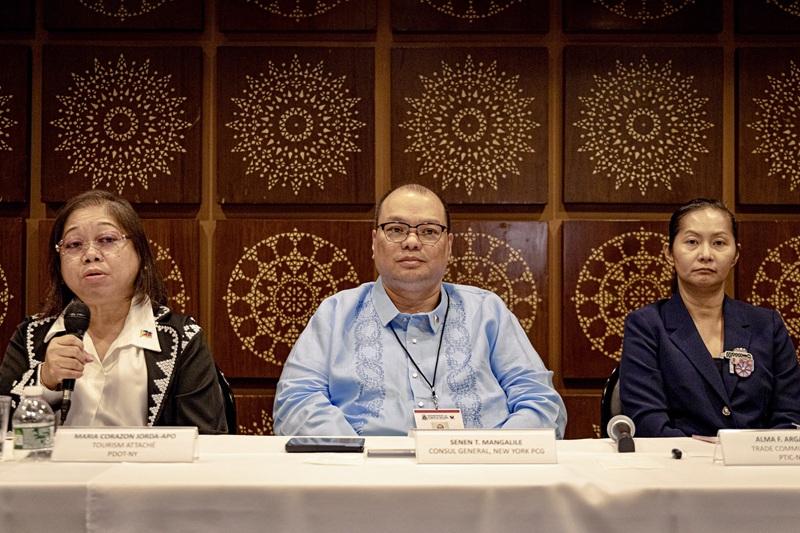
NEW YORK - The Philippine Consulate General in New York has confirmed that some Filipino travelers are denied entry at US borders, often due to discrepancies in travel documents or past criminal records.
Speaking during the Consulate’s “Media Hour,” New York Consul General Senen Mangalile said that in some cases, travelers’ visas did not match the purpose they stated during border interviews.
“Some of them have visas that do not match what was revealed during the border interview. For example, they may have tourist visas but are suspected of planning to work. Others are turned away because of past criminal records. I’m not saying they were necessarily imprisoned, but there were items in their record that the Customs and Border Protection officers discovered. These are usually the two main reasons travelers are turned away at the border,” Mangalile explained.
At present, less than ten cases are being monitored within the Consulate’s jurisdiction.
The Consulate is coordinating with the US Immigration and Customs Enforcement (ICE) on the case of two Filipino detainees from Boston and Philadelphia, who have already served prison sentences and are now awaiting deportation proceedings.
“Thousands of individuals of all nationalities are being deported, and our kababayan are among them. It will take time. Deportation is a costly process. They need to purchase tickets, and in some cases, ICE officers have to escort people. Some flights may even have to be chartered. So, even if our kababayan offer to undergo voluntary deportation, once they are already in the system, they will have to wait for their turn to be removed from the country,” Mangalile said.
Department of Foreign Affairs (DFA) clarified that there are only few instances wherein Filipinos travelers to the United States, particularly those on tourist visas, are being denied entry.
“The numbers of those turned away at the border are few and far between," DFA spokesperson Angelica Escalona told GMA News Online.
Assistance available
The Consulate, through the DFA, has funds to assist in the voluntary deportation of Filipinos, but these are available only on a case-by-case basis.
“I believe the DFA’s position is very clear — it will be on a case-by-case basis. If there is no threat to the person’s life or welfare, I don’t think the government should shoulder the cost,” Mangalile clarified.
The Consulate’s Assistance-to-Nationals (ATN) section has also reported an increase in inquiries about voluntary departure. Callers are advised to consult the US Department of Homeland Security (DHS) website, which outlines the process.
According to DHS guidelines, undocumented immigrants without criminal records are encouraged to leave the country voluntarily to improve their chances of being accepted should they wish to return in the future.
Mangalile reiterated the call of Philippine Ambassador to the US Jose Manuel Romualdez for undocumented Filipinos to assess their options.
“I will reiterate what the ambassador said before all of this began. First, if you no longer have any hope of obtaining proper status and legal residency here in the United States, one of your options is to return to the Philippines. Going back to the Philippines is as simple as buying a ticket and boarding a plane," said Mangalile.
"If your passport is not updated, you can come to us. If your passport has complications, then one option for you is to obtain a travel document and process your passport once you are in the Philippines. The advantage of this is that you will be going home without being arrested and therefore, theoretically, you will have the ability to return to the United States in the future — this is if you truly have no hope and no legal claim whatsoever," he added.
The Consul General also said that "Now, if you see a basis to remain here in the United States, then that is something you will need to decide on, but what can truly help you is an immigration lawyer. We regret, as the Philippine government, that we cannot provide immigration lawyers for all those without legal status here in the United States.” — with a report from Michaela del Callar/BAP, GMA Integrated News

