

 GMA Brandtalk
 Tracking
 Archives

Filipinas in Kyiv choose their families and the lives they’ve built amid the war
KYIV/BUCHA/IRPIN — The air was crisp and freezing, and yet Ruby Anne Gallego and her husband Igor Kurson were sweating as they sped away from a short bridge in Irpin. She implored him to pull over, realizing they were already trapped in the gunfire between Ukrainian soldiers and Russian ground troops. Overhead, rockets whizzed their vehicle.
It was February 28, 2022, the fourth day of Russia’s full-scale invasion of Ukraine. Russian forces had already advanced from the northwest into the neighboring city of Bucha, where the couple lived, in an attempt to encircle Kyiv. The road to the bridge was choked with cars peppered with bullet holes. No one stepped out of the vehicles anymore.
When Gallego opened the car door, a grenade landed just five steps away.
Kurson swerved into a U-turn, narrowly escaping the blast. They fled on foot, crouching behind leafless shrubs until they reached a nearby warehouse. Its guards motioned for them to stay low as they ran inside.
Gallego remembers only one certainty from that moment: she needed to stay with her husband, whatever happened next.
More than three years later, in September 2025, Gallego and Kurson brought me back to that warehouse on the outskirts of Irpin, a city about 28 kilometers northwest of Kyiv. Even the lush autumn foliage, now blocking the view of the bridge, couldn’t lift the heaviness they felt standing before the building that saved their lives.
“Napaka-lucky namin,” Gallego said softly. The fear, however, never left her.
“Every day, bago matulog, pabalik-balik sa isip ko, ‘Paano ako makaka-recover? Malapit na akong mamatay.’ Willing na ako—hinihintay ko na ngang sumabog kasi may granada sa harapan ko at rocket sa itaas namin. At that time, wala nang choice na mabuhay.”
(We’re so lucky. But every day before sleeping, it comes to my mind, ‘How can I recover? I’m going to die soon.’ I was already willing to die, in fact, I was waiting to be blown off because there was a grenade in front of me and a rocket overhead. At that moment, it felt like there was no choice but death.)
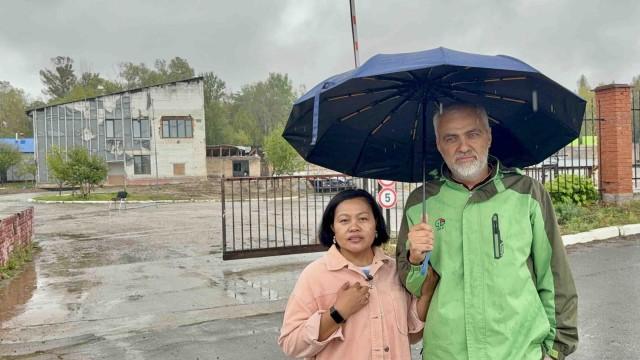
Gallego, who came to Kyiv in July 2021 as part of a religious mission, has chosen to stay with her husband.
When the war began, the Philippine government imposed a total deployment ban on Filipino workers in Ukraine and scrambled to evacuate its citizens. Many left through Poland or Moldova. Gallego did not.
“Kung iwan ko ang asawa ko, I don’t know kung magkikita pa kami,” she said. “Ang nasa mind ko ay kailangan kong suportahan ang husband ko, kasi hindi lang ang sarili ang iniisip niya.”
(If I leave my husband, I don’t know if we’ll ever see each other again. What’s in my mind is I need to support him, because he thinks of others as well.)
Her decision has rewritten her understanding of survival as much as it reveals an overlooked perspective in the war: the experiences of female migrants who have made Ukraine their home, even as a full-scale war keeps trying to push them out.
Seeing Irpin and Bucha
I first saw the scale of that devastation when I arrived in Kyiv for a reporting trip organized by Internews Ukraine on September 12, 2025. Four days earlier, Russia had launched an aerial assault on the Cabinet of Ministers building, killing an infant and another civilian. Yet, our local fixer, Vladyslav Bulka, reassured us that the capital remained relatively safe if we followed protocols.
Despite that, reminders of the ongoing war appeared without warning.
I was speaking with Bulka about how I could be the only Filipino in Kyiv—at least, I hadn’t met any yet—when our vehicle slowed to make way for an incoming hearse. It was for a Ukrainian soldier, he told me, explaining it was now customary to stop the traffic to honor soldiers killed on the frontlines. The silence inside the car felt heavier than the cold outside.
Later at our hotel, Bulka and I joined the three other journalists in our group for a briefing on our packed itinerary, including visits to Irpin and Bucha, the cities where Russian ground forces committed atrocities during their push toward Kyiv.
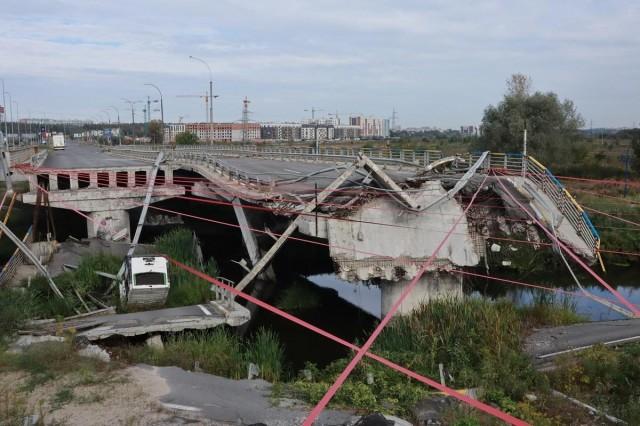
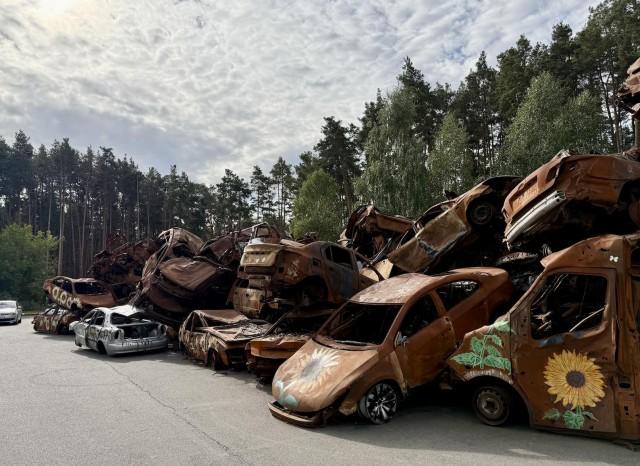
The next day, our group stopped by the blown-up Irpin Bridge, now a memorial. The Ukrainian army destroyed it, Bulka said, to prevent Russian forces from advancing into the city. Before leaving Irpin, we stopped by the Central House of Culture, an artistic venue completely razed during Russian ground force attacks. As we headed to Bucha, we saw the “car cemetery,” or a pile of rusted vehicles used by residents who tried to escape the occupation but were caught between gunfire and then burned.
The drive to Bucha was heavy. On one side, we could see houses damaged by shrapnel. On the other hand, residential flats and other high-rise buildings lay in ruins. We reached the Church of St. Andrew the First-Called, its white walls now marred with bullet holes, and behind it the memorial for 501 residents who perished during the Bucha massacre.
The oldest individual I saw listed was born in 1928. This person survived a world war and a global pandemic, until Russia’s invasion reached Bucha. Some of the plaques remain nameless.
“They are a reminder of those whose names we still do not know, who have not yet been identified,” our guide, Ivanna Skoryk, told me. She is the communications manager of the Bucha-based Institute for Sustainable Development of Communities.
“And this is precisely about dignity: we remember every victim of the Russians, even if we do not know their name.”
As we stayed in the church’s vicinity, Skoryk pointed to the flats, saying Bucha was once an upscale residential location. Many residents, like Gallego and Kurson, have since returned, although the city still looks muted.
“For some, it could be incredibly difficult,” Skoryk shared. “Their return is not just a simple relocation. It is a story of choice, resilience, and love for one’s home. It’s a way of saying: ‘We are here, and we are stronger than the evil that was here.’”
The 'Diaspora of Nine'
At the time of Russia’s full-scale invasion of Ukraine on February 24, 2022, the Philippine Department of Foreign Affairs (DFA) accounted for “some 181 Filipino nationals … the great majority of which are in Kyiv.”
As the Kyiv offensive happened, the DFA and the Philippine Embassy in Warsaw, which has jurisdiction in Ukraine, evacuated many of these Filipinos. The government’s total deployment ban on Filipino workers assigned to Ukraine, implemented in March 2022, remains in effect.
Now, what remains of the Filipino community there is just enough to fit a dinner table.
Gallego told me she knows eight other Filipinos married to Ukrainians, living in Kyiv and other cities.
Several of them, whom I met on my Kyiv trip, keep in touch on Facebook Messenger, checking in on each other whenever there’s an air raid. Rhea Rose Ramos, a native of Guimaras, recently relocated to Bucha with her husband, Oleg, and their four-year-old daughter. Eliza Almonte lives in Kyiv with her husband, an army veteran with whom she met several years ago in the Philippines. Their amiga, Diane Botenco, who has lived in Ukraine for 13 years, lives in a town near Lviv. She co-manages the advertising agency her husband established some years before the invasion.
Gallego and Ramos told me about the four other Filipinas and the only Filipino man. I asked to meet them, but they were working or begged off for personal reasons.
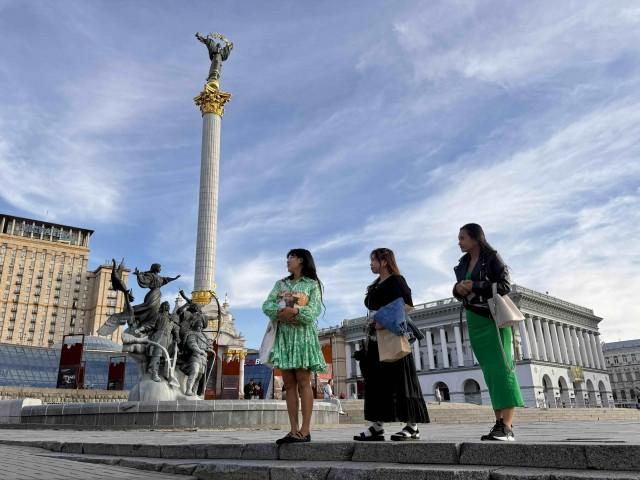
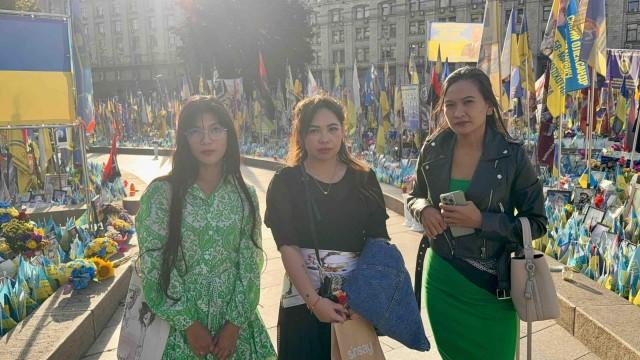
Ramos, Almonte, Botenco, and I walked through the memorial for the hundreds of fallen Ukrainian troops at the Maidan Independence Square. The portraits teemed with life and promise: many soldiers beamed with wide grins while others proudly held their rifles, ready to fight for their country. The sight was truly poignant, and it made me realize I was walking with a fragile sense of freedom earned through the sacrifice of these soldiers.
Among the three ladies, I noticed Botenco was trying to hold back her tears.
“How are you?” I asked her.
“OK naman po ako, at the moment,” she responded. “Pero minsan, mayroon akong anxiety lalo na kapag mayroon kaming mga massive attack. Simula po ng war, every time na may naririnig akong explosion, hindi namin alam baka yung apartment na namin yung masasabugan. And then, nadagdag yung sitwasyon ng asawa ko.”
(At the moment, I’m fine. But sometimes, I feel anxious whenever there’s a massive [air] attack. Whenever we hear explosions, we don’t know if our apartment will be hit. And then, it’s also about my husband’s situation.)
It’s always hard to visit the memorial, Botenco told me, because it evokes the fear of losing her husband. He was conscripted into the Ukrainian ground forces several days after the invasion began.
“Lumabas lang siya noon, mga 5 p.m., para bumili ng dinner namin. Alas-siyete na pero hindi pa rin siya nakabalik. Tumawag siya, sabi isa akin, nasa military office na raw siya at dinala siya ng dalawang sundalo at dalawang police officers. Usually, bibigyan dapat ng note or summon para mag-report sa (military) office. Hindi yun nangyari.”
(He went out at 5 p.m. to buy our dinner. It was already 7 p.m., but he still wasn’t home. He called, saying he was at the military office after being brought there by two soldiers and two police officers. Usually, men [who were to be drafted into the army] would be given a note or a summons to appear and report at a military office. In his case, it didn’t happen.)
Botenco has since been trying to “voice our rights” to have her husband released from service. He’s the only child and the guardian of his senior parents, she added.
“Hindi po ako maka-get-over doon sa pain, kasi nakita ko po ang asawa ko na in-escortan at ni-recruit. Pinuntahan ko siya sa military hospital, kasi binigay ko yung medical papers niya kasi hindi siya physically fit to serve the military.”
(I cannot get over the pain of seeing him being escorted out and recruited. I visited him in the military hospital to hand over his medical papers, because he is physically unfit to serve.)
Botenco held on, while Ramos told her, “I’m here, sis.”
As the war rages on, its mental toll on foreign spouses like Botenco, Ramos, and others in small diasporas often goes unnoticed.
The two Filipinas told me they have never encountered any psychological support programs from the Ukrainian government. Instead, they rely on their small group.
“Kaunti lang po kami dito [sa Ukraine] at hindi ako close sa lahat ng Pilipino dito. Only to a few lang talaga,” Botenco said. “If hindi ako nagpaparamdam, if I’m feeling down, or kung mayroon akong pinagpinagpadaanan sa issue ng asawa ko, sila palagi ang kumo-contact sa akin at sinasabi nila, ‘Halika dito, punta ka nga sa apartment. Lutuan kita nung favorite mong pagkain.”
(We’re a few here in Ukraine, and I’m not close to all Filipinos here, only to a few. So, if I don’t message, feel down, or face something about my husband’s situation, they reach out and say, ‘Come to our apartment. We’ll cook your favorite food.’)
During that, Ramos said, “Naiiyak ako!” (I’m getting emotional!)
“Nakakawala ng problema or iniisip kapag kasama ko po sila,” Botenco continued.
(I forget my problems and my mind clears up when I’m with them).
Rebuilding lives
Earlier this month, I checked in on the Filipinas and other contacts in Kyiv and learned that they were experiencing power cuts of up to 16 hours a day, following Russia’s continued attacks on Ukraine’s power supplies and networks, which intensified in mid-October.
“From time to time, it gets easier,” Skoryk shared, adding that she’s been trying to squeeze in as much work as possible during the short daylight hours.
“Personal lives are planned according to schedules, and businesses, shops, and organizations have switched en masse to generators to keep working.”
In Bucha, those who use natural gas for heating were “as for now, more lucky,” Skoryk said. Ramos and Gallego—now Bucha neighbors—often visit each other’s homes. On our recent video call, Ramos told me she was at Gallego’s house, which has a gas-run generator and solar panels, to prepare ingredients for a Christmas party potluck in a different city.
For now, “tuloy pa rin ang buhay kahit brownout,” Ramos said. “Sanay na naman tayo sa ganito.”
(Life goes on despite the power cuts. We’re used to this—something familiar in the Philippines.)
The power interruptions add to the long list of strains that Ukrainians endure daily during the war. Russia’s nightly drone assaults and the ensuing Ukrainian air sirens keep residents awake, and that alertness bleeds through the following working day.
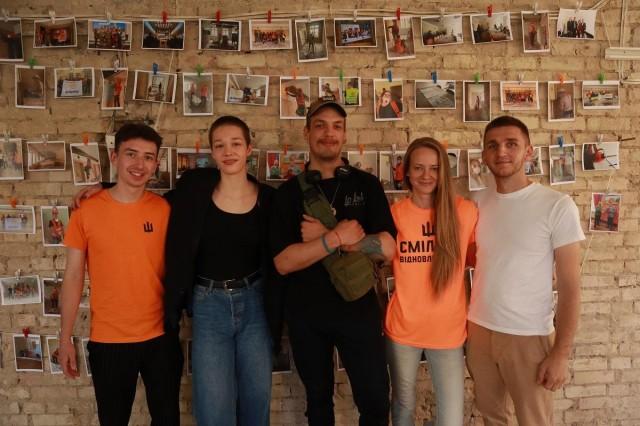
“It’s not normal, and it’s not fine,” Polina Riabchun, a Kyivan from the volunteer group Brave to Rebuild, told me. I met her and other volunteers in an old building they were repurposing into a mental health hub for Ukrainian soldiers and their families.
“Every day after this, when you meet good people, work together, and then go to an afterparty to have a drink and talk, you feel life so bright. The attacks make us tougher, stronger, and angrier.”
I asked her co-volunteer, Anna Zakharenkova, about what she thinks whenever she smashes the old building’s wall.
“Anger,” she said. “Anger at Russia’s invasion, at the unfairness happening in our world, at the death of the people I know—my friends on the front line, or those already dead. Many Ukrainians do have a lot of anger, and it’s good that [we could volunteer] to channel it to do something helpful.”
“In our work here, we are destroyers,” Riabchun said, “We destroy everything they set to destroy: floors and walls. It’s wonderful to have [this kind of] therapy, because you come here, take a hammer, and smash this wall.”
Support systems
Across Ukraine, rebuilding has moved beyond generators and bricks, and now into efforts to steady the mind as much as the country itself. In October, the Ministry of Defense approved a plan to establish a unified system to safeguard the mental health of service members.
The Kyiv-based non-governmental organization Veteran Hub has been working with government ministries to update Soviet-era systems for Ukraine’s veterans, which it estimates at 1.3 million, including those who have returned as frontline defenders.
“What we’re [pushing for] in this new law is for veterans not to be placed in some special villages. They are returning to civil society, and so, they should have normal services from medical hospitals and other stakeholders in general,” Veteran Hub project manager Kateryna Skorokhod said.
Aside from the veterans and their families, Ukraine’s internal refugees, which the United Nations High Commissioner for Refugees (UNHCR) estimates to stand at 3.75 million people, also need mental health support.
“With all this data, we know it’s not enough to have only Ukrainian mental health specialists working,” Ukrainian Ambassador to the Philippines Yuliia Fediv told me. “We need support from other countries.”
During his visit to the Philippines in June 2024, Ukrainian President Volodymyr Zelenskyy requested that his Philippine counterpart, Ferdinand "Bongbong" Marcos Jr., send Filipino mental health workers to his country.
“You mentioned about humanitarian possibilities especially for medicine and like I said to you, especially, psychological mental health and etc., army. So, you understand how many people need their help when they come back, they can’t lose in the families,” Zelenskyy was quoted as saying.
“That is something that I think we are able to offer,” Marcos said. “I am happy to do all that we can to make sure that we can help, especially the civilians and the innocents that are involved in the war.”
Since the meeting, the Philippine Embassy in Warsaw has been giving inputs and recommendations to the DFA and the Department of Migrant Workers (DMW) regarding Ukraine’s request.
“Pero ang caveat namin palagi is we’ll do this [deployment of mental health workers] when the war ends,” Conrado Demdem, Jr., the embassy’s minister and consul general, told me. “But we are studying this, pero post-conflict scenario na. Isa rin sa mga options yung remote counseling.”
(But our caveat is we’ll deploy mental health workers when the war ends. We’re studying it in a post-conflict scenario. Also, one of the options to send help is through remote counseling.)
At the same time, the Philippine Embassy in Warsaw regularly checks in on Filipinos in Ukraine through a group chat with its honorary consul and other diaspora members.
Meanwhile, Ukraine’s embassy in Manila has been negotiating with the DFA and the DMW to “waive the deployment ban” and work on a reciprocal visa-free agreement to make it easier for “building bridges in mental health support.”
“With what’s happening in the world, we sometimes underestimate the distance between us,” Fediv said.
“Wherever I go, many Filipinos tell me they are praying for Ukraine. It’s important for us to hear not only from politicians but also from people we just meet on the streets. And that’s why it’s crucial for me that we have a future together. We have more in common than we think we know.”
Community works
Just before the Brave to Rebuild volunteers and our press group separated, Riabchuk invited me to join their “destroying” work when I return to Ukraine. I told her I would.
“It’s always good to have more people,” she said. “That’s toloka.”
When I asked what it meant, she explained it simply: when someone in a village needs help, like building a house or fixing what was broken, everyone comes together to do it.
“It’s about feeling each other’s support, because we understand one another,” she said. “Helping people brings us light.”
Toloka, which Riabchuk and her fellow volunteers describe as what “keeps us going [even] after sleepless nights,” is Filipinos’ bayanihan. Among the Filipino “diaspora of nine,” it appears in small, familiar ways. Hours before I met Ramos, Botenco, and Almonte, they had gathered at Maidan Independence Square to film a TikTok dance video together.
“Coping is how we turn survival into strength. #sundatewithmyKyivgirls #copingmechanism #strongFilipinos,” Ramos’s post read.
“Sobrang happy kami kapag nakakasayaw at nagkikita kami ng mga Pilipino. Kumakain kami nang marami at yung TikTok ay way namin para magpababa ng kinain at makapagtawanan kami,” she explained.
(We feel happy whenever we dance and see each other, during which we eat a lot. TikTok dancing is our way to digest food and laugh a lot.)
In recording their lives amid the war, these Filipinas also document Ukraine as lived by migrants, unintentionally. For Ukrainian poet-journalist Yuliia Ilyukha, whom I met at the Frankfurt Book Fair during a session organized by the Ukrainian Institute, such stories reveal what she calls an “invisible and subtle emotional impact.”
“They support their loved ones, help them find their way around, and translate for them. Because of this, they experience fear not only for themselves, but also automatically feel responsible for others. And it is this responsibility that creates a sense of belonging to the place and the people around them.”
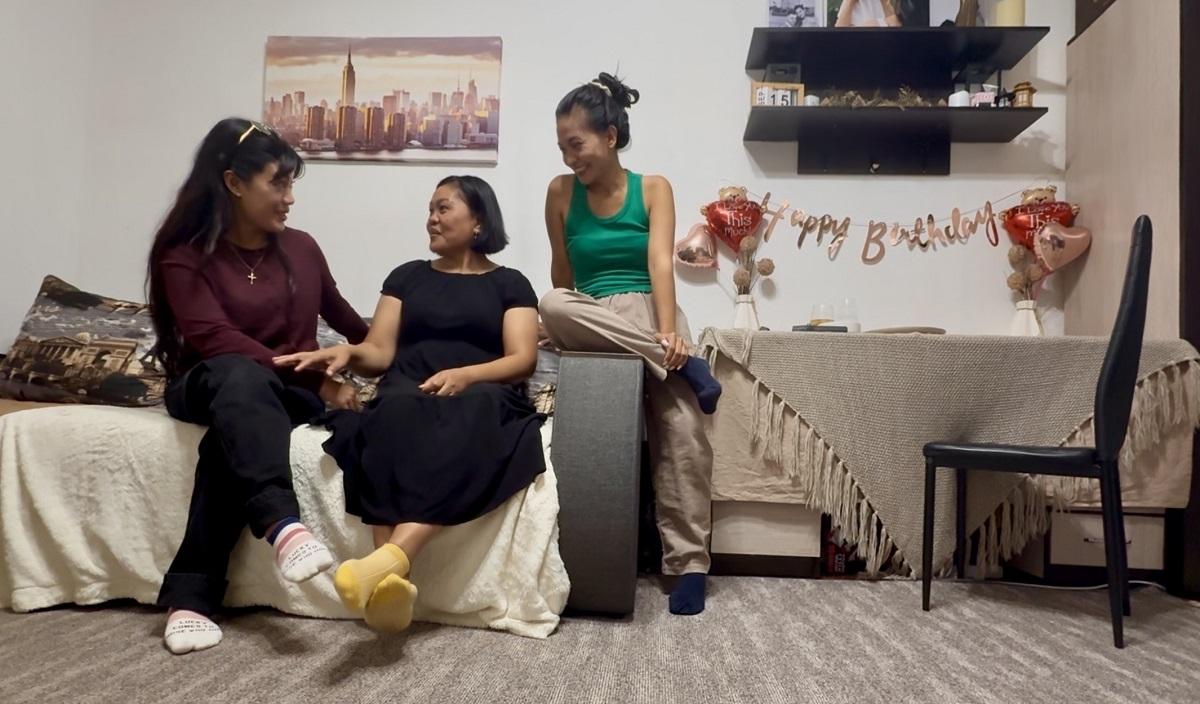
In this Filipino diaspora, Ramos often initiates gatherings or interactions to manage the impact of the war on her. She invited me to their house in Kyiv, just days before her family relocated to Bucha, and told me about the surprise birthday party she had been planning for Gallego.
“Kaming magkakaibigan dito, we never talk about our problems. Kapag nagkikita kami, happy-happy lang. Gusto ko ring ipakita ko sa friends at family ko sa Pilipinas na we’re living our lives, not less. Wala naman tayong control sa nangyayari. Ang pwede naming gawin is to control how we react.”
(Our friends here never talk about our problems. When we see each other, it’s a happy time. I also want to show my family and friends in the Philippines that we’re living our lives. We cannot control what’s happening, but what we can do is to control how we react.)
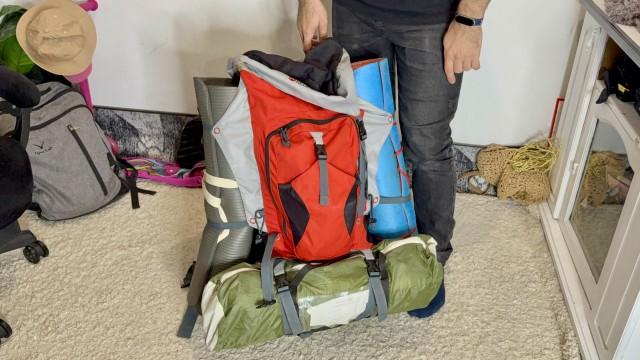
At home, Oleg Taibov, Ramos’s husband, showed me the “go bags” they prepared in case of extended air raids on Kyiv, in which residents must stay overnight in underground shelters or bunkers. Their bag includes three sleeping mats, clothing, a first-aid kit, water, ready-to-eat food, and other essentials that will last at least a night.
What’s hard for them, the couple shared, is how the war is already imprinted on their four-year-old daughter’s awareness.
“She knows what ‘bunker,’ ‘drones’, and ‘air attack’ mean,” Taibov said. Despite that, he is happy they’re together as a family.
“Even in the moments when we need to go down to the metro and put our tent as a shelter, it’s not ‘home’, but [being together] is what helps us to be strong.”
Since the invasion, Ramos has been able to travel back to the Philippines to visit her parents and try to secure finances. Ultimately, she decided to return to Ukraine.
“I understood and realized it’s better to be together during these tough times,” she said, while looking at Taibov.
“You are here. You are my home. So, I will always be wherever you are.”
Moments of care
Ramos, Botenco, and Almonte cooked Filipino dishes for Gallego’s 54th birthday party in September. It was also a send-off, as Ramos and her family would later move to Bucha.
When I arrived, the Filipinas immediately handed me a plate of crispy pata (pork cutlet). Between bites, they asked when I would return to Kyiv. There would always be another dinner, they said.
The gatherings did not stop there. On December 13, they met again for a small Christmas potluck in Ivano-Frankivsk, a city about 600 kilometers southwest of Kyiv. Ramos and Gallego traveled 12 hours by train, carrying the pork sisig they had prepared during a power outage in Bucha.
Their Christmas party, themed “Glitz and Glam,” featured many other Filipino dishes they shared at the same table. For that moment, the war temporarily receded.
For these Filipinas, care moves quietly in wartime. It can be from the table, or out onto the street.
In Bucha, Gallego saw it in her husband.
Kurson would carefully drive through the city, stopping at bus stations even as air raid alerts loomed. Public buses were still not running, but some residents had begun returning to work. Others, like Kurson, volunteered as the city was rebuilt. He promised his wife they would be safe.
“Sinusuyod niya yung mga bus stop, pini-pick up niya yung mga gustong magtrabaho,” Gallego recalled tearfully. “Very touching yun. Binibigay niya yung best niya para makatulong dahil alam niya ang situation ng country nila.”
(He went through every bus stop to pick up those who wanted to work. It’s very touching to see that he was giving his best to help because he saw their country’s situation.)
“Kaya ang ginagawa ko, suportahan siya. Kaya feeling ko, victorious ako kasi nag-stay ako sa kanya. And diyan ko rin nakita ang spirit ng Ukrainians. Matapang silang lumalaban.”
(That’s why what I do is to support him. It makes me feel victorious—that I stayed with him. That’s how I saw Ukrainians’ spirit. They have the courage to fight.) — BM, GMA Integrated News

