

 GMA Brandtalk
 Tracking
 Archives

In the face of war, some Pinoys choose to stay in UAE to support families in PH

DUBAI, United Arab Emirates — More than a month into the Middle East conflict, some war-weary overseas Filipino workers (OFWs) have made a tough choice not to be repatriated to the Philippines as they would rather take their chances here to support their families back home.
These migrant Filipinos are holding on, some of whom say it is more difficult to start over again back in the Philippines.
End of employment
Olivia Pasicolan saw her employment contract as a restaurant supervisor expire on February 7 this year.
She said she did not renew her contract as she wanted to rest for a month before looking for another job.
However, the Middle East conflict ended her plans when US-Israel forces attacked Iran on February 28.
Pasicolan then applied for a visit visa, which expires on April 20. She said she has been stressed out because work has been hard to come by.
"Not that I don't want po (to be repatriated), the thing is hindi pa po ako ready to settle sa Pilipinas kasi zero savings pa po. Mahirap ang buhay namin sa Pilipinas and isa din ako sa inaasahan sa pamilya kaya kahit gustuhin ko man umuwi hindi po puwede," Pasicolan said.
(It's not that I don't want to be repatriated. The thing is, I'm not ready to settle in the Philippines because I have zero savings. We have a hard life back in the Philippines and I'm one of those whom my family is counting on. So even if I want to go home, I can't.)
She added: "Nakakatakot din po umuwi kasi mahirap mag-umpisa ulit lalo sa Pilipinas, mahirap mag-apply ulit. Kung nasa Pilipinas po ako, hindi kakayanin ng family magpa-abroad ulit kasi senior na ang parents ko."
(I'm apprehensive to go home because it's difficult to start over again in the Philippines. It's hard to apply again. If I were in the Philippines, my family would be hard pressed to send me abroad because my parents are already seniors.)
!['Not that I don't want po [to be repatriated], the thing is hindi pa po ako ready to settle sa Pilipinas kasi zero savings pa po. Mahirap ang buhay namin sa Pilipinas and isa din ako sa inaasahan sa pamilya kaya kahit gustuhin ko man umuwi hindi po puwede, says Olivia Pasicolan, a former restaurant supervisor in Dubai. Photo courtesy: Olivia Pasicolan](https://images.gmanews.tv/webpics/2026/04/640_In_the_face_of_war,_some_Pinoys_choose_to_stay_in_UAE_to_support_families_in_PH_Courtesy_Olivia_Pasicolan_20260404_2026_04_04_14_01_37.jpeg)
Hailing from Cagayan Valley, Pasicolan, now 33, came to Dubai in 2019. Most of her earnings were sent home through the years, she said.
"Nakaka-stressed pero kailangan lumaban," she said. (It's stressful but I need to keep fighting.)
Hard life back home
Neil Lagria, 47, lost his job at a travel and tours consultancy company more than three weeks ago.
"Ang sarap na umuwi para sa pamilya pero 'di kaya. Ang hirap lalo sa Pilipinas," he said.
(It's good to go home for the family, but I can't. Life is more difficult back in the Philippines.)
Lagria, who came to Dubai in 2018, has two children in grade school. He hails from Cagayan de Oro.
Single mother
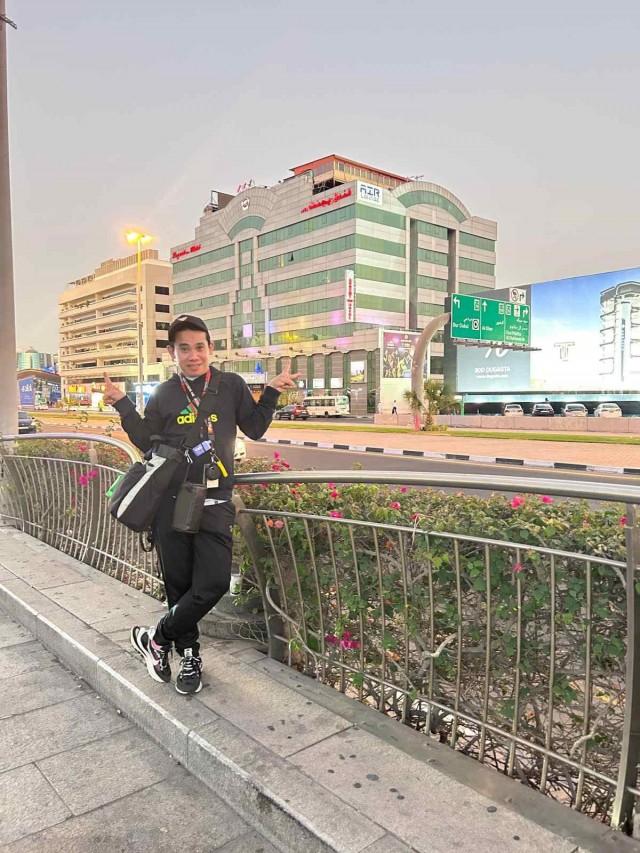
Guiaraine Miro, a saleslady at a night market in Rigga, Deira, Dubai who recently lost her job as the stall she was manning closed down, said she needs to stay because she is a single mother providing for the education of her three children.
"Dami ko pang obligasyon sa buhay. Wala akong hanapbuhay sa Pilipinas at may tatlong anak akong pinapaaral," she said.
(I still have a lot of obligations. I don't have a livelihood in the Philippines and I have three children going to school.)
Miro, who hails from Pagadian City, arrived in Dubai in 2018 and worked first as a domestic helper.
Repatriation for Filipinos
Labor Attaché John Rio Bautista, head of the Migrant Workers Office (MWO) in Dubai and the Northern Emirates, said he "respects" the move of OFWs who choose not to go home amid the Philippine government's ongoing repatriation program for Filipinos affected by the Middle East conflict.
"We respect the decision of those not wanting to be repatriated for whatever reason, personal or otherwise. Those with legal issues, we advise that they still address and resolve their concerns. Our repatriation program will continue to cater to those who are genuinely in need," he said.
Bautista has said in earlier interviews that the repatriation is a continuing program that also involves those who have finished their work contract, have health issues and could no longer work, or have parents who finally have to go home for good.
"We don't choose who will go as long as their papers are complete and they are willing to go home," Bautista said.
Support programs in PH
Migrant Workers Undersecretary Dominique "Nikki" Rubia-Tutay, who was in Dubai for the processing of an early batch of Filipino repatriates, said repatriated OFWs may avail of different programs once they are home.
She said the Department of Migrant Workers (DMW) and Overseas Workers Welfare Administration (OWWA) provide support for returning Filipinos, but other agencies are offering key programs as well.

According to Rubia-Tutay, displaced Filipinos may receive assistance from the Department of Social Welfare and Development (DSWD) and Department of Health (DOH).
Further, Rubia-Tutay said, "Ang Department of Trade and Industry (DTI) po ay ka-partner din natin. Kung gusto nilang mag-negosyo ay ipi-prepare po sila at bibigyan ng loan facility ng DTI para panimula sa kanilang negosyo."
The DTI is also our partner. If they want to put up a business, they will be prepared and will be given a loan facility for a start-up business.)
She added that the Technical Education and Skills Development Authority (TESDA) can provide training, while the Department of Labor and Employment (DOLE) can help match them with suitable employment opportunities.
Giving back
Meanwhile, a growing number of Filipino workers have received free food packs from Migrant Workers Office (MWO) in Abu Dhabi, while others were handed the same from a logistics firm in Dubai.
The number of recipients of the DMW Migrant Workers Office (MWO) in Abu Dhabi's one-time, food pack program has increased from 40 last week to almost 150 this week—and counting.
Romeo Asuit, MWO welfare officer, said most of those who availed of MWO's food pack program were school and bus assistants, as well as cleaners.
Students have been doing classes online at home due to the situation.
"Before, as they come in and want to avail of the program with their complete requirements, nagbibigay po kami (we give out the aid). Medyo dumami lang (It increased) now that we have the situation in the Middle East," said Asuit.
According to Asuit, the MWO in Abu Dhabi has so far received 147 OFWs, who have satisfactorily submitted the identification and work status requirements to qualify for the food packs.
"Mayroon pa rin pong mga gustong mag-avail as of now, continue naman po kami dito sa MWO-Abu Dhabi sa aming program as long as they comply po sa requirements," said Asuit.
(There are those who want to avail as of now, our program at MWO-Abu Dhabi remains as long as they comply with the requirements.)
He said it has been a longstanding program of MWO-Abu Dhabi to give out food packs to displaced OFWs.
The number grew with the outbreak of the war, which affected all industries–from schools to tourism-related ones, as well as oil and gas, among others.
A food pack includes rice and canned goods.
The MWO has a hotline at +971 54 557 2121 where an OFW can place a call and the person on the other end asks work-related details to determine eligibility.
Laliebeth Petancio, who has been active in the Abu Dhabi Filipino community, said she has been getting her share of OFWs asking for aid.
"Marami pong nanghihingi ng ayuda. More than 100 since Sunday (March 29) nga lang ako nag-initiate magbigay," she said.
(A lot has been asking for support. More than 100 people have come to me since Sunday, when I started to initiate giving food assistance.)
Petancio was also a go-to person during the height of the COVID-19 pandemic, when she also gave food aid.
Helping hand
A logistics firm in Dubai has also handed out free groceries to its 200 employees, only one of whom opted to be repatriated.
Marlyn Flores Castro, owner of the logistics firm, said she decided to provide free groceries to her employees as "it's about giving back" to them.
According to Rumelyn Aribon, the company's human resources manager, they have given the employees an option to file for a No Objection Certificate (NOC) so they can look for other jobs while the situation at the logistics firm appears not so good, with the intent to go back to them in the future.
"We can give NOC but they should come back when the situation normalizes because their (employment) visa was issued by us," said Aribon.
An NOC means the company does not have anything against the employee doing part-time jobs for the time being.
Being in the care box business, the company has been operating on a skeleton work force as the transit of ships through the Strait of Hormus and on to the Philippines have been constricted. — VDV, GMA Integrated News

