

 GMA Brandtalk
 Tracking
 Archives

EXPLAINER: What gov't assistance awaits returning OFWs from Middle East?
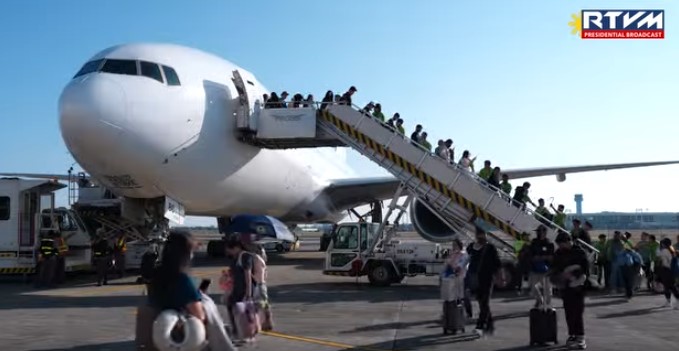
Over five weeks into the conflict between US-Israeli forces and Iran, thousands of overseas Filipinos have been repatriated back to the Philippines—farther away from the drums of war in the Middle East.
Now, what lies ahead for the displaced overseas Filipino workers (OFWs) who are reunited with their families, but are no longer able to provide them much-needed dollars?
Government agencies have assured various forms of support for OFWs—touted as the country's modern-day heroes—regardless if they seek work abroad anew or start a fresh chapter in the Philippines.
The Department of Migrant Workers (DMW) has said the Marcos administration is implementing a "whole-of-government" approach to assist the displaced Filipino workers upon their arrival, including reintegration services in partnership with other government agencies. According to the DMW, this covers the following:
- medical assistance from the Department of Health (DOH)
- psychosocial counseling and additional support from the Department of Social Welfare and Development (DSWD)
- training opportunities from the Technical Education and Skills Development Authority (TESDA)
- business opportunities from the Department of Trade and Industry (DTI)
Government assistance that has been recently announced or offered for returning OFWs include:
- Cash assistance through the Bayanihan Para sa Balikbayang Manggagawa program — financial aid (ayuda) and OFW support for livelihood or business opportunities
- Reintegration initiatives by the Department of Education (DepEd) for displaced OFW teachers from the Middle east — this includes providing employment opportunities, financial assistance, and education support for the teachers' families
- PAG-IBIG Fund special benefits package for repatriated OFWs — Qualified OFWs may access their Pag-IBIG fund savings or avail of loan moratoriums to help ease their financial burdens.
- DTI's business start-up and multi-purpose loans for returning OFWs — Offered through the DTI's financing arm, the Small Business Corp., the P2-billion loan facility is available to qualified borrowers
Upon arrival
The Overseas Workers' Welfare Administration (OWWA) has support programs in place for arriving Filipino repatriates from the Middle East, such as helping them with transportation to reach their hometowns.
The agency also offers other post-repatriation services including hotel accommodations, meals, and financial assistance.
The Department of Social Welfare and Development (DSWD) has also been providing temporary accommodations for some OFWs prior to their return to their respective provinces.
On Monday, the DMW also launched a one-stop shop for reintegration assistance for the OFWs and a job fair offering 5,000 vacancies.
Growing numbers
As of April 3, the DMW recorded a total of 4,241 repatriates from the Middle East.
More arrivals have been logged since then, including 67 from Qatar on Saturday, 27 more from Middle East areas over the weekend, and 7 from Lebanon on Monday. The numbers are expected to grow as the conflict drags on.
While some chose to return for safety, others opted to stay in the region to continue supporting their families in the Philippines.
Filipinos in the Middle East
Tensions in the Middle East escalated following the joint military operations launched by the United States and Israel against Iran on February 28, 2026.
Over 2.4 million Filipinos are in the Middle East as of March 1, 2026, according to data gathered by GMA News Research. Bulk of these Filipinos are in the United Arab Emirates (UAE) and Saudi Arabia, with populations of 975,000 and 813,000, respectively. — VDV, GMA News

