

 GMA Brandtalk
 Tracking
 Archives

ADVERTISEMENT
Filtered By: Scitech
SciTech
More and more US students believe they're 'superstars' -- Study
+
Make this your preferred source to get more updates from this publisher on Google.
Aside from being multi-billionaires, what do tech icons Steve Jobs, Mark Zuckerberg and Bill Gates have in common? They dropped out of their respective colleges after realizing that an Ivy League wouldn't make them any better in the success field.
Zuck, Jobs and Gates aren't the only ones who think that way, however.
A study which came from analyzing survey forms dubbed the “American Freshman Survey” wshows that "more and more American university students think they are something special," BBC reported. The study started back in 1966.
The study started by psychologists Jean Twenge of the San Diego State University in California, Brittany Gentile and Keith Campbell measured how students rated themselves in basic skills areas.
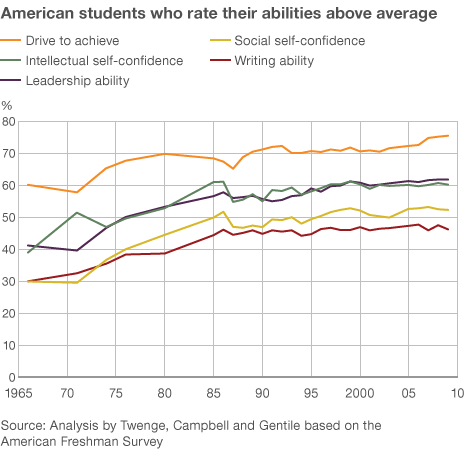
Twenge and her colleagues found that over the four decades, more students start to describe themselves as being "above average" in their drive to achieve, in academic ability, mathematical ability, and self-confidence.
BBC reported that Twenge and her team also found that while "students are increasingly likely to label themselves as gifted in writing ability, objective test scores indicate that actual writing ability has gone down since the 1960s."
"And while in the late 1980s, almost half of students said they studied for six or more hours a week, the figure was little over a third by 2009--a fact that sits rather oddly, given there has been a rise in students' self-proclaimed drive to succeed during the same period," BBC reported.
Narcissistic
Twenge conducted another related study from 1982 to 2009 and found US students's narcissistic attitudes increase by 30 percent over the decades.
"Our culture used to encourage modesty and humility and not bragging about yourself," Twenge was quoted in a BBC report.
"It was considered a bad thing to be seen as conceited or full of yourself," she added.
Narcissism is the "excessive self-love or vanity; self-admiration, self-centerdness," according to the “Oxford English Dictionary.”
In a book Twenge and Campbell wrote titled "The Narcissism Epidemic," Twenge blamed the rise of narcissistic attitudes on parenting styles, social media, access to easy credit, and celebrity culture. These trends "allow people to appear more successful than they are," said Twenge.
"What's really become prevalent over the last two decades is the idea that being highly self-confident - loving yourself, believing in yourself--is the key to succes," Twenge was quoted in a BBC report.
"Now the interesting thing about that belief is it's widely held, it's very deeply held, and it's also untrue," she added.
Is self-help the answer?
Commercially available self-help books propagate the idea that in able for people to succeed, they just have to be more confident.
However, in over 15,000 journal articles BBC found to have examined the relation between self-esteem and educational attainment, job opportunities, happiness, and health among others, BBC noticed that "very little evidence that raising self-esteem leads to tangible, positive outcomes."
Florida State University's Roy Baumeister wrote a paper in 2003 which analyzed self-esteem research outputs.
"If there is any effect at all, it is quite small," Baumeister was quoted in BBC.
Generation Me
Twenge even coined the term "Generation Me" to describe those born post-1981. She even wrote a book explaining her study and attempted to describe this generation.
"This makes the book unique among those that discuss generations, because it summarizes psychological data – and a very large amount -- collected at various times....I’ve found data on what Boomers were like when they were young in the 1960s and 1970s and compared it to data on young people from the 1990s and 2000," Twenge wrote in her book's website.
In 2006, Florida State University's John Reynolds published a study similar to that of Twenge's.
Reynolds' study showed that while students are "increasingly ambitious," they have also become "increasingly unrealistic with their expectations."
"Since the 1960s and 1970s, when those expectations started to grow, there's been an increase in anxiety and depression," Twenge was quoted in BBC.
"There's going to be a lot more people who don't reach their goals," Twenge added.
But if Jobs, Gates and Zuckerberg succeeded, it does really mean that it was just because they thought they were great. They actually worked for their greatness. – KDM, GMA News

