

 GMA Brandtalk
 Tracking
 Archives

ADVERTISEMENT
Filtered By: Scitech
SciTech
'Anti-GMO claims are myths' – former anti-GMO activist Mark Lynas
+
Make this your preferred source to get more updates from this publisher on Google.
Many people spend years defending a truth they believe in. Some are willing to lay down their lives and fight what they believe is a good fight.
For British author and environmentalist Mark Lynas, that fight was against genetically modified crops. But not anymore.
Fighting against GMOs

Mark Lynas at the media discussion titled, "Meeting the Challenges of Food Security with Biotechnology," organized by SEARCA, ISAAA, and ABSP, at the Dusit Hotel in Makati on August 23. All photos from the organizers
By 1997, Lynas was participating in the destruction of GM crops, what anti-GM organizations call “direct action."
Around the time of the London May Day riots of the year 2000, which he helped organize, Lynas began to have doubts. "I thought it was a disaster. Everything we'd been trying to achieve was undermined by all the violence and window smashing. It just alienated people. Tolerance and open-mindedness were qualities that people paid lip service to but were not really valued."
Conversion
Lynas is a historian and political scientist by education, and a journalist by training. "I moved from being an activist campaigner to a science writer," he said. "I began authoring books on climate change, beginning in 2004 with a book called High Tide, then another book called Six Degrees in 2007. Both of these books were based very much on a broad reading of the scientific literature. So each one has hundreds of references, mostly to peer-reviewed scientific papers."
"I was really in the process of writing my latest book, called God Species, that I changed my mind on this issue. I was starting a chapter on agriculture which I intended to be anti-GMO, and when I looked at all of the science across the board in all of the different journals, I found that there was no factual basis for what I previously believed. So the chapter ended up being kind of pro-GMO. The more I looked into it, the more I realized that biotechnology could be a major step forward in a positive direction for the environment."
All the science-based information he found was in complete opposition with what he had believed for years.
Lynas has received recognition as a science writer. "Six Degrees was made into a film by National Geographic. I received a prize from the Royal Society for science books. I was pleased to get recognition from the scientific community but at the same time I was still making statements against GMOs which had no scientific basis."
According to Lynas, anti-GMO claims are anti-science. "This is a very clearly anti-scientific agenda which is being advanced. There is no scientific basis to any of these rumors. People have been told that GM cassava and other crops will turn them sterile, will make their children homosexuals, some kind of Western conspiracy. And so these conspiracy theories, these lies are undermining the food security of innocent people."
In a live, televised debate in 2010, he defended GMOs and nuclear power. But he truly 'came out' with the truth about his conversion early this year, when he spoke at the Oxford Farming Conference—an event he previously denounced—and apologized for his actions.
"I apologize for having spent several years ripping up GM crops. I am also sorry that I helped to start the anti-GM movement back in the mid 1990s, and that I thereby assisted in demonizing an important technological option which can be used to benefit the environment," went part of his speech.
That speech became so controversial and widely read that his website, on which he had posted the full text, crashed.
Now Lynas speaks on the importance of biotechnology for food security, especially in worldwide efforts to cope with climate change.
From an age of chemistry to an age of biology
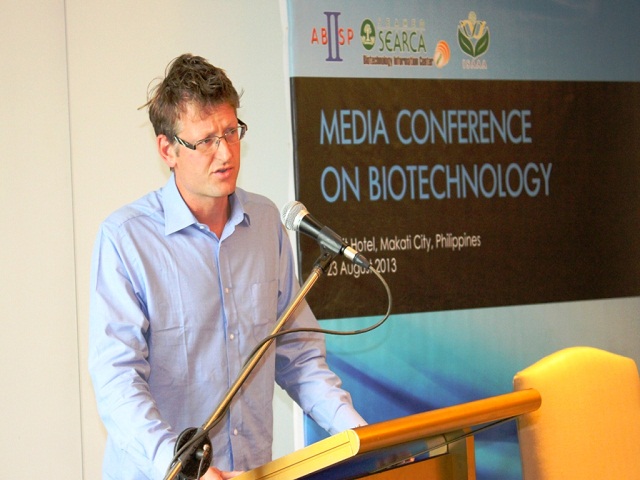
Mark Lynas explains the problem of vitamin A deficiency all over the world, especially in children, and how this problem is being addressed in Africa. This problem, among many others, he believes, can be addressed by GMOs.
He was recently in the Philippines on a research trip funded by Cornell University, having come from the Borlaug Global Rust Initiative 2013 Technical Workshop in New Delhi. A media conference, titled "Meeting the Challenges of Food Security with Biotechnology," was organized by SEARCA, ISAAA, and ABSP, at the Dusit Hotel in Makati on August 23.
Lynas talked about the problem of vitamin A deficiency all over the world, especially in children, and how this problem is being addressed in Africa.
"In the world as a whole, 6,000 children per day die because of Vitamin A malnutrition. This is an invisible killer. It turns children blind," explained Lynas. "But also it's an immunodeficiency problem, so the children then die from aggravated diseases, whether it's pneumonia or diarrhea or other complaints.
He added, "In Africa this is already being addressed with what's known as bio-fortification. There's orange-fleshed sweet potato which has been produced by another international scientific collaboration known as HarvestPlus. This is now in the field, and it's in the hands of farmers, and it's saving lives in Mozambique and other countries in that part of the world."
According to Lynas, biotechnology can help solve food security issues in many ways: drought-tolerant crops, nitrogen-efficient crops, even fertilizer. "The other great challenge is the amount of fertilizer that humans are using, which has major effects on ecosystems. The runoff causes dead zones in the oceans," he noted.
Even the practice of agriculture can be harmful to the environment. "The human activity which most threatens biodiversity is agriculture. The conversion of rainforest and wetlands to farming is the number one threat to biodiversity in our world today. Now how can we best manage that challenge whilst we still need to produce more food for a growing human population?"
The solution? Efficient, high-yielding crops resistant to pests. But it's a solution that's meeting resistance from activists.
Lynas in Laguna
While he was here, Lynas looked into the story of golden rice, which recently made the news when angry farmers supposedly destroyed the field trials conducted by International Rice Research Institute (IRRI).
According to his interviews, the field trials were not destroyed by farmers, but by anti-GMO activists; apparently the farmers had been bussed in to attend the event.
Lynas wrote about the incident on Slate.com.
GMOs are still a controversial issue, for farmers, scientists, and consumers alike. But Mark Lynas was able to lay down arms in pursuit of the truth. Whatever their beliefs, perhaps Lynas’ example can encourage other passionate activists to put an end to the violence and spar with facts instead. — VC/TJD, GMA News

