

 GMA Brandtalk
 Tracking
 Archives

ADVERTISEMENT
Filtered By: Scitech
SciTech
New giant dinosaur discovered in China
New giant dinosaur discovered in China
While it probably wasn’t any good at basketball, this extinct plant-eating giant from China is still, without a doubt, a remarkable discovery.
Identified by paleontologists from China and the United States as Yongjinglong datangi, the massive prehistoric animal belonged to the dinosaur group Titanosauria, a family of sauropods (long-necked dinosaurs) that munched on the leafy greens of the Cretaceous period over 100 million years ago. The sauropods were among the largest animals in the history of the planet.
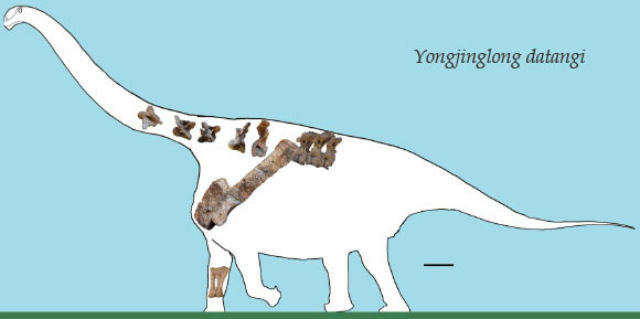
The newly-discovered fossil bones and their speculated placement in the animal's body.
Image credit: Li L-G et al., via Sci-news.com
Image credit: Li L-G et al., via Sci-news.com
The study was funded by the National Natural Science Foundation of China, the Hundred Talents Project of the Chinese Academy of Sciences, the Gansu Bureau of Geology and Mineral Resources, and the National Science Foundation. Details of Yongjinglong’s discovery were recently published in the online journal PLOS ONE.
A tall tale
The team was able to identify the new dinosaur based on a number of bones unearthed in 2008, in the southeastern area of the Gansu province’s Lanzhou Basin in northwestern China.
Among the fossils found were three teeth, eight vertebrae, the left scapula, and the right radius and ulna of the long-necked behemoth.
“The shoulder blade was very long, nearly 2 meters, with sides that were nearly parallel, unlike many other Titanosaurs whose scapulae bow outward,” revealed study lead Li-Guo Li, who hails from the University of Pennsylvania.
“The scapula was so long, indeed, that it did not appear to fit in the animal’s body cavity if placed in a horizontal or vertical orientation, as is the case with other dinosaurs. The bone must have been oriented at an angle of 50 degrees from the horizontal.”
Described as a medium-sized titanosaurid, the Yongjinglong specimen that the scientists discovered is believed to have been a juvenile, estimated to have reached between 50 to 60 feet (15 to 18 meters) in length.
Li added that they came to this conclusion because the scapula and coracoid of shoulder blade they discovered were unfused, “leaving potential for growth” in its adulthood.
Similar sauropods, different dinosaurs
While the sauropod bore similarities to another Chinese titanosaur, Euhelopus zdanskyi, the fossils’ unique characteristics allowed them to identify Yongjinglong as an all-new species.
The longest tooth that the scientists discovered almost reached 15 centimeters in length, while a shorter tooth revealed two buttresses (bony ridges), as opposed to Euhelopus’s teeth (having only one ridge). Furthermore, the eight vertebrae (one from the neck, seven from the body) also revealed the possibility that the gigantic herbivore had air sacs within its body.
“These spaces are unusually large in this species,” according to study co-author Peter Dodson, a professor from the University of Pennsylvania. “It’s believed that dinosaurs, like birds, had air sacs in their trunk, abdominal cavity and neck as a way of lightening the body.”
To answer their questions about Yongjinglong’s genealogy, the scientists compared the fossils against other specimens from China, Africa, South America, and the United States.
“We used standard paleontological techniques to compare it with phylogenies based on other specimens,” Dodson explained. “It is definitely much more derived than Euhelopus and shows close similarities to derived species from South America.”
Asian invasion
This new find also enhanced the researchers’ views on exactly how long (and where) sauropods proliferated in the Mesozoic era.
"Based on U.S. fossils, it was once thought that sauropods dominated herbivorous dinosaur fauna during the Jurassic but became almost extinct during the Cretaceous," admitted Dodson.
"We now realize that, in other parts of the world, particularly in South America and Asia, sauropod dinosaurs continued to flourish in the Cretaceous, so the thought that they were minor components is no longer a tenable view."
Yongjinglong is not the first long-necked wonder from the area in recent history – within the last decade, two other titanosaurs, Huanghetitan liujiaxiaensis and Daxiatitan binglingi, were unearthed in a valley just one kilometer away.
Nevertheless, the findings show that Yongjinglong is the most evolutionarily advanced of the Asian sauropods discovered so far.
"As recently as 1997 only a handful of dinosaurs were known from Gansu," Dodson said. "Now it's one of the leading areas of China.”
“This dinosaur is one more of the treasures of Gansu." — TJD, GMA News

