

 GMA Brandtalk
 Tracking
 Archives

ADVERTISEMENT
Filtered By: Scitech
SciTech
This is how the ancient Egyptians likely built the pyramids
+
Make this your preferred source to get more updates from this publisher on Google.
Much to conspiracy theorists' dismay, it likely wasn't aliens. It was wet sand, according to a report by Phys.org.
Ancient Egyptians made transporting pyramid stones via sledge easier by moistening the sand over which it moved, a group of Physicists from the FOM (Fundamental Research on Matter) Foundation and the University of Amsterdam revealed recently.
The discovery was published in Physical Review Letters on Tuesday, April 29. It was supervised by FOM group leader Prof. Daniel Bonn as part of the FOM's 'Fundamental aspects of friction' program.
Ancient Egyptians had to transport 2.5-ton blocks of stone and large statues across the desert via huge sledges during the construction of the pyramids. Workers—not slaves, as popularly believed—had to pull the sledge over the hot desert sands.
The physicists emulated this by making a laboratory version of the Egyptian sledge in a tray of sand. When they moved the sledge with heavy cargo on top over dry sand, it digs into the sand ahead of it. As a result, a large pile of sand accumulates in front of the sledge, which would have made it more difficult for the poor workers to pull it from point A to point B:
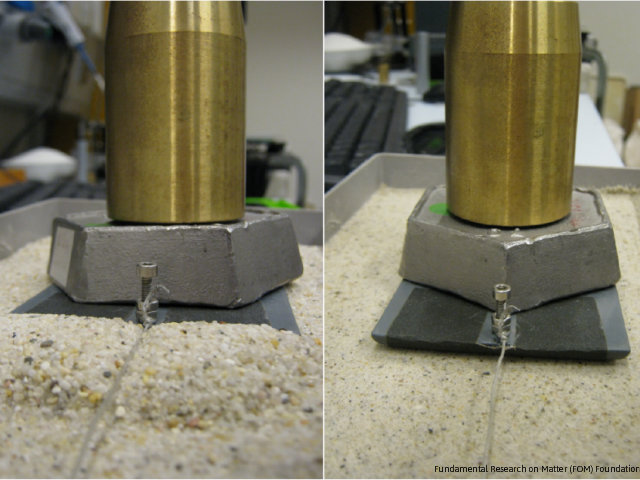
But with the right amount of dampness, the sand stiffens and the problem of sand accumulation no longer occurs. This reduces the amount of pulling force by half.
The Phys.org article explained:
"[The physicists] determined both the required pulling force and the stiffness of the sand as a function of the quantity of water in the sand. To determine the stiffness they used a rheometer, which shows how much force is needed to deform a certain volume of sand.Experiments revealed that the required pulling force decreased proportional to the stiffness of the sand. Capillary bridges arise when water is added to the sand. These are small water droplets that bind the sand grains together. In the presence of the correct quantity of water, wet desert sand is about twice as stiff as dry sand. A sledge glides far more easily over firm desert sand simply because the sand does not pile up in front of the sledge as it does in the case of dry sand."
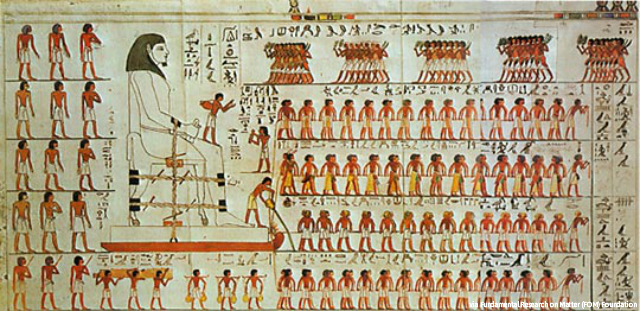
A wall painting in the tomb of Djehutihotep shows that the Egyptians were probably aware of this clever trick. It shows a worker pouring water over the sand in front of a sledge with a huge statue on top:
The Phys.org article also said that these results could also be used for modern-day applications.
"We still do not fully understand the behaviour of granular material like sand. Granular materials are, however, very common. Other examples are asphalt, concrete and coal. The research results could therefore be useful for examining how to optimise the transport and processing of granular material, which at present accounts for about ten percent of the worldwide energy consumption," the article said. — Kim Luces/TJD, GMA News

