

 GMA Brandtalk
 Tracking
 Archives

ADVERTISEMENT
Filtered By: Scitech
SciTech
Pinay scientist needs your help to save the world's largest flower
+
Make this your preferred source to get more updates from this publisher on Google.
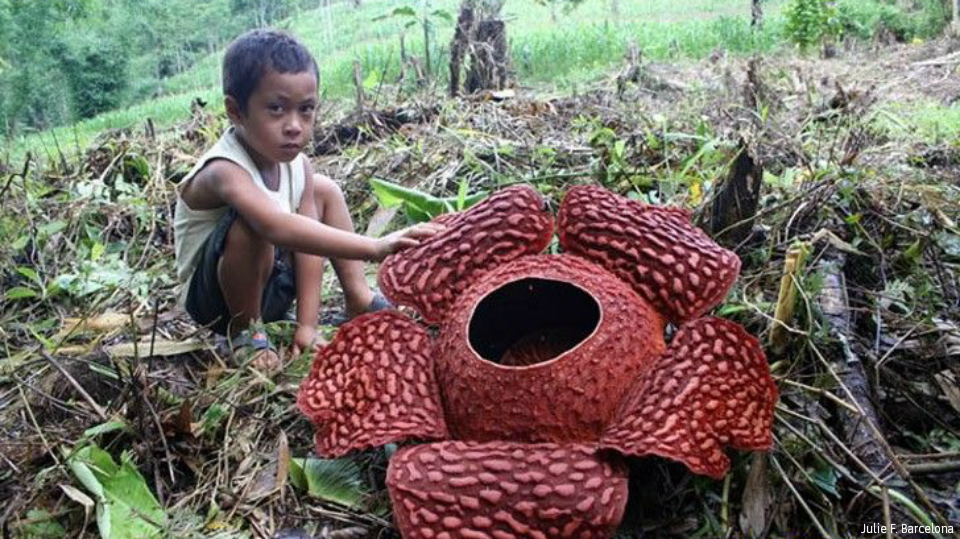
A Filipina scientist is turning to the Internet to help save the world's largest flower.
"Rafflesia, despite many attempts, has not been grown out of the wild. And my life’s mission as a scientist is to make this happen," biologist Jeanmaire Molina said on crowdsourced funding site Indiegogo.
Molina said she wants to find out more about the rare Rafflesia and see how it can be grown outside of its natural environment in the hopes of saving it from possible extinction.
"How do the seeds get into its host plant? What makes the seeds germinate and thrive in its host? How can we replicate the process in artificial environment so that botanic gardens can grow it? To answer these questions, I will be traveling to the Philippines, the hub of Rafflesia diversity, home to more than 10 Rafflesia species," she explained.
Selfless effort
She said the donations to Indiegogo would fund two weeks of fieldwork including costs for travel, field supplies, wages for field assistants, and relevant lab experiments.
Donors to the Indiegogo project will get regular updates and will be fully acknowledged in research publications from this project, Molina said.
"I ask for NO money for my own personal efforts. The experience of learning about Rafflesia is a reward in itself," she said.
A beautiful monster
Molina extols the Rafflesia as an evolutionary marvel. "If Lady Gaga could wear a flower, it'd be Rafflesia. Yes, the world's largest flower is a freak of nature," she half-jokes.
"It has no roots, stems or leaves, just a massive red-orange flower, a spectacle so seldom (seen) in the midst of the rainforest that tourists pay to see it, in spite of (its) permeating stench," she explains.
More importantly, however, it turns everything we know about plants on its head.
"It has no roots, stems or leaves, just a massive red-orange flower, a spectacle so seldom (seen) in the midst of the rainforest that tourists pay to see it, in spite of (its) permeating stench," she explains.
More importantly, however, it turns everything we know about plants on its head.
"The chloroplast genome, the set of genes for making plants green and photosynthetic, is believed to be universal in all plants—until we couldn’t find it in Rafflesia," she said.
While the Rafflesia is considered a parasite, it is an "innocuous" one, according to Molina, in contrast to the destructive crop-killing witchweeds of Africa and Asia.
She noted the flower grows only on Tetrastigma, an ordinary forest vine with no known practical uses, which she said does not seem to mind its parasitic partner.
"Theirs is an ancient fragile partnership wrought by millions of years of careful evolution," she said. — Joel Locsin/TJD, GMA News

