

 GMA Brandtalk
 Tracking
 Archives

ADVERTISEMENT
Filtered By: Scitech
SciTech
Fish-eating spiders are everywhere! (Except Antarctica)
+
Make this your preferred source to get more updates from this publisher on Google.
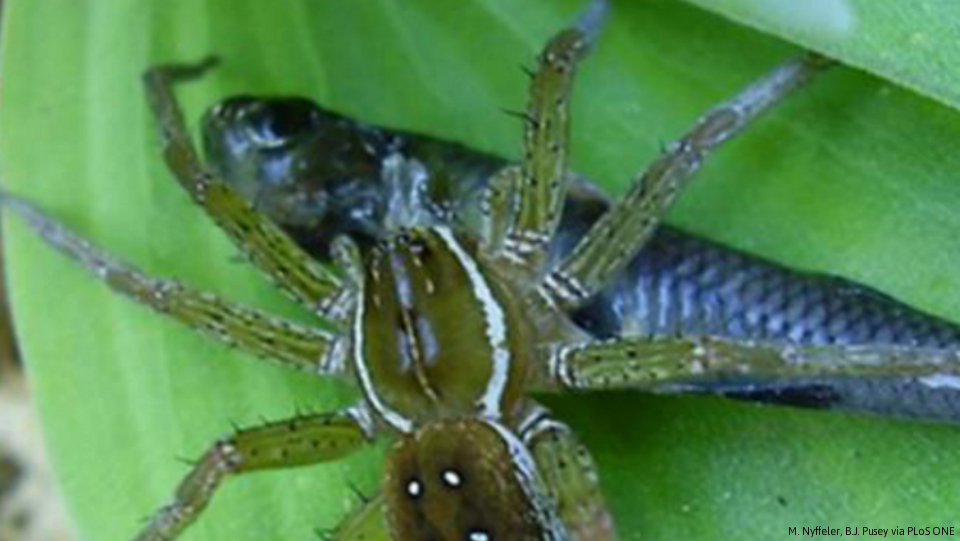
No wonder Spider-Man doesn’t have a formidable fish-themed arch-nemesis.
A recent study conducted by researchers from Switzerland and Australia reveals a fascinating new truth about the dietary habits of spiders across nearly all of Earth’s continents.
While spiders have long been known as predatory nightmares for insects all over the world, zoologists Martin Nyffeler from Switzerland’s University of Basel and Bradley Pusey from the University of Western Australia observed more than 80 incidences of semi-aquatic spiders preying on small fish. These findings were published in the online journal PLoS ONE.
While spiders have long been known as predatory nightmares for insects all over the world, zoologists Martin Nyffeler from Switzerland’s University of Basel and Bradley Pusey from the University of Western Australia observed more than 80 incidences of semi-aquatic spiders preying on small fish. These findings were published in the online journal PLoS ONE.
...does whatever a spider can—including fishing, apparently
“Fish predation by spiders appears to be more common in warmer areas between 40° S and 40° N,” wrote the authors in their study. “The fish captured by spiders, usually ranging from 2–6 cm in length, are among the most common fish taxa occurring in their respective geographic area.”
The researchers verified that at least 26 species of spiders scattered across almost all the continents in the world – save for Antarctica – are capable of fishing for prey. Eighteen of these species, from five families of spiders, demonstrated "piscivorous" tendencies in the wild, while eight species from three other arachnid families that exhibited fish-catching abilities under laboratory conditions.
These fish-catching spiders typically dwell at the fringes of shallow freshwater streams, swamps, ponds, lakes, and rivers. They are adept at fish predation, despite having to deal with prey about twice as large and four times as heavy as they are.
The new discovery expands upon the previously established list of known semi-aquatic fishing spiders – also known as pisaurids – which includes the six-spotted fishing spider (Dolomedes triton), the great raft spider (Dolomedes plantarius), and other species under the Dolomedes and Nilus genera.
No nets needed
Remarkably, these semi-aquatic arachnids don’t even build webs to catch fish. Instead, they rely on neurotoxins and enzymes to subdue and kill their prey.
Using its hind legs as anchors, a fish-eating spider attaches itself to a plant or stone, while preparing its front legs to snag any fish that swims near the water’s surface. The spider then proceeds to drag its catch to a dry place, after which it injects digestive enzymes into the fish and sucks out the dissolved tissue in the same way it would devour an insect.
In addition to insects, certain spiders have been known to prey upon bats, lizards, frogs, and snails. However, despite the fact that many photographers have observed – and taken numerous photographs of – spiders participating in piscivorous behavior, this is the first time that scientists officially acknowledged these fish-eating tendencies in Ancylometes spiders and other families.
Fish are rare delicacies for spiders
However, this doesn’t mean that these spiders were specifically built for a fish-only diet.
Nyffeler, a spider expert, notes that fish may actually be a “big ticket” prey item for the eight-legged creatures, either as a “lucky catch” when fishing for aquatic insects or as a possible pre-mating meal.
"Fish meat is high-quality prey regarding protein content and caloric value," explained Nyffeler. "Feeding on fish may be particularly advantageous during the mating period when the elevated energy and protein requirements of gravid (pregnant) female spiders require increased food intake, or at times of limited availability of invertebrate prey."
Nyffeler also revealed that these spiders usually take "many hours to devour a fish until nothing is left but bones and scales." Not exactly a “friendly neighborhood” mental image, is it? — TJD, GMA News

