

 GMA Brandtalk
 Tracking
 Archives

ADVERTISEMENT
Filtered By: Scitech
SciTech
This flower blows its wad when birds try to swallow it
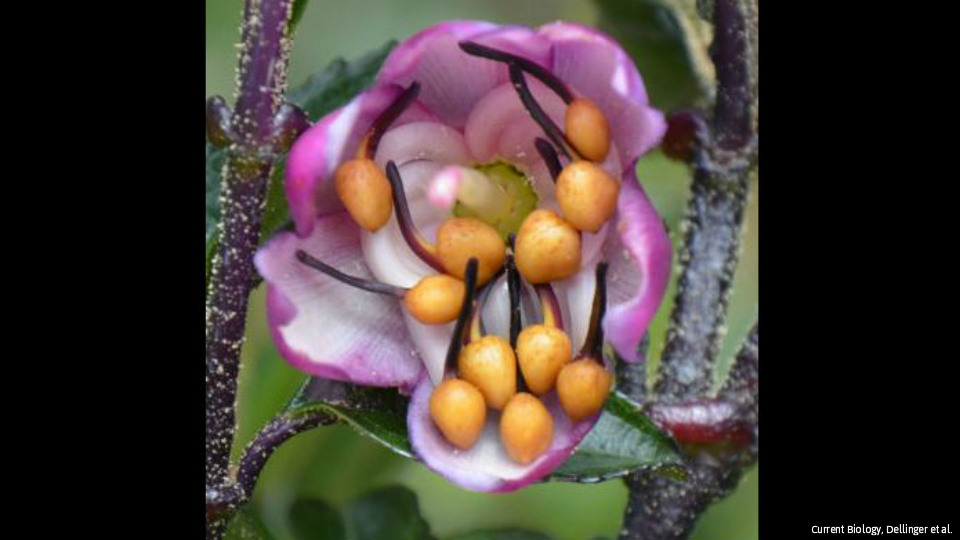
There's really no such thing as a free lunch: in exchange for their squishy, sugar-rich stamens, Axinaea flowers use their complex “bellows” organs to blast pollen straight into the faces of hungry birds.
The blast is triggered when the birds—usually tanagers and finches—initially grab the appendages, expelling air and pollen out through the pore at the end of the anther. The pollen sticks to the birds' heads and beaks and are carried to the next flower.
Don't feel sorry for the birds though: they are well-rewarded as the stamen appendages are full of fructose and sucrose and contain 15,100 Joules/gram. The study was published in the scientific journal, Current Biology.
Don't feel sorry for the birds though: they are well-rewarded as the stamen appendages are full of fructose and sucrose and contain 15,100 Joules/gram. The study was published in the scientific journal, Current Biology.
"This unique and highly complex pollination system is completely new to science and provides another example of the intricate relationships that have evolved between flowers and their pollinators," says lead author Agnes Dellinger of the University of Vienna. "The majority of bird-pollinated flowers offer nectar as a reward, and in the rare known cases involving food bodies, these reward tissues are restricted to the outer, sterile floral organs and are never found on reproductive organs." Axinaea flowers are unique in having such distinct bellows organs. No other plants are known to have this level of specialization.
Axinaea flowers are found in the mountains of Central and South America at elevations of 1,000m to 3,600m, with their center of biodiversity lying in the Andes in southern Ecuador and northern Peru.
Researchers used a combination of pollination experiments, video monitoring, and detailed analysis of stamen structure and composition to study the pollination mechanisms. Considering that the majority of Axinaea's relatives are pollinated by bees and not birds, researchers also say that this study gives a glimpse into how plants and their pollinators co-evolved. Previous studies have suggested that at higher altitudes, birds are more efficient pollinators compared to bees.
Researchers used a combination of pollination experiments, video monitoring, and detailed analysis of stamen structure and composition to study the pollination mechanisms. Considering that the majority of Axinaea's relatives are pollinated by bees and not birds, researchers also say that this study gives a glimpse into how plants and their pollinators co-evolved. Previous studies have suggested that at higher altitudes, birds are more efficient pollinators compared to bees.
"Only about 100 of the 5,000 or so species in the family Melastomataceae are known to produce nectar and to be pollinated by other insects or vertebrates," says Jürg Schönenberger, senior author of the study. "In the evolution of these species, including Axinaea, pollinator shifts in combination with changes in the floral morphology must have occurred." — TJD, GMA News
Macy Añonuevo earned her MS Marine Science degree from the University of the Philippines. She is a published science and travel writer and was a finalist in the 2013 World Responsible Tourism Awards under the Best Photography for Responsible Tourism category. Her writings and photographs may be found at www.theislandergirl.com.

