

 GMA Brandtalk
 Tracking
 Archives

ADVERTISEMENT
Filtered By: Scitech
SciTech
Mysterious sea creatures may be a new classification of life
+
Make this your preferred source to get more updates from this publisher on Google.
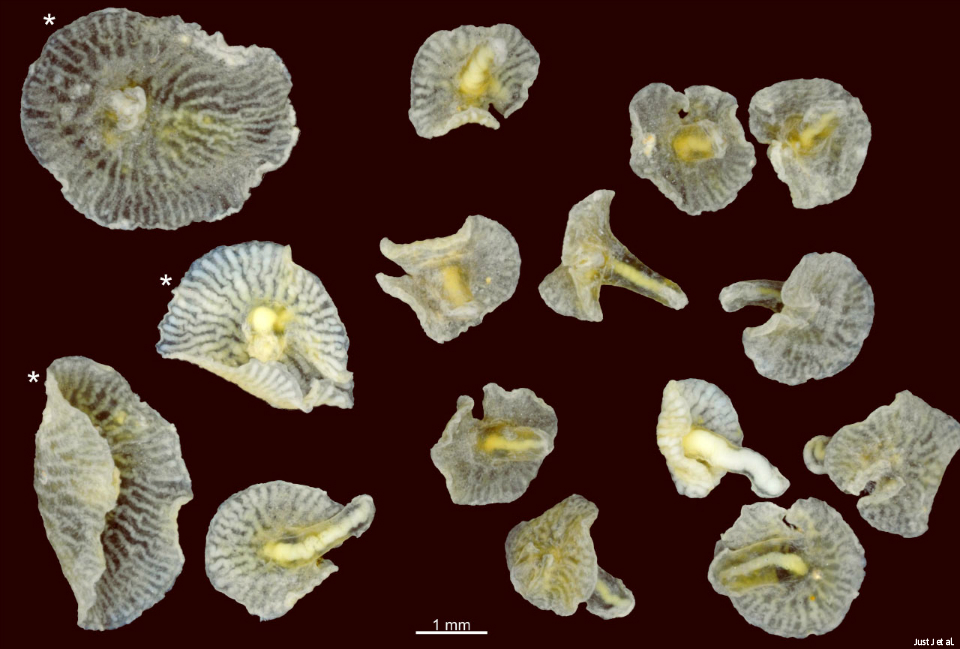
Contrary to what their appearance may suggest, these bizarre life forms living some 400 m to 1,000 m underwater off Australia are neither mushrooms nor jellyfish.
In fact, scientists haven't been a hundred percent sure what they actually are, until now.
Discovered in 1986 but only recently classified and named, Dendrogramma enigmatica and Dendrogramma discoides (the latter indicated by * in the photo above) are the only two species under the newly-devised family, Dendrogrammatidae.
Well-kept secrets of the deep
The genus and family name were adapted from the word “dendrogram” (a tree diagram often used in biology to represent organisms’ evolutionary relationships based on their cluster arrangement and hierarchical position); meanwhile, enigmatica refers to the mysterious quality of the animals, and discoides is a reference to their disc-like appearance.
These multicellular, mostly non-symmetrical creatures measure about 2 cm when alive, and have “a dense layer of gelatinous material between the outer skin cell and inner stomach cell layers.”
While D. enigmatica and D. discoides bear a striking similarity to chanterelle mushrooms, these strange creatures also possess a small mouth connected to a digestive canal that forks upon reaching their mushroom-like “caps.” Due to the size of their mouths, the organisms are believed to subsist on microbes, ensnaring them with mucus generated by the lobes around their mouths.
While D. enigmatica and D. discoides bear a striking similarity to chanterelle mushrooms, these strange creatures also possess a small mouth connected to a digestive canal that forks upon reaching their mushroom-like “caps.” Due to the size of their mouths, the organisms are believed to subsist on microbes, ensnaring them with mucus generated by the lobes around their mouths.
A total of 14 specimens were collected and examined by zoologist Jean Just, researcher Dr Jørgen Olesen, and professor Reinhardt Møbjerg Kristensen, scientists from Copenhagen who wrote a detailed paper on the subject in the online journal PLoS ONE.
“Dendrogramma shares a number of similarities in general body organisation with the two phyla, Ctenophora (comb jellies) and Cnidaria (jellyfish, hydra, sea anemones, corals), but cannot be placed inside any of these as they are recognised currently,” wrote the researchers.
Possibly prehistoric
As mysterious as their true nature is their way of life. The researchers have sufficient reason to believe that D. enigmatica and D. discoides are free-living animals that do not attach to other organisms or surfaces; however, they also seem to lack the ability to swim, as evidenced by the rigid nature of their discs and apparent lack of any ability to propel themselves.
Interestingly, the scientists noted that these life forms may actually represent “an early branch on the tree of life,” due to their similarity to extinct Pre-Cambrian organisms (Albumares, Anfesta, and Rugoconites, to be specific) from 600 million years ago – creatures that may have been nature’s failed first shots at multicellular life.
As neurobiologist Leonid Moroz from the University of Florida's Whitney Laboratory for Marine Bioscience put it, this discovery has the potential to "completely reshape the tree of life, and even our understanding of how animals evolved, how neurosystems evolved, how different tissues evolved.”
“It can rewrite whole textbooks in zoology,” Moroz concluded. — TJD, GMA News

