

 GMA Brandtalk
 Tracking
 Archives

ADVERTISEMENT
Filtered By: Scitech
SciTech
Watch Bill Gates drink water from poop
+
Make this your preferred source to get more updates from this publisher on Google.
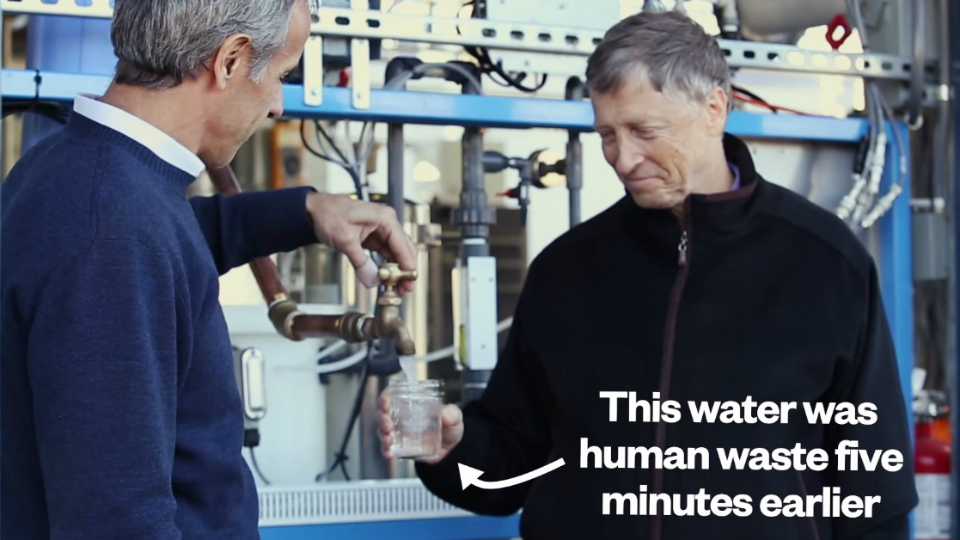
Soon, poor countries may hit two birds with one stone with a machine that can turn human waste into drinking water.
Microsoft founder and philanthropist William "Bill" Gates III said his Gates Foundation is funding the machine, whose product he recently tested—and tasted.
"I watched the piles of feces go up the conveyer belt and drop into a large bin. They made their way through the machine, getting boiled and treated. A few minutes later I took a long taste of the end result: a glass of delicious drinking water," he said.
Dubbed the Omniprocessor, the project was designed and built by Janicki Bioenergy, an engineering firm based north of Seattle.
'I would happily drink it every day'
Gates said the Omniprocessor is a safe repository for human waste and may provide a solution to many places without modern sewage systems, where truckers take the waste from latrines and dump it into the nearest river or the ocean—or at a treatment facility that doesn’t actually treat the sewage.
"Either way, it often ends up in the water supply. If they took it to the Omniprocessor instead, it would be burned safely," he said.
Not only that: the machine by burning human waste also produces electricity "plus a little ash," he said.
Improving lives in poor countries
"The water tasted as good as any I’ve had out of a bottle. And having studied the engineering behind it, I would happily drink it every day. It’s that safe," Gates said.
Improving lives in poor countries
He said the machine is part of the Gates Foundation’s effort to improve sanitation in poor countries.
Gates noted this machine could benefit "a shocking number of people, at least two billion," who use latrines that are not properly drained.
With some simply defecating in the open, the human waste can contaminate drinking water for millions of people.
"Diseases caused by poor sanitation kill some 700,000 children every year, and they prevent many more from fully developing mentally and physically," he said.
But he said western toilets are not the answer, as they require a massive infrastructure of sewer lines and treatment plants.
While ideas have surfaced to reinvent the toilet, he said another idea is to reinvent the sewage treatment plant.
High temperature = no nasty smell, taste
Gates said the machine runs at such a high temperature (1000 degrees Celsius) that there’s no nasty smell, and it even meets the emissions standards set by the U.S. government.
"Through the ingenious use of a steam engine, it produces more than enough energy to burn the next batch of waste. In other words, it powers itself, with electricity to spare. The next-generation processor, more advanced than the one I saw, will handle waste from 100,000 people, producing up to 86,000 liters of potable water a day and a net 250 kw of electricity," he said.
"If we get it right, it will be a good example of how philanthropy can provide seed money that draws bright people to work on big problems, eventually creating a self-supporting industry. Our foundation is funding Janicki to do the development," he added.
But Gates also said there is still a lot to learn and the next step is the pilot project.
Later this year, he said Janicki will set up an Omniprocessor in Dakar, Senegal, where they’ll study everything "from how you connect with the local community to how you pick the most convenient location."
"It might be many years before the processor is being used widely. But I was really impressed with Janicki’s engineering. And I’m excited about the business model. The processor wouldn’t just keep human waste out of the drinking water; it would turn waste into a commodity with real value in the marketplace. It’s the ultimate example of that old expression: one man’s trash is another man’s treasure," he said. — Joel Locsin/TJD, GMA News

