

 GMA Brandtalk
 Tracking
 Archives

ADVERTISEMENT
Filtered By: Scitech
SciTech
Ancient ‘Gospel of the lots of Mary’ was used to predict the future
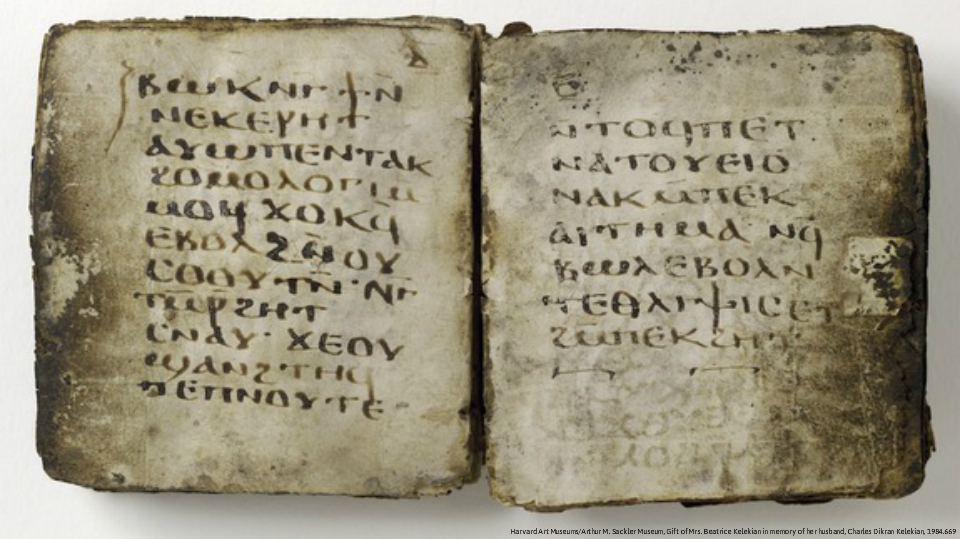
When we hear the word “gospel,” an account of the life and death of Jesus Christ comes into mind. But this newly-deciphered gospel, however, is unlike any yet discovered.
Inadvertently discovered inserted into a 1,500-year-old book, the much older “Gospel of the lots of Mary” has been translated from Coptic—an Egyptian language that uses the Greek alphabet. And according to Princeton University professor of religion Anne Marie Luijendijk, the gospel could have been used for encouragement, guidance, and, most interesting of all, divination.
The manuscript opens as follows:
The Gospel of the lots of Mary, the mother of the Lord Jesus Christ, she to whom Gabriel the Archangel brought the good news. He who will go forward with his whole heart will obtain what he seeks. Only do not be of two minds.
“When I began deciphering the manuscript and encountered the word ‘gospel’ in the opening line, I expected to read a narrative about the life and death of Jesus as the canonical gospels present, or a collection of sayings similar to the Gospel of Thomas (a non-canonical text),” wrote Luijendijk in her book, “Forbidden Oracles? The Gospel of the Lots of Mary.”
Instead, she found an ancient manuscript consisting of 37 oracles, only a handful of which say anything about Jesus.
Predicting the future
In times of doubt and trouble, an individual owning the book could have selected a page at random, whose content would have then provided an answer to their question.
Alternatively, the person could have sought out a diviner owning the text. Similarly, a solution to the person’s problem was found by picking one of the 37 oracles randomly, which the diviner then interpreted for better understanding.
The language used in the writing of all 37 oracles is very ambiguous. For example, oracle 34 says:
Go forward immediately. This is a thing from God. You know that, behold, for many days you are suffering greatly. But it is of no concern to you, because you have come to the haven of victory.
And, according to the seventh oracle:
You know, o human, that you did your utmost again. You did not gain anything but loss, dispute, and war. But if you are patient a little, the matter will prosper through the God of Abraham, Isaac, and Jacob.
Luijendijk observed that “the text refers to hardships, suffering and violence, and occasionally one finds a threat. On the whole, however, a positive outlet prevails.”
Oracle 24 is a reflection of this positive outlook:
Stop being of two minds, o human, whether this thing will happen or not. Yes, it will happen! Be brave and do not be of two minds. Because it will remain with you a long time and you will receive joy and happiness.
The message of Oracle 25 is similar:
Go, make your vows. And what you promised, fulfill it immediately. Do not be of two minds, because God is merciful. It is he who will bring about your request for you and do away with the affliction in your heart.
'Lot books'
So what exactly does it mean for the manuscript to be called the “Gospel of the Lots of Mary”?
A “lot book” was the term the ancient world used for books whose purpose was to predict the future of an individual. Strangely enough, this is the only lot book that refers to itself as a “gospel” – or, quite literally, “good news.”
“The fact that this book is called that way is very significant,” Luijendijk explained to Live Science. “To me, it also really indicated that it had something to do (with) how people would consult it and also about being (seen) as good news. Nobody who wants to know the future wants to hear bad news in a sense.”
Little book of oracles
The book is quite tiny, with a height of less than 3 inches and a width of around 2.7 inches. This made it portable and easy to hide from those church leaders who denounced divination.
“Given the book’s small size, the handwriting is surprisingly legible and quite elegant,” stated Luijendijk in her book.
The book shows signs of heavy use – not least of which are the visible thumbprints along the margins.
Origins
At the moment, the origins of the gospel are a little vague.
In 1984, a certain Beatrice Kelekian donated the codex to Harvard. Her husband’s father, Charles Dikran Kelekian, was “an influential trader of Coptic antiquaries, deemed the ‘dean of antiquities’ among New York art dealers,” according to Luijendijk’s research.
Unfortunately, the Kelekian family archive offers no clues as to where and from whom the text was acquired.
There may be hints at a “Christian site of pilgrimage and healing” in Egypt, however, at the Shrine of Saint Colluthus. As texts including written queries have been found here, archaeologists suggest this place could have been some sort of center for the practice of divination. It’s therefore possible that, in ancient times, one of the site’s diviners could have used this book to assist people with their problems.
“Among the services offered to visitors of the shrine were dream incubation, ritual bathing, and both book and ticket divination,” said Luijendijk.
The book is now owned by Harvard University’s Sackler Museum. — TJD, GMA News

