

 GMA Brandtalk
 Tracking
 Archives

ADVERTISEMENT
Filtered By: Scitech
SciTech
LOOK: Scientists find evidence of White Dwarf star ‘eating’ a planet
NASA astronomers have found evidence in an “ancient cluster of stars” near the edge of the Milky Way galaxy that a white dwarf star ripped apart a planet that may have passed a bit too close.
A white dwarf is a star that’s burned up all of the hydrogen, the substance that stars use as nuclear fuel. They’re incredibly dense—on Earth, one teaspoonful of white dwarf matter weighs about the same as an elephant—with all their matter packed into a radius a hundredth of their original size.
This results in a greatly enhanced gravitational pull: on the surface of a white dwarf, the gravitational pull is more than 10,000 times stronger than the pull on the surface of our own sun.
This results in a greatly enhanced gravitational pull: on the surface of a white dwarf, the gravitational pull is more than 10,000 times stronger than the pull on the surface of our own sun.
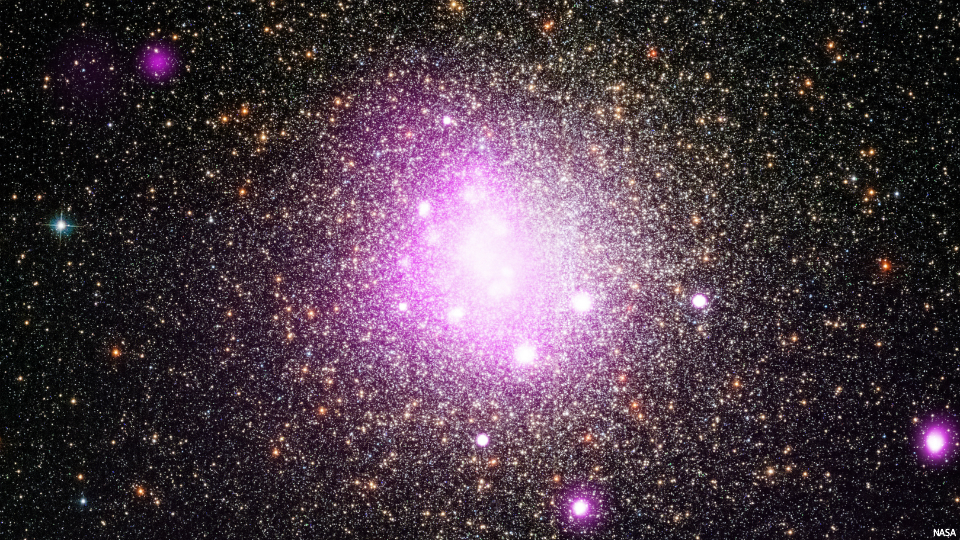
Star cluster NGC 6388
Researchers discovered an X-ray source near the center of the cluster NGC 6388 using the European Space Agency’s INTErnational Gamma-Ray Astrophysics Laboratory (INTEGRAL). In a follow-up observation using NASA’s Chandra X-ray Observatory, the astronomers determined that the observed X-rays weren’t coming from the black hole in the middle of the cluster.
Further monitoring using the X-ray telescope on NASA’s Swift Gamma Ray Burst mission led researchers to hypothesize that the X-ray source may be the remnants of a planet destroyed by a white dwarf.
According to theoretical models, the gravity of a concentration of stars in a cluster pulls away a planet from its parent star. When it passes too close to a white dwarf, it can be ripped apart by the intense gravitational tidal forces. It’s the debris from the destroyed planet that glows in X-rays. The current observed X-rays support this hypothesis. Other data gleaned using multiple telescopes eliminate other possible explanations for the observed X-rays. — TJD, GMA News

