

 GMA Brandtalk
 Tracking
 Archives

Bracing for the effects of a continuing strong El Niño in 2016
Early in March, the Philippine Atmospheric, Geophysical and Astronomical Services Administration (PAGASA) confirmed the onset of El Niño in the country. Barely five months later, the weather bureau warned that the phenomenon had strengthened.
In its most recent advisory issued on December 7, PAGASA said that the El Niño in the tropical Pacific is still persisting, with climate prediction models suggesting that it will likely peak between November 2015 to January 2016.
According to local and international weather bureaus, the 2015-2016 El Niño may be worse than the 1997-1998 phenomenon.
With this, Socioeconomic Planning Secretary Arsenio M. Balisacan on December 17 said that President Benigno Aquino III approved a P19 billion budget to combat the effects of El Niño, which may last until May 2016.
PAGASA will give its next update on the El Niño phenomenon on January 6, 2016.
Droughts and dry spells, stronger typhoons
El Niño is a large-scale meteorological phenomenon that develops in the Pacific Ocean. It is commonly associated with drought in the Philippines. It hit the country just when the planting season starts in the the biggest rice-producing regions, which may affect food security.
El Niño does not only cause drought, it also brings stronger typhoons.
PAGASA chief Vicente Malano in an interview said that the El Niño also causes the behavior of tropical cyclones to become erratic, affecting both their track and intensity. But this is expected only in the latter part of the year.
Two of the most recent typhoons to hit the country, Marilyn and Nona, helped provide relief from El Niño's effects, especially in rice-producing regions.
PAGASA in its latest update on the El Niño said that most parts in the country experienced "way below to below normal rainfall condition" in 2015. But as of December 7, the provinces affected by dry spell include Laguna, Mindoro Occidental and Oriental, Albay, Aklan, Antique, Guimaras, and North Cotabato. Meanwhile, Quezon, Camarines Norte, Northern Samar, and Samar (Western Samar) provinces experienced drought conditions.
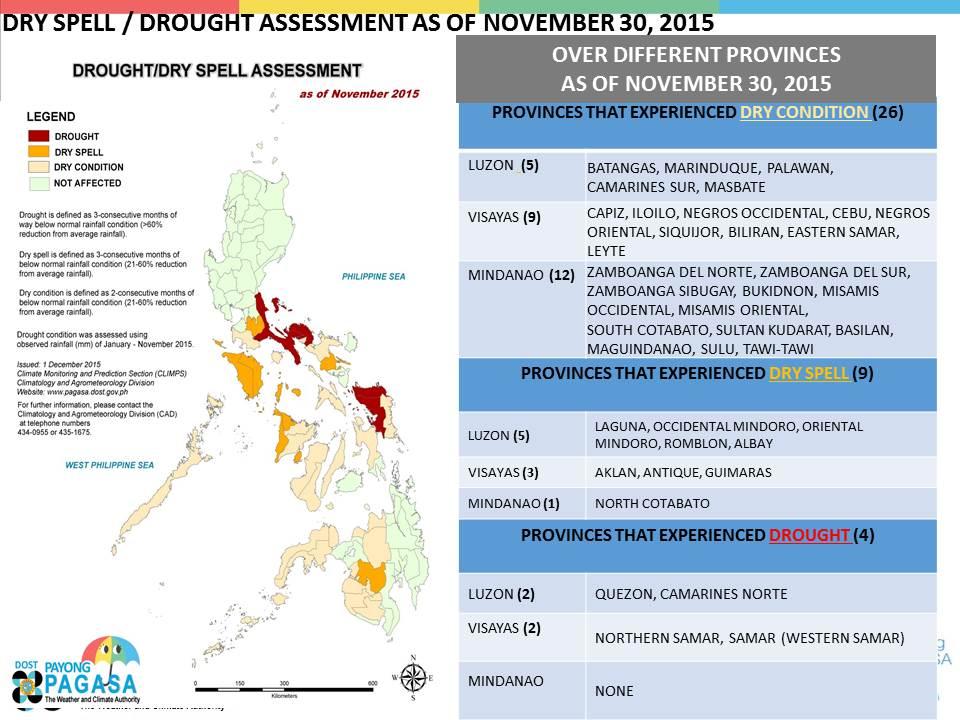
Dr. CP David, the executive director of Philippine Council for Industry and Energy Research and Development (PCIERD) of the Department of Science and Technology (DOST) and a consultant for GMA News' IM Ready, also said that the entire Luzon except for the Bicol area is out of drought danger since Typhoons Marilyn and Nona which affected Luzon filled most reservoirs.
"In fact, except for Pantabangan, all dams are filled to their high water mark," he told GMA News Online.
Only Angat Dam at 213.95 meters of reservoir water level (RWL) reached its flood season high water level (FSHWL) of 212 meters, according to PAGASA's update on Tuesday morning.
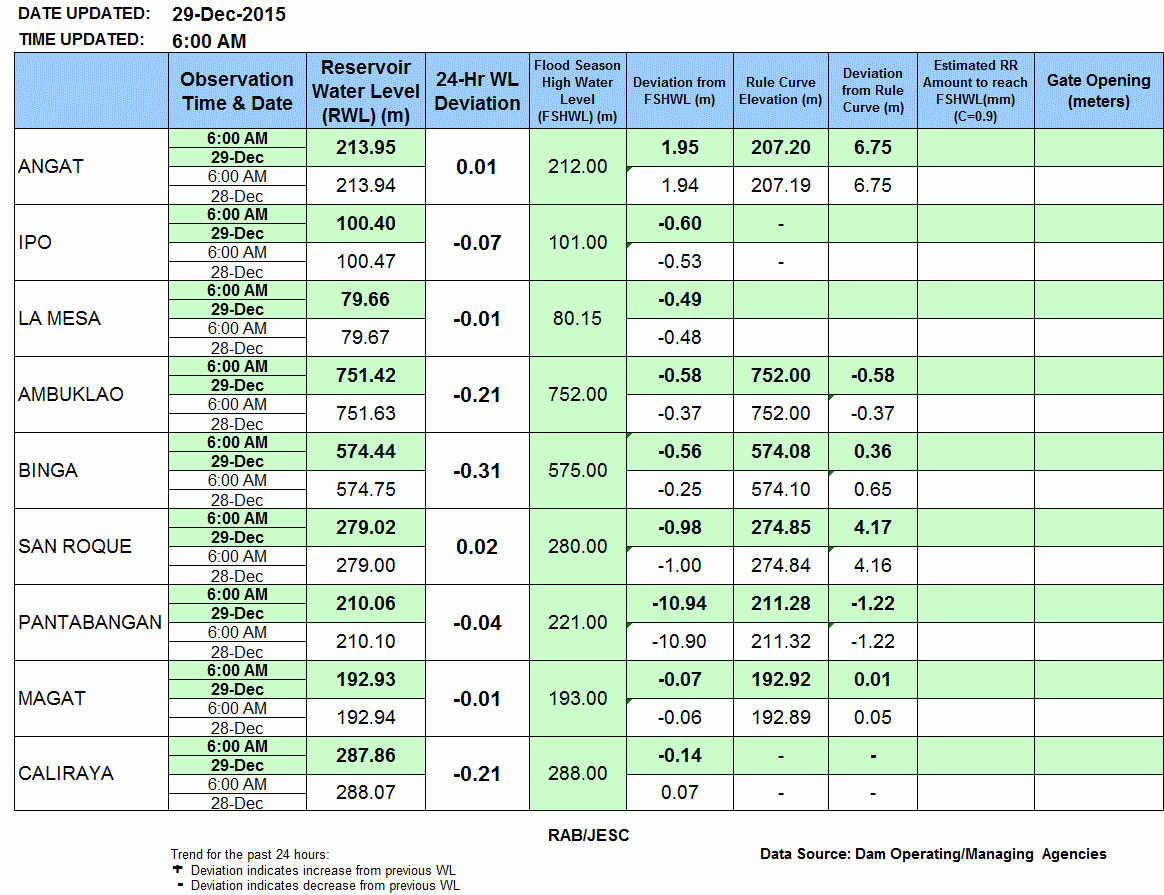
Ipo, La Mesa, Ambuklao, Binga, San Roque, Magat, ang Caliraya dams only need less than one meter of water more to meet their FSHWLs. Pantabangan, on the other hand, still requires over 10 meters.
"We're in a much better position in terms of providing water for domestic and agri use," he also said.
But Samar and Central Mindanao are still experiencing dry spell, he added.
Dr. Gerry Bagtasa of Weather Manila, however, pointed out that El Niño and its effects are set in stone.
"There is no direct/one-to-one correspondence on El Niño intensity and what will happen in a particular place in [the Philippines]. What I mean is if warming is say 1 degree Celsius, will rain in NCR lessen by 10%? If 2 degrees, will rain lessen by 20%? And so on. Walang ganoon," he said.
"There are so many things that are happening all at the same time, that we can't quantify the exact effects. Like this year, NCR [National Capital Region] had ample rain even if there's El Niño.," he added.
Worst yet to come?
"Kung ako ang tatanungin, the worst is yet to come pagdating sa El Niño."
That is according to Philippine Movement for Climate Justice (PMCJ) national coordinator Gerry Arances.
"Kaya importante ma-develop ang capacity to prepare, to mitigate, and to adapt sa mga bagay na ito [effects of a strong El Niño] na hindi na natin kontrolado kumabaga dahil na-trigger na ng climate change," he added.
Arances later clarified that El Niño and climate change has no direct connection. But he said that a stronger El Niño may be linked in some way to climate change.
"Mahirap i-link ang El Niño [sa climate change]. Baka ang enhanced El Niño," Arances also said.
The PMCJ national coordinator cited the Fifth Assessment report of the Intergovernmental Panel on Climate Change (IPCC) which stated that climate change affects weather events in the entire world.
"Kumbaga, in-enhance ng climate change iyong katulad ng El Niño at nararamdaman natin iyon ngayon at mas mararamdaman pa natin siya lalo next year," he added.
Bagtasa, on the other hand, stressed that El Niño causes changes in the climate--but the proper term is climate variability, not climate change.
"The changes are relatively short term and cyclical, and these (El Niño/La Niña) are natural processes that have been observed for centuries," he said.
"However, these are different from the human-induced climate change because of CO2 emissions. The mechanisms are different, however, their effects may compound each other," he added.
La Niña next?
The current El Niño is expected to last until May 2016. After this, the ocean may start to cool down to its normal temperature, Bagtasa also said.
"The portion of the ocean has been getting warmer and warmer in the last half of 2015, it looks that that warming will be sustained for a another month or so, then start to cool down, until it reaches its 'normal' temperature around May-June-July of 2016," he said.
"Latest forecasts show it cooling down than normal after mid 2016, that's La Niña, that may last until the end of the 2016. For now, it does not look like we're going to have a significant La Niña event," he added. — TJD, GMA News

