

 GMA Brandtalk
 Tracking
 Archives

Planet in star system next door may have ocean
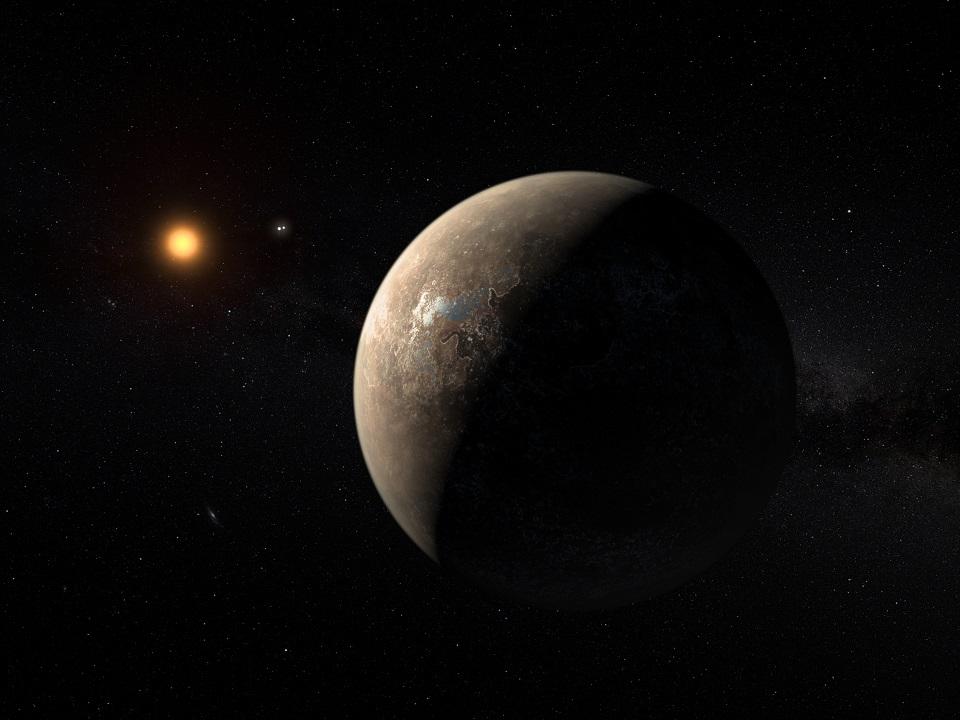
PARIS - A rocky planet discovered in the "habitable" zone of the star nearest our Sun may be covered with oceans, researchers at France's CNRS research institute said Thursday.
A team including CNRS astrophysicists have calculated the size and surface properties of the planet dubbed Proxima b, and concluded it may be an "ocean planet" similar to Earth.
Scientists announced Proxima b's discovery in August, and said it may be the first exoplanet—planet outside our Solar System—to one day be visited by robots from Earth.
The planet orbits within a "temperate" zone from its host star Proxima Centauri, some four light years from us.
It is estimated to have a mass about 1.3 times that of Earth, and orbits about 7.5 million kilometers (4.6 million miles) from its star—about a tenth the distance of innermost planet Mercury from the Sun.
"Contrary to what one might expect, such proximity does not necessarily mean that Proxima b's surface is too hot" for water to exist in liquid form, said a CNRS statement.
Proxima Centauri is smaller and 1,000 times weaker than our Sun, which means Proxima b is at exactly the right distance for conditions to be potentially habitable.
"The planet may very well host liquid water on its surface, and therefore also some forms of life," the statement said.
The size of exoplanets are generally calculated by measuring how much light they block out, from Earth's perspective, when they pass in front of their host star.
But no such transit of Proxima b has yet been observed, so the team had to rely on simulations to estimate the planet's composition and radius.
They calculated the radius was between 0.94 and 1.4 times that of Earth, which is 6,371 kilometres on average.
Assuming a minimum radius of 5,990 km, the planet would be very dense, with a metallic core making up two-thirds of the entire planet's mass, surrounded by a rocky mantle.
If there is surface water, it would not contribute more than 0.05 percent to the planet's total mass, the team said—similar to Earth, where it is about 0.02 percent.
In the larger planet scenario, with a radius of 8,920 km, Proxima b's mass would be split 50-50 between a rocky centre and surrounding water.
"In this case, Proxima b would be covered by a single, liquid ocean 200 km deep," said the CNRS.
"In both cases, a thin, gassy atmosphere could surround the planet, like on Earth, rendering Proxima b potentially habitable," it concluded. — Agence France-Presse

