

 GMA Brandtalk
 Tracking
 Archives

LIST: Deadliest earthquakes in the Philippines
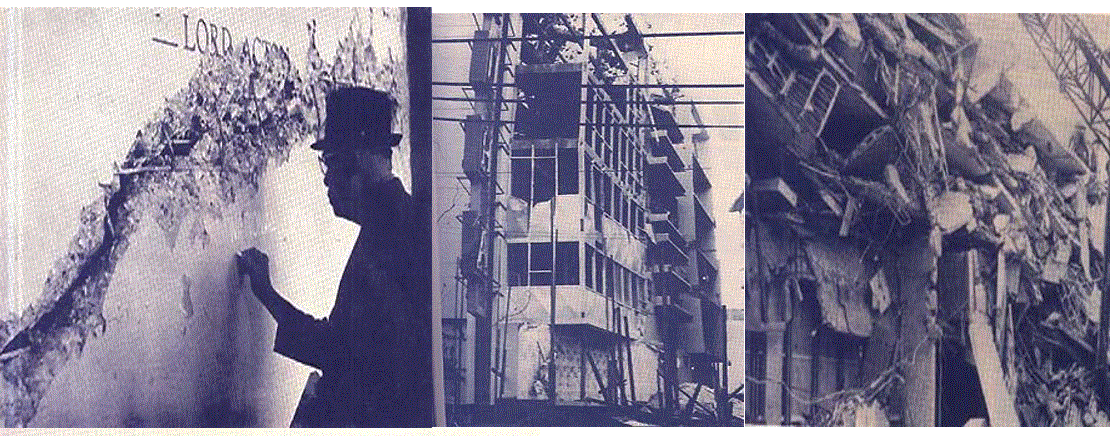
The Philippines is part of the Pacific Ring of Fire, a region around the Pacific Ocean where many earthquakes and volcanic eruptions occur.
According to PHIVOLCS, the country has an average of 20 recorded earthquakes per day, some of which cause not only infrastructure damage but also deaths.
The recent earthquake that jolted Bogo City on Tuesday has so far resulted in at least 68 fatalities.
Here are some of the deadliest earthquakes in the country:
Moro Gulf (Aug. 17, 1976)
A few minutes after midnight on August 17, 1976, a magnitude 8.1 earthquake hit Mindanao and caused a tsunami that destroyed over 700 kilometers of coastline bordering Moro Gulf in the North Celebes Sea.
The tsunamigenic earthquake took 1,440 lives. PHIVOLCS said the number of fatalities could be attributed to the time of the event and the tsunami that struck the coasts in Regions 9 and 12, which cover Region 9 (Pagadian City, Zamboanga del Sur, Zamboanga City, Basilan, and Sulu) and Region 12 (Sultan Kudarat, Maguindanao, Cotabato City, Lanao del Sur and Lanao del Norte).
The surveys at the time showed that the tsunami caused 85% of the deaths, 65% of the injuries, and 95% of the missing people.
Generated by the Cotabato trench, the Moro Gulf earthquake was the largest tsunamigenic earthquake to have occurred in Mindanao in the last two decades.
Rizal, Nueva Ecija (July 16, 1990)
Over 1,200 fatalities were recorded after the magnitude 7.8 earthquake hit Rizal, Nueva Ecija, on July 16, 1990.
It produced a 120-kilometer-long ground rupture along the Digdig segment of the Philippine Fault.
The earthquake caused damage to structures in Baguio City, Benguet; Cabanatuan City, Nueva Ecija; Dagupan City, Pangasinan; San Fernando City, Pampanga; and Metro Manila.
Records showed that the affected areas incurred about P10 billion of structural damage.
Other geologic impacts, such as liquefaction and earthquake-induced landslides, were also documented.
Lanao del Sur (April 12, 2017)
The magnitude 7.5 earthquake that jolted Lanao del Sur is considered one of the most damaging earthquakes in the province.
The earthquake resulted in about 400 deaths and several structural damage in the Lanao area, Zamboanga City, and Pagadian City.
Liquefaction and landslides were also documented.
Casiguran, Aurora (Aug. 2, 1968)
The magnitude 7.3 earthquake in Casiguran, Aurora was considered the most severe and destructive earthquake recorded in the Philippines during the last 20 years.
It killed 270 people and injured 261 in Manila; then Aurora Sub Province; and Guagua, Pampanga.
Several major buildings in Binondo and Escolta, Manila were also damaged while landslides and disasters were monitored in the mountainous parts of the epicentral area.
The largest landslide was on the cliff at Dinajawan Point facing Casiguran Bay, while another landslide was observed in Manglad River, a tributary of the Cagayan River.
Bohol (Oct. 15, 2013)
More than 200 people were killed after a magnitude 7.2 earthquake struck Bohol and the entire Visayas Region.
With the epicenter near the boundary of Sagbayan and Catigbiam towns, the earthquake had at least 3,900 recorded aftershocks, of which over 100 were felt.
It also affected more than 600,000 families and left about P2 billion worth of infrastructure damage.
The earthquake was generated by the North Bohol Fault and was associated with surface rupture.
Liquefaction, earthquake-induced landslides, and several sinkholes were also reported.—LDF, GMA Integrated News

