

 GMA Brandtalk
 Tracking
 Archives

What are nature-based solutions and can they help prevent flooding?
Typhoon Tino and Super Typhoon Uwan have left a trail of destruction in the Philippines. Cebu for instance had P26.7-billion flood control projects but saw a death toll of 158 following Tino. Negros Occidental meanwhile saw agricultural losses amounting to over P35M.
The damages have not only reignited netizens' anger over anomalous flood control projects, they also reawakened discussions about the Sierra Madre's natural protection, as well as a new-found interest toward nature-based solutions.
In a Facebook post that's now gone viral, landscape architect Paulo Alcazaren shared snaps of his firm's proposal for a nature-based solution and strategy for Cebu's Butuanon River. It showed a tree-lined boardwalk, foot path bridges, and more foliage.
"Visiting a few months ago, I was disheartened to see that the DPWH had defaulted into their concrete-based default flood-control initiatives," Alcazaren said.
"I understand that with all the lessons gleaned in the past few months, there is now hope that the DPWH will be reformed, look at NbS, coordinate better with LGUs, and be more transparent and accountable for how our tax funds are spent," he added.
But what are nature-based solutions, or NbS? According to the International Union for Conservation of Nature (IUCN), "Nature-based Solutions address societal challenges through actions to protect, sustainably manage, and restore natural and modified ecosystems, benefiting people and nature at the same time."
Speaking to GMA News Online, Atty. Alaya de Leon Deputy Executive Director, Forest Foundation Philippines and its program manager of the Philippines-Canada Partnership, a nature-based solutions for climate adaptation program, zeroed in on three elements of the broad and very verbose definition: Actions that take place within an ecosystem addressing a clearly defined societal challenge that provide benefits to humans and to nature.
Reforestation and mangrove rehabilitation are some of the more popular NbS examples but according to de Leon, NbS can also take place in cities and urban areas. She points to Bangkok, Thailand where an old tobacco factory in the heart of the city was transformed into park that has also addressed flooding issues in the area.
"They planted trees but the way they designed the park incorporated water catchments so may pupuntahan yung tubig. Naging storehouse siya ng flood water," de Leon shared.
At the Benjakiti Forest Park, an area was created where plants could thrive. "More birds started coming, animals are also able to enjoy the area, and it's become a green space where people can enjoy the clean air and do their social activities," she added.
The Benjakiti Forest Park is a good example of NbS. "It's very rare that they will only solve just one problem. If we design it well and if we understand the starting point, the situation and the challenges that we're dealing with, may multiple benefits talaga siya. It really has to address social challenges and make sure there are benefits for humans and biodiversity."
But de Leon clarifies NbS doesn't necessarily have to be purely a green intervention.
"We can also have your green-gray infrastructure where we combine the green types with [grey] infrastructure, so with a mangrove restoration, we can also build additional seawalls and dikes to complement the green infrastructure of mangroves."
"They are not mutually exclusive, but what's important is to understand that NbS is not a one-size fits all. NbS has to be tailor-fit and be very responsive to the specific geography, climate, topography, um even the community," she said.
In the Philippines, Forest Foundation has implemented a couple of NbS projects in San Carlos City in Negros Occidential, where flood, soil erosion, and rain-induced landslides have been identified as hazards.
"The NbS solutions they are undertaking is the active restoration of the riverbank easements," de Leon said.
In the 10 hectares of riverbank easement of the Malogo River, communities have started planting appropriate species of trees as "sufficient tree cover can absorb more rain water, water flows down into the river, and hindi matatangay ng rainwater yung lupa that would otherwise erode into the river and cause siltation and overflow," de Leon said.
"The tress there can help add integrity of the riverbank," she added.
Another NbS project was implemented in easement of the Sicaba River located near farms, using bioswales to catch water. "It serves both as a catchment or a canal for storm water, but because this is in agriculture areas, it also provides irrigation. So nagagamit yung stored water, both from the water, just in there katabi ng planting areas and they're also able to use it for uh, the agriculture. for watering their crops," she added.
De Leon says NbS can really provide a win-win situation "but we first need to understand that it has to be science-based. It has to be evidence based."
"Hindi pwedeng mawala assessments, studies, research before we deploy any kind of nature-based solution. Local knowledge also is very important," she added.
But de Leon warns NbS cannot be an end-all, be-all solution to things like flooding.
Pointing to Cebu's flooding and destruction, de Leon said, "there's so much flood that it's no longer really just about flood control anymore. There's no flood control project that can stop that water."
"It's already a conversation about early warning systems, understanding the projections and modeling for rainfall and typhoon pathways the long, short, medium, and long term," she said.
"We know it will increase over the years because of climate change, on top of how vulnerable our communities already are. So that's a bigger play strategy that goes into our adaptation planning, our DR our planning," she continued.
Still, de Leon pushes what she's long been advocating for: "NbS is not option C or option D."
She asks: "When we have a societal issue, can we turn to nature [first] and see how I can do a positive action for the environment, for the ecosystem, for biodiversity that can help address that societal issue?"
"Minyan kasi para siya na yung last resort," de Leon said as she compares mangroves and sea walls as short-term interventions.
"When we think about specific interventions na short term, we think [with sea walls] it's going to keep us safe but when water comes in, it can also trap water inside," she said.
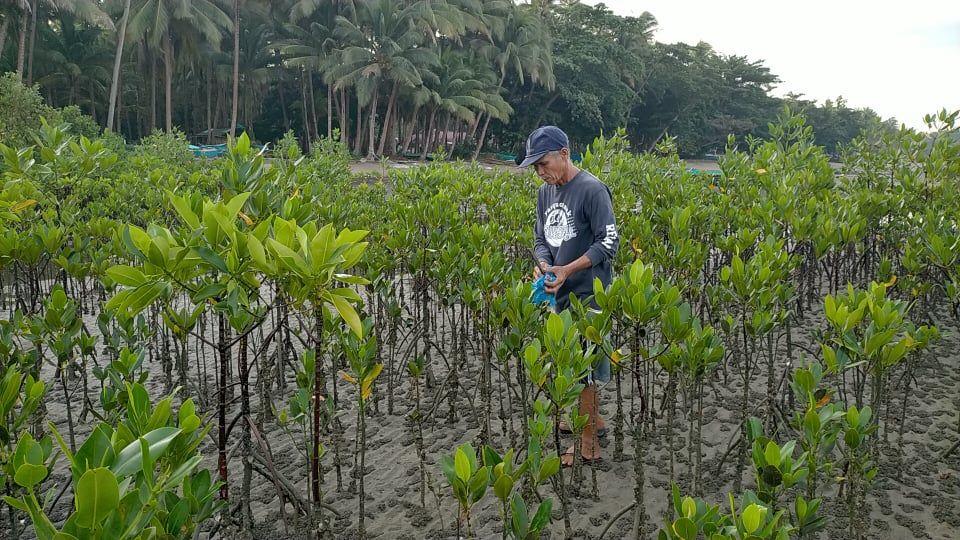
"Whereas if you just think about mangroves themselves, it's a popular NbS. Mangroves are natural protection against strong winds, storm surges. So if we think about looking at NbS first, instead of immediately constructing a seas wall, we turn to mangroves. It has a lower cost and the community can help rehabilitate and regenerate them."
"Do I automatically go to my short-term solution where I build so that the water cannot come in? Or do I take a pause, understand the ecosystem better and see whether there's a nature-based solution that I can prioritize that can then provide these multiple benefits?" — GMA Integrated News

