

 GMA Brandtalk
 Tracking
 Archives

Manila Observatory expert: ‘Polluted air has no political boundaries’
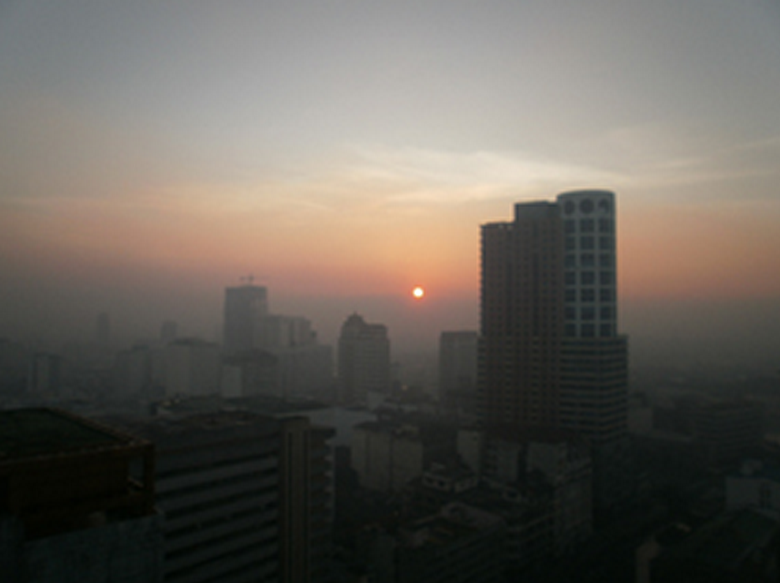
Experts believe that having clean air must be a national priority, as air pollution knows no boundaries.
James Bernard Simpas, Manila Observatory’s Air Quality Dynamics Laboratory head, said that air pollution is a problem not exclusive to one group or area.
“Clean air is a national priority because clean air knows no political boundaries. Polluted air knows no political boundaries,” he told GMA News Online.
“Metro Manila, for example, you can't control it by cities and say that, ‘Okay, Quezon City is cleaning up [...] But then, of course, if you have neighboring areas, the same thing, your own pollution is not necessarily affecting you alone, or most likely not just affecting you,” Simpas added, noting that air pollution is “a problem that's not solvable on a micro scale.”
Simpas earlier said, citing the Manila Observatory’s data in 2023, that concentrations of particulate matter (PM) 2.5 have decreased due to policy interventions in previous years, including the implementation of stricter emission standards for motor vehicles.
But he said concentrations of PM 2.5 are still above the threshold set by the World Health Organization.
According to the Manila Observatory, particulate matter (PM) is composed of tiny solid particles and liquid droplets floating in the air. This matter is classified by size, where PM 2.5 specifically denotes particles with a diameter of 2.5 micrometers or smaller.
The common sources of PM 2.5 pollution in Metro Manila are motor vehicle exhaust, construction site dust, road dust, practices related to waste management, and the burning of organic matter, known as biomass burning. Contributions also come from natural sources, such as sea salt.
Ethel Garcia, Regional Account Manager for SEA and Oceania at Clarity Movement, said that the first step in combating air pollution is acknowledging the problem.
“Siguro, the most important part doon is for us to recognize muna that there's a problem with air pollution, that it's not normal. Kapag na-realize mo na it's really a problem or a crisis that we need to address, doon lang papasok kasi yung interventions coming from the government,” she told GMA News Online.
(Maybe, the most important part is for us to recognize first that there's a problem with air pollution, that it's not normal. When you realize that it's really a problem or a crisis that we need to address, that's where the interventions coming from the government will come in.)
Garcia also called for amendments to the Clean Air Act of 1999, which sets standards for key pollutants and establishes a framework for mitigating air pollution.
“Parang, it's the right time to update the Clean Air Act. Kasi, it's been a while, 1999, and we haven't updated the standards. We haven't updated yata even the penalties dun sa mga polluters,” she said.
(It seems like it's the right time to update the Clean Air Act because it's been a while, 1999, and we haven't updated the standards. I guess we haven't updated even the penalties for the polluters.)
“So, inflation 1999 versus today; industries 1999 versus today. Malaki na yung change in terms of development. So, we need to review the Clean Air Act kasi I think it's the right time to update it. Even the technology na nandoon, it's not the technology that is available now.”
(So, inflation 1999 versus today and industries 1999 versus today. The change in terms of development is big. So, we need to review the Clean Air Act because I think it's the right time to update it. Even the technology that is there is not the technology that is available now.)
Uncertain
Simpas and Garcia both said that it remains uncertain how long it will take for the Philippines to reduce air pollution.
“Well, not yet. Kasi, I don't see any reduction. And aside from fuel, let's say Euro 4, I don't know when we'll adopt it. I think they're already studying Euro 6. And maybe that will help because that changes the fuel and therefore changes the emissions,” said Simpas.
(Well, not yet, because I don't see any reduction. And aside from fuel, let's say Euro 4, I don't know when we'll adopt it. I think they're already studying Euro 6, and maybe that will help because that changes the fuel and therefore changes the emissions.)
“But in terms of emissions testing and seeing that vehicles are roadworthy not only in terms of their mechanics but also in terms of their air pollution, we're not yet there. And I don't know how long that will take,” he added.
Garcia said, “It's very difficult to answer yung time. Kasi, I don't think also we're at the time na we realize that this is really a problem of concern. So it's really not a priority."
(It's very difficult to answer about time because I don't think we're also at the time when we realize that this is really a problem of concern, so it's really not a priority.) —VBL, GMA Integrated News

