

 GMA Brandtalk
 Tracking
 Archives

Coalition wants real-time air quality monitoring to solve pollution woes
A group of technology and academic institutions is seeking to provide real-time air quality monitoring to solve the air pollution debacle in Metro Manila.
Breathe Metro Manila, inspired by the Breathe London project, aims to combat air pollution in the National Capital Region (NCR) by integrating technology, scientific methods, and community involvement. The group aims to get real-time air quality monitoring by setting up sensors in various cities.
Technology provider Clarity Movement is part of the coalition and plays a key role for this undertaking. Ethel Garcia, Clarity Movement regional account manager for Southeast Asia and Oceania, said it is important to get data on the air quality in Metro Manila before making any interventions.
"We always realize na if we don't have the data, how can we make policies for intervention?" she told GMA News Online, adding that, "Air pollution is invisible so no one can see it. It can only be seen through numbers"
"So that's what we are trying to address. Showing the numbers for us to create yung solutions dun sa problem," Garcia said.
(We always realize that if we don't have the data, how can we make policies for intervention? So that's right, as you mentioned earlier, air pollution is invisible, right, so no one can see it. It can only be seen through numbers. So that's what we are trying to address. Showing the numbers for us to create the solutions to the problem.)
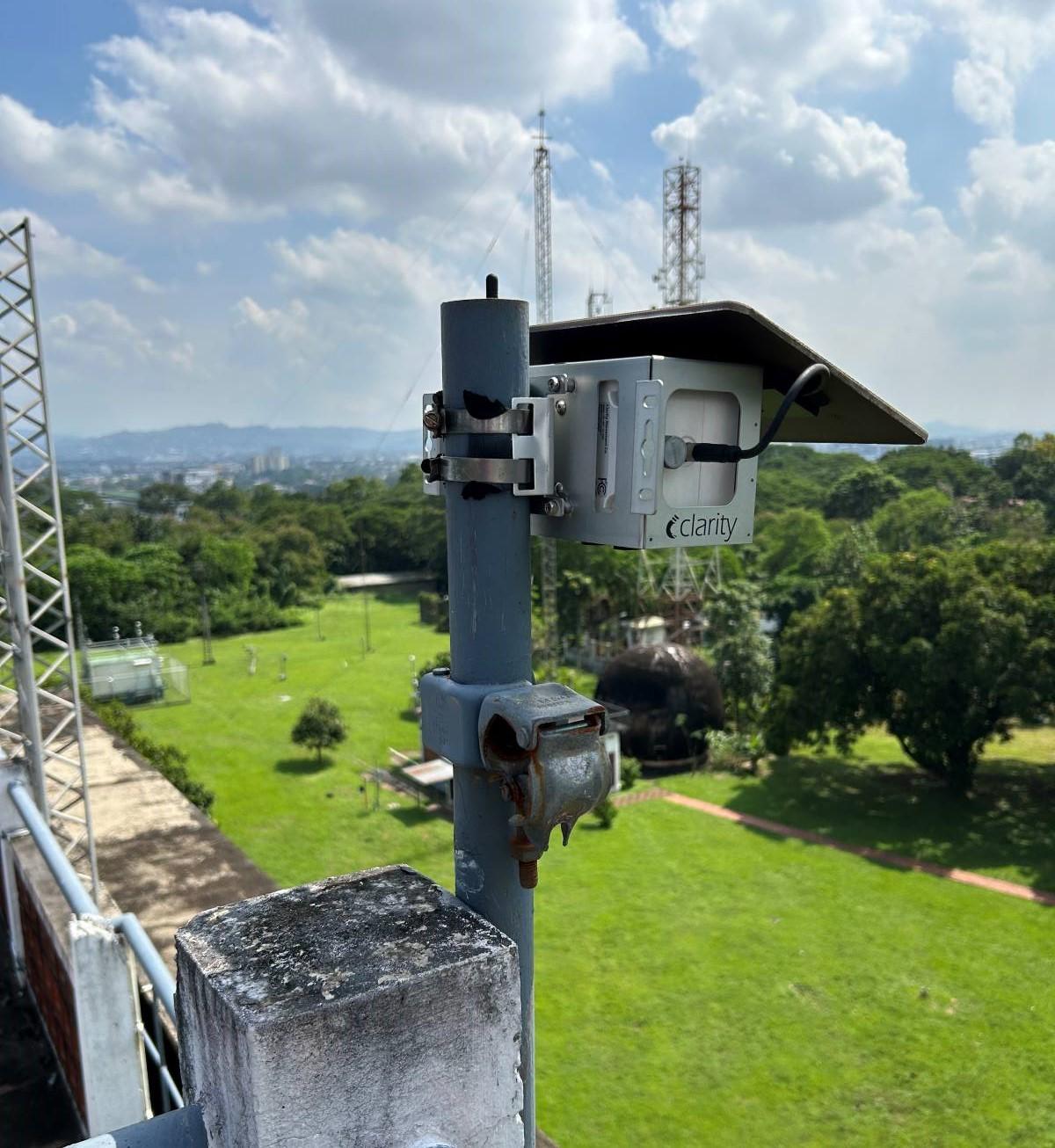
The coalition and Clarity Movement have set up nearly 40 sensors in eight Metro Manila cities, namely Caloocan, Valenzuela, Navotas, Quezon City, San Juan, Mandaluyong, Taguig, and Manila. Garcia said that these sensors monitor particulate matter (PM) 2.5.
"We are focusing on PM 2.5. Kasi, 'yun nga, ang focus is public health. So, we already know the effects of PM 2.5. So, one pollutant at a time. So, lahat ito, it measures PM 2.5," she explained.
(We are focusing on PM 2.5. Because, again, the focus is public health. So, we already know the effects of PM 2.5. So, one pollutant at a time. So, all of these measure PM 2.5)
Garcia added that the sensors are solar-powered and SIM cards are placed inside to receive and transmit data.
"How it functions ay may fan yan sa loob. Humigop siya ng hangin. May dalawang butas siya sa ilalim. Humigop siya ng hangin, tapos ilalabas niya 'yun. Once humigop siya ng hangin, 'yun 'yung dini-detect niya 'yung pollution level. So, that's why meron kang mass concentration. 'Yung nakita mo sa taas na microgram per cubic meter, that's the mass concentration of PM 2.5," she further explained.
(How it functions is that there's a fan inside. It sucks in the air. It has two holes underneath. It sucks in air, then it lets it out. Once it sucks in the air, that's when it detects the pollution level. So, that's why you have mass concentration. What you see above as microgram per cubic meter, that's the mass concentration of PM 2.5.)
Under Breathe Metro Manila's monitoring that is available online, the air quality index (AQI) are categorized as whether good, fair, unhealthy, very unhealthy, or emergency. Hourly trends in the AQI per area can also be tracked on the website.
Check your area's current air quality by visiting the Breathe Metro Manila map by clicking here.
Garcia said the sensors are placed in public places with high-foot traffic such as near schools, churches, markets, and transportation hubs.
"Normally ang nilalagay nila siya sa mga matataong lugar. So, laging gan'un. Kasi nga, ang nagiging goal ni cities ay public health eh, to protect their own communities," she said.
(Normally these are placed in crowded areas. So, it's always like that. Because, after all, the goal of the cities is public health, to protect their own communities.)
However, Breathe Metro Manila admitted it still has things to improve on, particularly in data gathering. Garcia said the company is hoping to put up more sensors in other cities.
"Right now, it's really expansion eh. So kasi we need to determine 'yung hotspots, alin 'yung mga areas na kailangan i-focus. So it's really the expansion. 'Yung mga current, mga cities na wala pa, kasi kailangan din ma-complete 'yung picture. It's just connecting the dots kasi eh," she said.
(Right now it's really expansion. Because we need to determine the hotspots, which areas need to be focused on. So it's really the expansion. The current cities that don't have any yet, because the picture needs to be completed. It's just connecting the dots.)
Garcia also said the project is looking forward to upgrade the sensors so it can monitor other pollutants.
"We're now focusing on PM 2.5, but there are other pollutants. Smog is related to nitrogen dioxide and ozone. So wala tayo n'un," she said. — VDV, GMA Integrated News

