

 GMA Brandtalk
 Tracking
 Archives

Scientists find 'nuclear traces' in West Philippine Sea
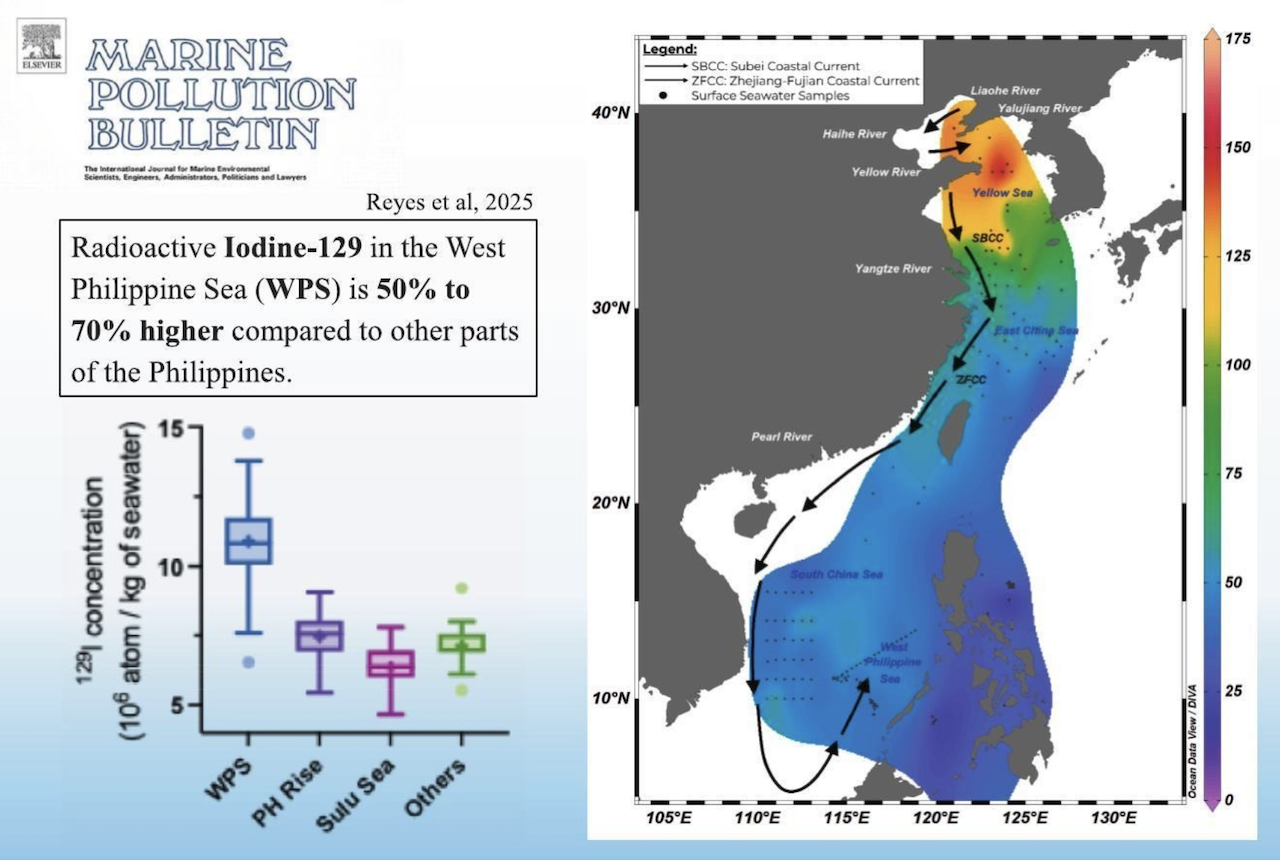
Scientists have detected what they described as "unusually high" levels of a radioactive substance called iodine-129 in the West Philippine Sea (WPS)—the chemical often used as a clue to track nuclear activities.
The study was conducted by experts from the Department of Science and Technology–Philippine Nuclear Research Institute, the University of the Philippines Marine Science Institute, and the University of Tokyo.
Researchers tested 119 samples of seawater from different parts of the Philippines and found that the iodine-129 levels in the WPS were much higher than in other areas—suggesting something is bringing it there.
Even though there are no nuclear plants or known nuclear activities in the area, experts believe the iodine-129 may have traveled from far away.
They suspect it came from the Bohai Sea and Yellow Sea in China, carried by ocean currents. These areas have been exposed to iodine-129 from old nuclear fuel processing, past nuclear weapons tests, and the Chernobyl disaster.
According to the study, iodine-129 from these sources settled in northeastern China’s soil, was washed into rivers, and then carried to the sea. From there, ocean currents pushed it all the way to the WPS.
The researchers say this shows how radioactivity can cross borders and travel long distances through ocean water. They also say iodine-129 can help scientists better understand how ocean currents move in the South China Sea.—MCG, GMA Integrated News

