

 GMA Brandtalk
 Tracking
 Archives

Astrophysicists figure out what caused a super-bright supernova
WASHINGTON - A supernova - the explosion marking the end of a massive star's life - is one of the brightest cosmic events, usually about a billion times more luminous than the sun. But some - a small fraction - are even brighter than that, 10 to 100 times more luminous. These are called superluminous supernovas.
Why these are so bright has been a mystery in astrophysics. But one such superluminous supernova involving a huge star in a galaxy about a billion light-years from Earth is now helping scientists solve the mystery. A light-year is the distance light travels in a year, 5.9 trillion miles (9.5 trillion km).
This supernova, first spotted in December 2024, was studied using the Las Cumbres Observatory, headquartered in California, and the Chile-based ATLAS survey telescope.
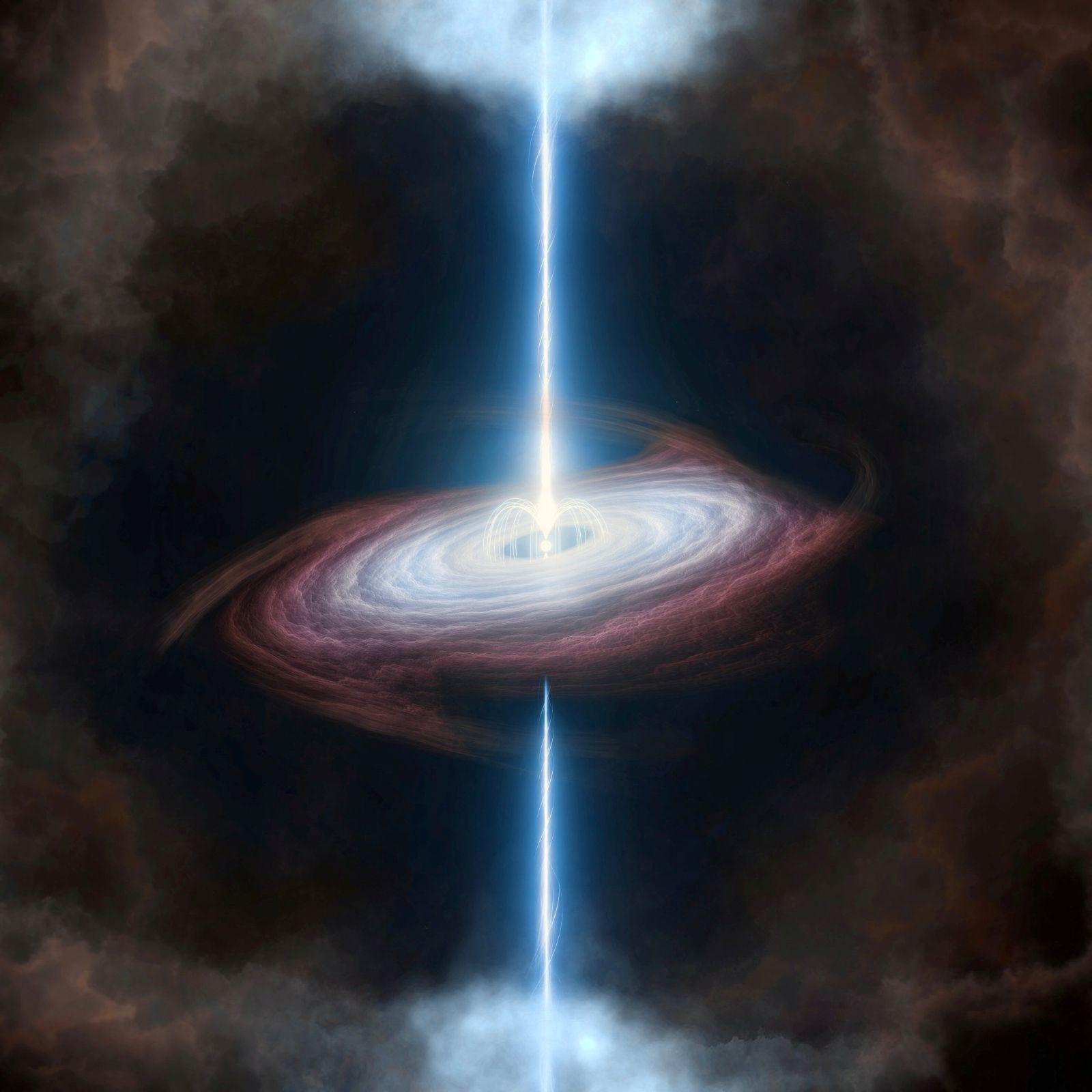
Researchers determined that it became ultra-bright because the explosion left behind a magnetar, an extremely compact and rapidly spinning stellar remnant with an immensely powerful magnetic field. The magnetar amped up the luminosity by sweeping up charged particles while it was spinning hundreds of times per second and flinging them into the expanding cloud of gas and dust from the star that was blasted outward into space.
A magnetar is a type of neutron star, the collapsed core of a massive star after its death.
"When a massive star exhausts its nuclear fuel, it can no longer resist the crushing force of gravity," said Joseph Farah, a doctoral student in astrophysics at the Las Cumbres Observatory and the University of California, Santa Barbara, lead author of the research published on Wednesday in the journal Nature.
"The core of the star is squeezed under the weight of the entire star above it, crushing it so hard that protons and electrons merge to form neutrons," Farah said, referring to the three fundamental subatomic particles that make up atoms. "If the mass of the core is too large, it will just collapse into (forming) a black hole. But if the conditions are right, the nascent neutron star will survive the core collapse."
Thus, the magnetar is hidden at the center of the supernova, powering its tremendous luminosity from within.
The first superluminous supernova was identified in 2006 by Las Cumbres Observatory astrophysicist Andy Howell, a co-author of the new research. The hypothesis that a magnetar could be the power source for such supernovas was proposed in 2010. Howell said he believes the new findings confirm this hypothesis.
Most supernovas brighten and fade in a predictable course. But some superluminous supernovas, like this one, undulate in brightness over months. As with this one, the bumps in luminosity become shorter and shorter over time.
The researchers attributed this to a phenomenon called Lense-Thirring precession in which the fabric of space-time is twisted by the spinning magnetar. After the detonation, the magnetar's gravitational strength pulled in some stellar material, forming a disk around it. Because of Lense-Thirring precession, the disk wobbles.
"This causes the transfer of the energy from the magnetar to the newly expanding supernova to vary," creating undulations in the supernova's brightness, Howell said.
The researchers have not determined precisely how big the star was before its spectacular demise.
"We don't know a lot about the star that exploded, but it was likely a very massive star" that was many dozens of times more massive and hundreds of thousands of times more luminous than the sun, Farah said.
A supernova's luminosity is hard to fathom.
"There's a great 'what if' that asks: what would be brighter, the sun going supernova 93 million miles (150 million km) from Earth," Farah said, referring to the orbital distance between our planet and its host star, "or a hydrogen bomb detonating on your eyeball? And the answer is the supernova - by nine orders of magnitude."
"So that's just a regular supernova. A superluminous supernova is 10 to a hundred - or more - times brighter than that. In absolute terms, our supernova had a luminosity brighter than the output of the entire Milky Way galaxy combined," Farah said. — Reuters

