

 GMA Brandtalk
 Tracking
 Archives

Five young scientists present studies at NAST competition
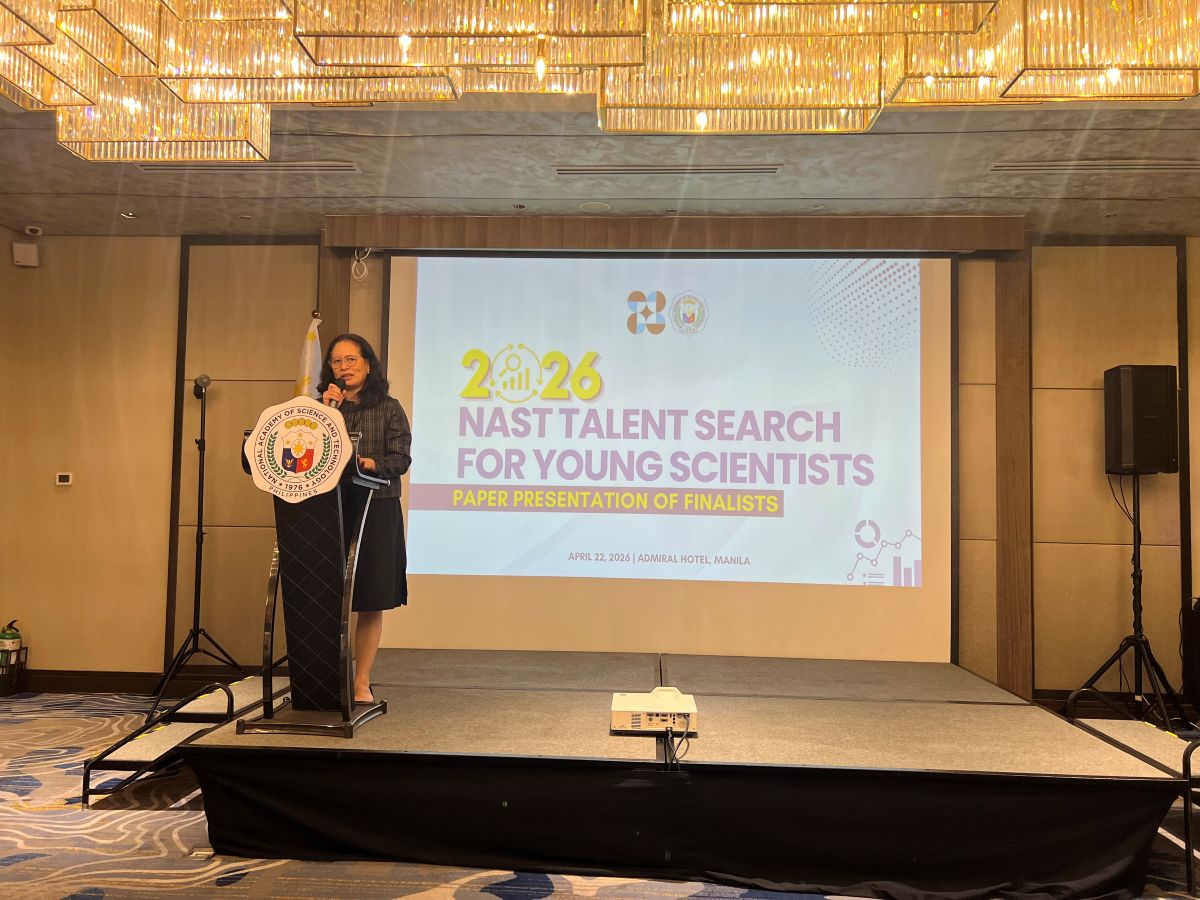
Five young Filipino researchers from different universities presented their studies as part of the 2026 NAST Talent Search for Young Scientists (NTSYS).
NTSYS was established in 1991 with the goal of inspiring young people who are 35 years of age or under in the year of the award to pursue careers in science.
“We have to continue these programs because they are a way of ensuring that our young researchers really continue doing research and there's no gap in terms of career development as far as research is concerned so that our research productivity will still be at its peak, and we continue to address national problems through science, technology, and innovation,” said National Academy of Science and Technology president Acd. Jaime Montoya at a conference in Manila on Wednesday.
The five finalists for NTSYS 2026 are the following:
Timothy Scott Chu (De La Salle University)
Timothy Scott Chu, an assistant professor of mechanical engineering at DLSU, presented his study on UAV-based concrete crack detection and segmentation.
The study intends to improve crack detection precision in hard-to-reach areas where conventional inspection methods are often hard to conduct.
It also seeks to improve safety measures through early identification of structural defects, particularly in the Philippines, where infrastructure is often exposed to natural hazards.
Joe Anthony Manzano (University of Santo Tomas)
Molecular and chemical biologist Joe Anthony Manzano is a researcher with a particular focus on studying interconnected fields of molecular biology, drug discovery, cancer biology, infectious disease biology, biotechnology, and computational biology.
His study explored the use of the local plant Voacanga globosa or the bayag-usa as an anti-cancer medicine.
His presentation focused on the “mechanistic investigation” of the plant's properties against cancer and its ability to induce apoptosis, or programmed cell death.
The study, which also dives into experimental and computational approaches, addresses issues surrounding cancer and places medical value on local Philippine plants in the search for new drugs.
Ronnel Nolos (Marinduque State University)
Environmental scientist Ronnel Nolos studied the distribution of potentially toxic elements in the soil of Marinduque Island.
His study provided an analysis of potential toxic contamination in the soil, including its effects from inhalation, incidental ingestion, and dermal contact, as well as the associated human health risks.
The study aims to help produce local policies and health interventions on toxic element exposure from soil in the country.
John Vincent Pleto (University of the Philippines Los Baños)
Another environmental scientist John Vincent Pleto explored the ecosystem health of San Pablo City’s Seven Lakes.
The study utilized the phytoplankton index of biotic integrity (Phyto-IBI) to assess how healthy the ecosystem of the lakes, which provided aquaculture and ecotourism, was.
The results of the study would help understand the management and environmental needs of the lake’s ecosystem.
Rance Derrick Pavon (University of the Philippines Diliman)
Microbiologist Rance Derrick Pavon studied the detection and characterization of food-based bacteria, Salmonella.
Authoring several studies into the topic, his presentation focused on the visual detection of Salmonella enterica in meat products.
Pavon’s study explores the possibility of alternative tools that would help determine the presence of Salmonella enterica serovar Typhimurium through isothermal molecular techniques (LAMP), creating a simpler, faster, more practical way to determine the presence of said bacteria and ensure outbreak prevention.
The study seeks to significantly reduce the constant need for routine-based gold-standard testing for Salmonella, which often took days in laboratories and ran the risk of delays that threatened food safety and security.
The presentations will be evaluated by the NTSYS Board of Judges headed by National Scientist Raul Fabella.
Winners will be announced on July 9. The first prize winner will receive P100,000 cash and a P500,000 research grant. —VBL, GMA News

