

 GMA Brandtalk
 Tracking
 Archives

Strange Milky Way planetary system leaves scientists puzzled
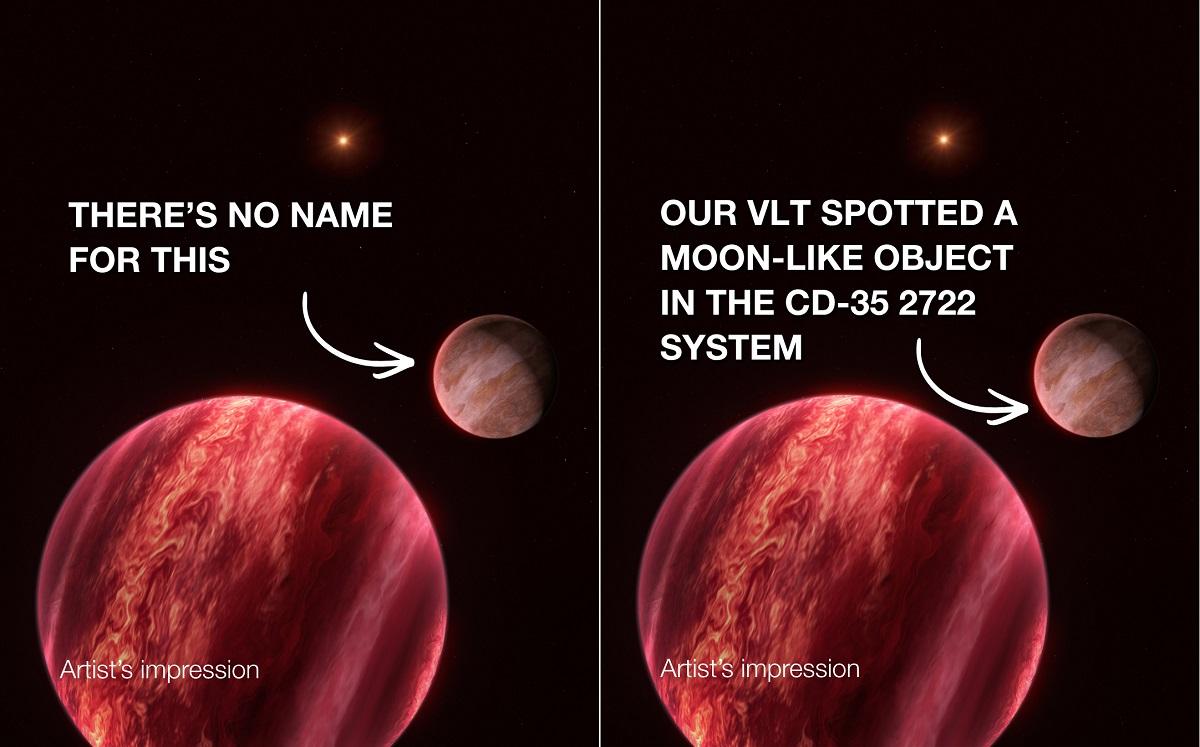
WASHINGTON — Scientists are documenting a planetary system in the Milky Way galaxy that is so starkly dissimilar to our own solar system that they are struggling to find the proper terminology to describe it.
The system includes a red dwarf star about 40% of the mass of our sun that is orbited by a brown dwarf, a celestial body that blurs the line between planet and star. The brown dwarf, in turn, is orbited by a gaseous Jupiter-sized world, newly discovered using the European Southern Observatory's Chile-based Very Large Telescope.
Using our solar system as a definitional frame of reference, a body that orbits another body that orbits a star should be called a moon—or in this case an exomoon, because it is beyond our solar system. But the object that orbits the brown dwarf is unlike any of the many moons in our solar system—all of which are relatively small rocky or icy worlds—in terms of composition and size.
So what should we call it?
"This will certainly be a matter of debate. In general, most astronomers are fine with the term exosatellite, at least as a placeholder until we formally adopt definitions for objects like the one we found," said Kevin Hoy, a doctoral student in astrophysics at Universidad Diego Portales in Chile also affiliated with the exomoon research group YEMS, lead author of the study published in the journal Nature.
"We're really hitting the limits of how far we can stretch the words we invented to describe the solar system to describe other systems in this case," Hoy said.
This system is about 71 light-years away from Earth. A light-year is the distance light travels in a year, 5.9 trillion miles (9.5 trillion km).
The exosatellite possesses at least 90% of the mass of Jupiter, the gas giant that is our solar system's largest planet. It completes an orbit of the brown dwarf every 170 days at a distance about a fifth of that separating Earth and the sun.
'A Pandora's box'
"I think this discovery has opened a Pandora's box for the scientific community. This type of object is completely new and unusual, truly different from what we are familiar with in our solar system. Now we will have to understand, through theoretical models, how these kinds of objects form and whether they are common or not," said study co-author Alice Zurlo, a Universidad Diego Portales astrophysicist and YEMS director.
"We deliberately chose not to call it a moon. That's because this object is unlike any moon in our solar system. It's much more massive, and it doesn't orbit a planet—it orbits a brown dwarf, an object that's somewhere between a planet and a star. Since we've never seen a system quite like this before, we're still figuring out the best way to describe it," Zurlo said.
While more than 6,300 exoplanets—as planets outside our solar system are known — have been discovered, finding exomoons has proven more challenging, with only a few good candidates identified.
The researchers are trying to figure out the origins of the exosatellite.
"It may have formed from the disk of gas and dust around the brown dwarf, just as planets form around stars. Or it may have been captured (gravitationally) by the brown dwarf later on," Zurlo said.
A brown dwarf is neither a star nor a planet, but something in between. They could be considered aspiring stars that during their formative stages did not reach the mass necessary to ignite nuclear fusion at their core like a star. But they are more massive than the biggest planets.
The one in this system is about 33 times more massive, 50% larger in size and much hotter than Jupiter.
"Because the system is very young, the brown dwarf is still shining with the heat left from its formation," Zurlo said.
Since the first detection of exoplanets in the 1990s, scientists have spotted a wide variety of planetary systems, some built much like our own and others quite different. The one examined in the new research is an outlier.
"Yep, this system is definitely weird. There was likely a pretty chaotic dynamical history that left it in its current state, but it's really hard to tell exactly what kind of chaos it went through," Hoy said. — Reuters

