

 GMA Brandtalk
 Tracking
 Archives

EXPLAINER: Xavier University project explores gasification to turn waste into electricity
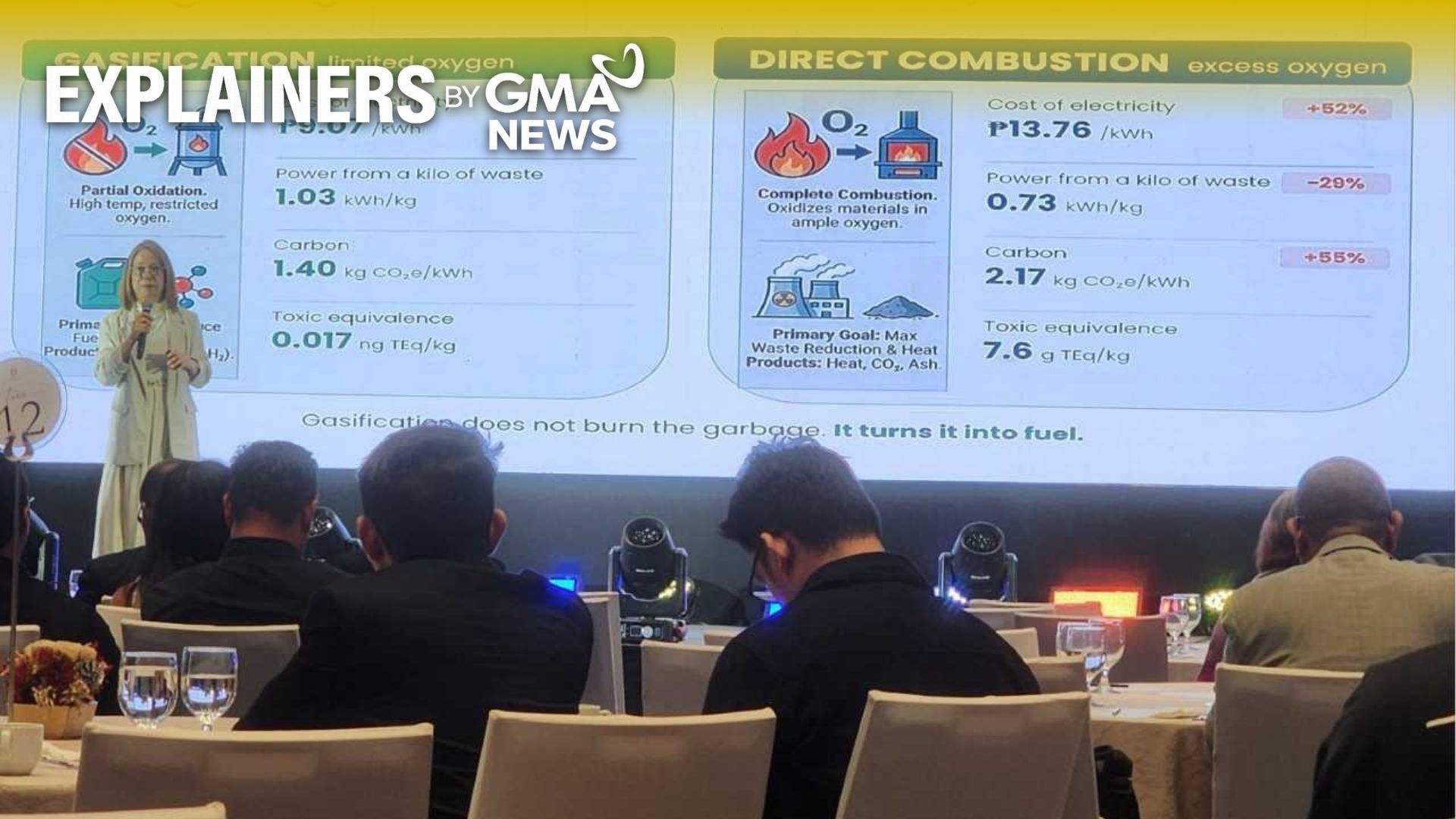
The government is exploring potential sites for waste-to-energy facilities as successive storms washed tons of garbage into parts of Metro Manila’s river system.
According to the US Energy Information Administration, waste-to-energy plants burn garbage to produce heat, which boils water to generate steam. The steam then drives a turbine connected to an electricity generator.
However, a school in Cagayan de Oro City is exploring an alternative approach that uses gasification instead of directly burning waste.
How does the technology work, and could it offer a more sustainable approach to waste management and energy generation?
Maria Theresa Cabaraban, a chemical engineer and professor at Xavier University – Ateneo de Cagayan, explained that gasification is a thermal process that converts waste into synthesis gas, or syngas, through the application of heat under controlled conditions.
The resulting gas mixture can then be burned to power a generator and produce electricity.
“Sa generator, burning in effect, but hindi na yung basura ang sinusunog. Ang sinusunog ay yung cleaner na gas,” Cabaraban said.
(There is still a burning process in the generator, but the waste itself is no longer being burned. Instead, a cleaner gas is burned.)
“Mostly hydrogen and carbon monoxide. So kung hydrogen, tubig lang yung nabubuo kapag sinusunog. Kaya it's a cleaner alternative to yung burning talaga, yung sinusunog natin yung basura,” she added.
(The gas is composed mostly of hydrogen and carbon monoxide. When hydrogen is burned, it produces water. This makes it a cleaner alternative to directly burning waste.)
SWEEP CDOC
Cabaraban leads Xavier University’s “Optimizing Urban Sustainability: Empowering Cagayan de Oro City with Smart Decision Support for Waste-to-Energy,” or SWEEP CDOC.
The research project is funded by the Department of Science and Technology – Philippine Council for Industry, Energy, and Emerging Technology Research and Development (DOST-PCIEERD).
The waste-to-energy facility began operating in February 2026, following the project’s approval in 2025.
Cabaraban said the facility primarily processes paper and plastic waste collected from the city’s municipal solid waste stream.
“We get it from the municipal solid waste in our landfill,” she said.
“Our study provides a platform na makatulong sa aming LGU to choose ano yung pinaka-appropriate na technology given yung klase ng waste na basura ng aming city,” she added.
(Our study provides a platform to help our local government unit determine the most appropriate technology based on the types and composition of waste generated in our city.)
The facility can currently generate electricity to charge mobile phones and laptops and power evaporative cooling fans and floodlights at XU.
Cabaraban said that processing seven to 10 kilograms of waste can generate five kilowatt-hours of electricity.
Based on the project’s life-cycle cost estimates, the cost of generating electricity is approximately P9 per kilowatt-hour, including initial capital investment and operating expenses.
This is lower than the electricity rate in Cagayan de Oro, which is around P16 per kilowatt-hour, she said.
Addressing gaps
While SWEEP CDOC explores an alternative approach to waste management and energy generation, Cabaraban acknowledged that several challenges remain, including how to manage the residue from gasification and how to protect the livelihoods of garbage collectors.
“Meron kaming napo-produce na char. Usually, kapag ka-agricultural waste, ang char ay pwedeng gamitin na fertilizer. Pero hindi namin ma-claim na pwede siyang gamitin sa fertilizer. Kasi nga baka meron ibang contaminants, hindi pa namin natetest yun,” Cabaraban said.
(We produce char, or a carbon-rich solid residue. When agricultural waste is processed, this material can sometimes be used as fertilizer. However, we cannot claim that ours is suitable for fertilizer because it may contain other contaminants that we have yet to test for.)
Instead, the team is studying whether the char could be used in a cooling system for the facility, which currently uses water.
Cabaraban also said the project aims to ensure that adopting waste-to-energy technology would not displace garbage collectors.
“We would like to include them (garbage collectors) into our ecosystem. So para kahit na mag-adopt ang city ng waste to energy, hindi sila mawawalan ng trabaho,” said Cabaraban, who is also a science and technology fellow at DOST-PCIEERD.
Looking ahead, Cabaraban envisions using electricity generated through gasification to power electric vehicles, potentially through partnerships with private entities. —VBL, GMA News

