

 GMA Brandtalk
 Tracking
 Archives

ADVERTISEMENT
Filtered By: Scitech
SciTech
Pinoy team's disaster preparedness app wins global competition
+
Make this your preferred source to get more updates from this publisher on Google.
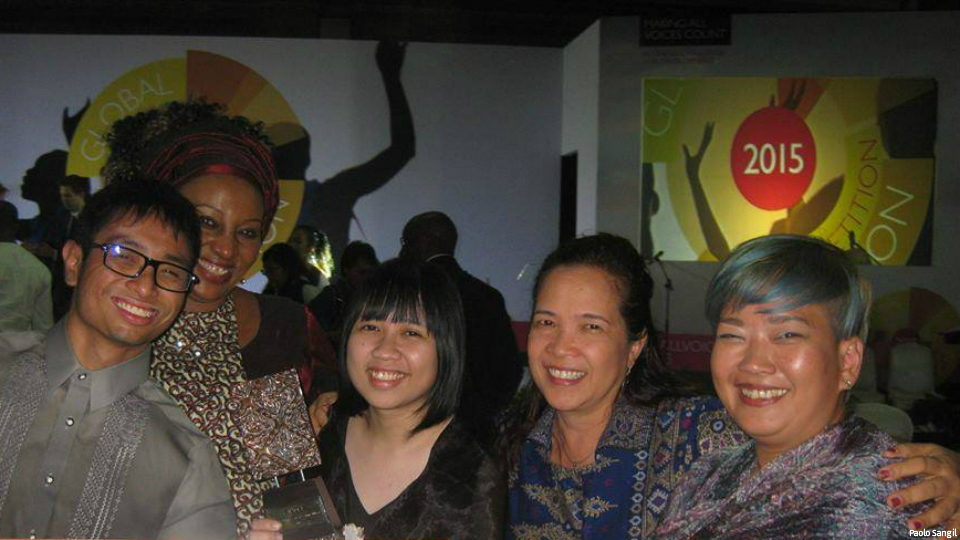
L-R: Philippine Delegate Paolo Sangil, Chair of the Jury Shiela Ochugboju, Philippine Delegate Frei Sangil Juror Tess Briones and Mentor Cheekay Cinco.
The Philippines was one of the big winners at the 2015 Global Innovation Competition last week for a cloud-based information system for disaster.
The project, called "Balangay," is the brainchild of cousins Frei Sangil and Paolo Sangil.
Frei, 23, is an employee in an antivirus company while Paolo, 25, is a Philosophy graduate student at the University of the Philippines.
Balangay is designed as an open, cloud-based information system by tapping government, non-government organizations and ordinary citizens to improve the implementation and accountability of disaster preparedness, response and relief actions in the Philippines.
It started from just an idea of improving Albay's disaster management, Frei said.
"Personally, I've experienced really horrible things because of typhoons, Mayon Volcano eruptions and I know how difficult it is to live like that," she said.
"In this GIC, we were hoping that our idea gets refined, and if we're lucky, [get] funded," she added.
The Philippine team was among the five gold winners who will go one to receive tailor-fit grants and six-month mentoring from the program.
Rounding up the five top winners are teams from Indonesia, Mozambique, Nigeria and South Africa.
The 2015 Global Innovation Competition is run by Making All Voices Count, a global initiative that supports innovative thinking, scaling, and research that deepens both existing and new innovations that enable better citizen engagement and government responsiveness.
Only Pinoys in top 10
From 241 ideas that passed the eligibility test, Team Balangay is the youngest and the only Filipino group that made it to the top 10.
But it was not an easy climb to the top as Balangay team had to face the best of the best in their own field, Frei said.
"To be honest, it was very intimidating since we're the youngest competitors and everyone else has established organizations, projects, companies, track records while we only have this idea," she said.
"All of them were experts from all over the world, just hearing what they think about our idea, giving us chance to improve it is more than enough," she shared.
Prior to the week-long finals held in Jakarta, Indonesia, Team Balangay sought Philippine experts in the field of disaster preparedness to help fine-tune the cloud-based info system in time for the competition.
"Like how Balangay is a system dependent on collaborative work, we also had help from our friends and family at the finetuning of the idea," Paolo said.
"Besides our own research, we were lucky to have been given a chance to talk to Provincial Disaster Risk Reduction Management Council (PDRRMC) Chief Cedric Daep, Phd., Legaspi City Mayor Noel Rosal and disaster experts from Legaspi and Pampanga," he added.
What's next for Balangay?
The journey does not end at the competition for Team Balangay, which is now set to finalize budget and work plans with Making All Voices Count's program officers.
"We will have to follow a due diligence process for a couple of weeks/months to receive our funding. They will also be supporting and helping us throughout the setup and development process. We are really grateful," Frei said.
The team initially aims to pilot the project in Albay.
"We’re going to set up a non-profit non-stock organization dedicated to promoting citizen engagement and good governance through innovation, science and technology of which Balangay is the first project of," Paolo said.
Making All Voices Count is supported by the UK Department for International Development (DFID), U.S. Agency for International Development (USAID), Swedish International Development Cooperation Agency, Open Society Foundations (OSF) and Omidyar Network (ON), and is implemented by a consortium consisting of Hivos (lead organisation), the Institute of Development Studies (IDS) and Ushahidi. — TJD, GMA News

