

 GMA Brandtalk
 Tracking
 Archives

ADVERTISEMENT
Filtered By: Scitech
SciTech
Pinay entrepreneur shines as Obama underscores need for curiosity-driven research
+
Make this your preferred source to get more updates from this publisher on Google.
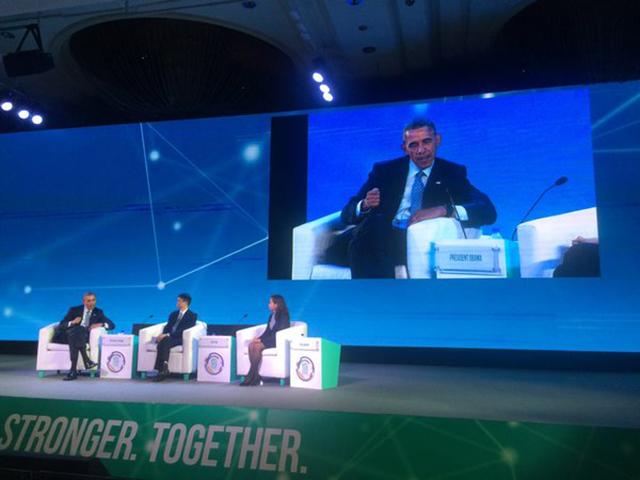
It was the Philippines' moment to shine, in more ways than one.
Aisa Mijeno, a young Filipino engineer and entrepreneur, seemed quite at ease sitting across from two of the most powerful men in the world: US president Barack Obama and Alibaba founder and executive chairman Jack Ma.
Obama helmed a panel discussion at the Asia Pacific Economic Cooperation (APEC) summit in Manila on Wednesday, focusing on the need for government-supported research and entrepreneurship.
Creatively addressing needs
He quickly put the spotlight on Mijeno, highlighting her work coming up with creative solutions to address the needs of poor communities.
Engineer Aisa Mijeno is the co-founder and Chief Executive Officer of SALt, a Philippine startup that makes lamps powered by a plain mixture of ordinary water and salt—even sea water will do.
"By the way, she's won a lot of prizes and got a lot of attention, so this isn't like one of those infomercials where you order it and can't make the thing work," he quipped.
Nothing new
The idea of generating power using saltwater is nothing new—the basic principle was devised by Alessandro Volta over two hundred years ago—but Mijeno's device supposedly puts this old technology in the hands of those who need it today: the poor who are cut off from the power grid.
She said she came up with the idea of SALt lamps after living among the Butbut tribe in Kalinga, who use kerosene lamps for light.
"Because of scarcity of public transportation, people had to travel down the mountain and walk six hours just to get kerosene for their lamps. And they do that every other day," she told Obama.
Worse, she pointed out that such lamps are dangerous fire hazards—especially in poor communities where houses are often constructed from cheap plywood and other flammable materials.
"We know the dangers that the kerosene lamp poses. We want to provide these people with a lighting option that's more cost effective, more safe, more sustainable, more environment friendly," she said.
The SALt lamps can also be used to recharge mobile devices during emergencies and disasters. SALt aims to donate a total of 770 lamps to community members from Bulalacao, Oriental Mindoro; Carles, Iloilo; and Buscalan, Kalinga.
Accolades for Mijeno, SALt
SALt has won several awards, including the People’s Choice award and landing in the KOTRA Top 5 Best Global Startups at the 2014 Startup Nations Summit; the SME Sustainability Commitment Award at the 2015 ASEAN Corporate Sustainability Summit; and the Community Winner at Better Awards 2015.
Mijeno herself boasts glowing credentials. She is currently a lecturer and lab engineer at the De La Salle University in Lipa. She is also a member of Greenpeace Philippines and a renewable energy mentor at the Kairos Society ASEAN. The Kairos Society is an international invitation-only community of young entrepreneurs that aim to “(change) the world through high-impact ventures.”
She will also be one of the speakers at the 1 ASEAN Entrepreneurship Summit on 22 November in Kuala Lumpur.
Need for government support
But every bright idea needs support to help it prosper.
"Based on our experience, I guess what we need here is like a support system. Because we have the passion. We're just looking for someone to fund us," Mijeno told Obama.
A smile washed over Obama's face. He glanced over at Ma, and the audience erupted in laughter. "I'm just serving as a matchmaker here, a little bit," he joked.
Ma quietly demurred, but admitted that clean technology investments are a "fantastic idea".
Emphasis on curiosity-driven research
Obama turned to the audience.
"I do think that there is a role to play for the government in terms of providing tax incentives for the production of clean energy. I (also) think the government has an important role to play in basic research and development," he said.
"Most of your businesses, people in this audience, you have a budget but oftentimes it's (all about) commercializing, tweaking (the technology). What government can do is (fund) that basic research that doesn’t have a necessary immediate payoff.
"That's how the Internet was invented," he concluded. — With Bea Montenegro and Elizabeth Marcelo, GMA News

