

 GMA Brandtalk
 Tracking
 Archives

From classrooms to competitions: How a science school is using AI
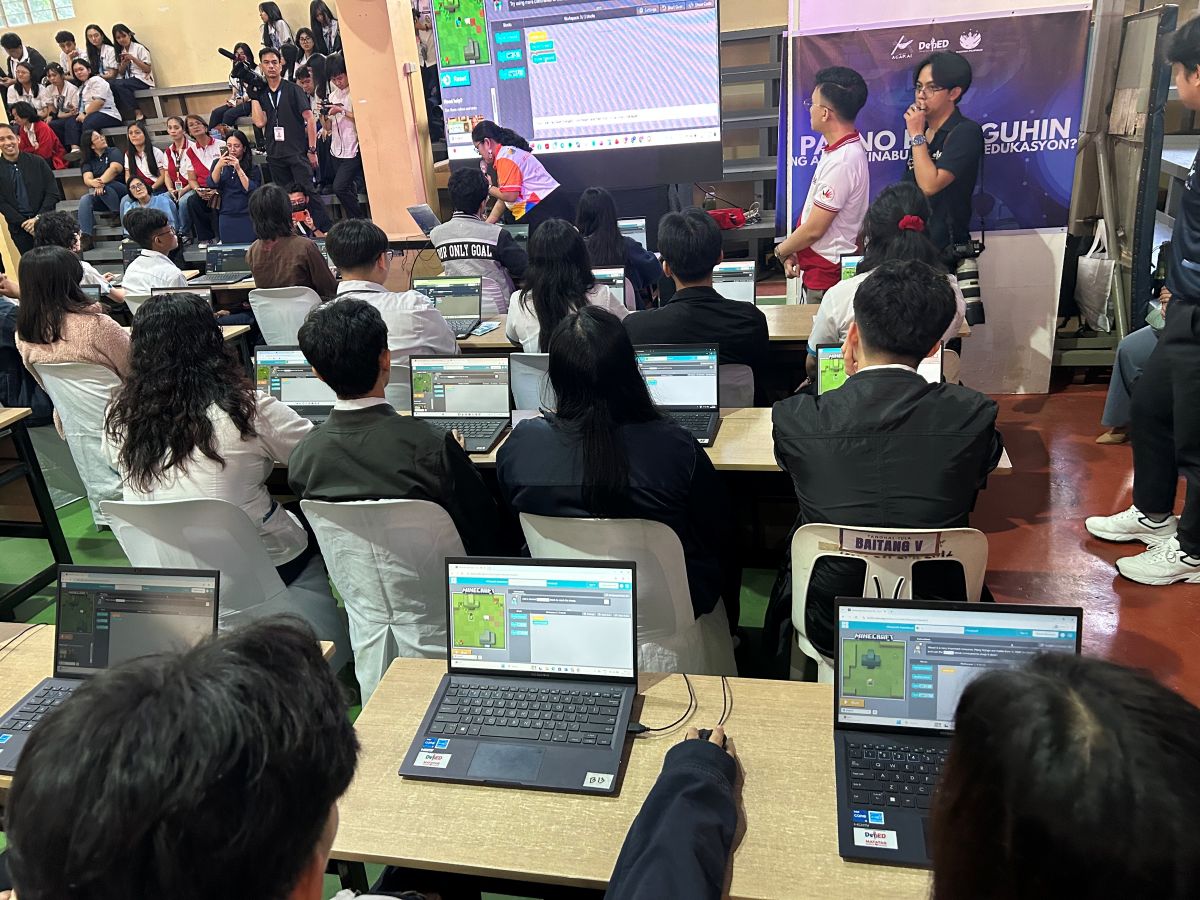
Long before the government formally rolled out Project AGAP.AI, students at a public science high school in Quezon City were already coding, researching, and competing with the help of artificial intelligence—while being taught about its limits.
At Quezon City Science High School, the regional science high school of the National Capital Region, AI is no longer treated as a future concept but as a present-day learning tool embedded across grade levels, from creative technology classes to robotics and research.
“We are the regional science high school of the National Capital Region, and Project AGAP.AI is very helpful because AI is already integrated in our curriculum,” said school principal George Emanuel Martin.
(We are the regional science high school of the NCR, and Project AGAP.AI is very helpful because AI is already part of our curriculum.)
Early exposure
Martin said students are introduced to technology-driven learning as early as junior high school, a setup showcased during the visit of President Ferdinand Marcos Jr. on Friday, January 9, for the launch of Project AGAP.AI at the school.
“Our President earlier enjoyed the class of Grade 7 since we are offering creative technology for Grade 7 and Grade 8, and they are preparing these students for robotics in Grade 9 and Grade 10,” Martin said.
(The President earlier observed and enjoyed a Grade 7 class because we offer creative technology in Grades 7 and 8, which prepares students for robotics in Grades 9 and 10.)
Marcos attended the launch with Education Secretary Sonny Angara and Quezon City Mayor Joy Belmonte, touring student booths set up outside the school gymnasium where learners showcased AI-driven projects, research outputs, and technology-based inventions developed as part of their coursework.
As AI-powered tools become more accessible, Martin stressed that ethics and responsibility are deliberately built into instruction.
“In this generation, transforming the ordinary classroom through AI-powered teaching, I would like to emphasize the proper and responsible use of AI—emphasizing the principles of ethics, transparency, and digital inclusion,” he said.
“Since our teachers act as facilitators, malaking bagay ang capacity-building for our teachers to develop their pedagogy, or their art of teaching, that will be transferred to our learners,” Martin said.
(Since our teachers act as facilitators, capacity-building is crucial so they can develop their pedagogy and pass this on to learners.)
At Quezon City Science High School, AI is used not only in class discussions but also in research and international competitions.
“As a matter of fact, our school competes internationally in terms of AI and robotics, integrating artificial intelligence because it is already part of our curriculum,” Martin said.
(Our school competes internationally in AI and robotics because artificial intelligence is already integrated into our curriculum.)
Research is a core requirement for students, spanning physical science, life science, team and individual projects, and intelligent machines that rely on AI.
“Kaya talagang gamit na gamit po ang artificial intelligence—of course, in a good way,” Martin added.
(That’s why artificial intelligence is widely used—of course, in a good way.)
'Supplementary tutor'
For students, AI learning is designed to be engaging while remaining grounded in responsibility.
Grade 12 STEM student Aedan Comiso said Minecraft-based coding activities helped simplify complex concepts.
“The Minecraft coding was very helpful because it helps us visualize the code. The system uses blocks as codes, so it’s very easy to learn, and you can see the character moving forward and backward,” Comiso said.
(The Minecraft coding helped us visualize the code. Since it uses blocks, it’s easy to learn, and you can immediately see how the character moves.)
“It’s very helpful and entertaining. It has around 15 stages—parang naglalaro ka—but it’s also very educational,” he added.
(It feels like playing a game, but it’s also educational.)
Beyond technical skills, Comiso said ethics is part of how AI is taught.
“We are also taught about AI ethics and the proper use of AI,” he said.
(We are taught about AI ethics and how to use AI properly.)
In daily life, he said, AI serves as a support tool—not a substitute for learning.
“In my daily life, I usually use AI to explain hard topics like science and math, and it also helps me organize and brainstorm ideas,” Comiso said.
(I use AI to help explain difficult topics like science and math and to organize ideas.)
“AI should only be a supplementary tutor for you,” he added.
(AI should only serve as a supplementary tutor.)
Martin said technology’s benefits depend on guidance from both schools and families, especially amid concerns about literacy and comprehension.
“Alam natin na maraming negative effects ang technology, pero doon tayo sa brighter side na makakatulong sa ating mga learners,” he said.
(We know technology has negative effects, but we focus on the brighter side—how it can help learners.)
“Kahit anong turo ng mga guro, kung walang gabay ng mga magulang sa bahay sa tamang paggamit ng teknolohiya, magkakaroon talaga ng problema,” he added.
(No matter how much teachers teach, without parental guidance at home on proper technology use, problems will arise.) —VBL, GMA Integrated News

