

 GMA Brandtalk
 Tracking
 Archives

SMS scams drop 86.6% in 2025; scammers shift to making calls —Whoscall report
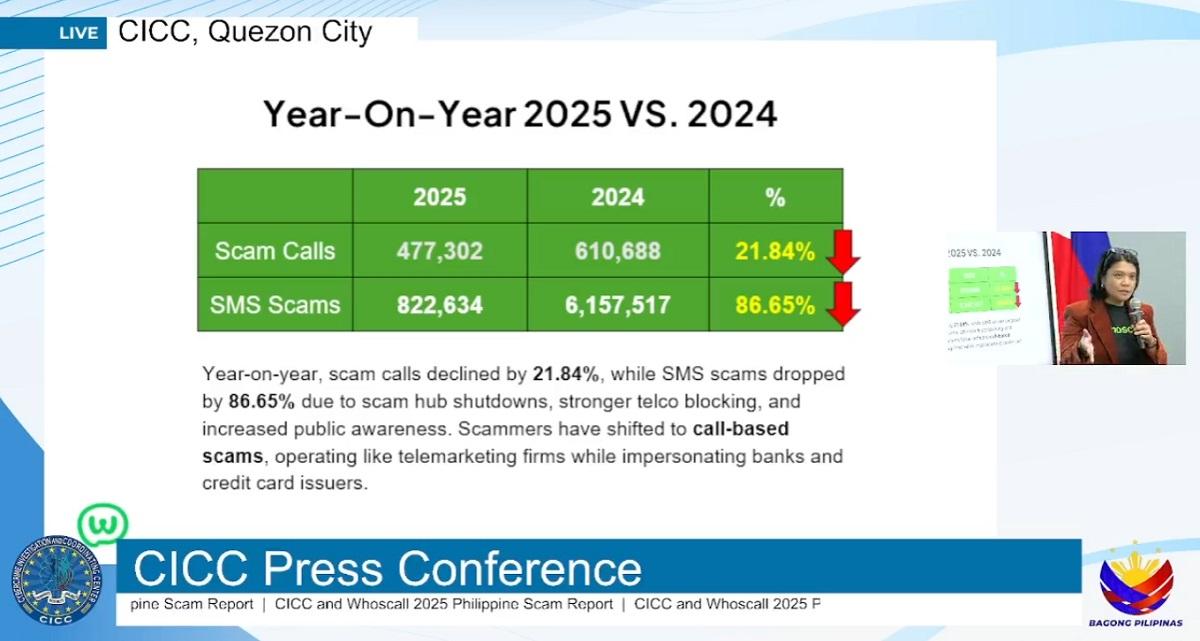
Text or short message service (SMS) scams decreased significantly by 86.6% in 2025, as scammers shifted to call-based scams by impersonating banks and credit issuers, according to a report by caller ID and anti-fraud app Whoscall.
In a press conference at the Cybercrime Investigation and Coordinating Center (CICC) in Quezon City on Thursday, Whoscall Philippines country head Mel Migriño reported that there were 822,634 SMS scam texts sent in 2025, down from 6,157,517 in 2024.
Whoscall PH attributed the decrease to scam hub shutdowns, stronger telco blocking, and increased public awareness.
“Scammers have shifted to call-based scams, operating like telemarketing firms while impersonating banks and credit card issuers,” the report said.
However, while many scammers have shifted to calls, these have also gone down by 21.84% from 610,688 in 2024 to 477,302 last year.
The reported scam calls also fell from Q3 (62,390) to Q4 (28,294).
The report also stated that the number of SMS scammers increased from Q3 (37,609) to Q4 (71,751).
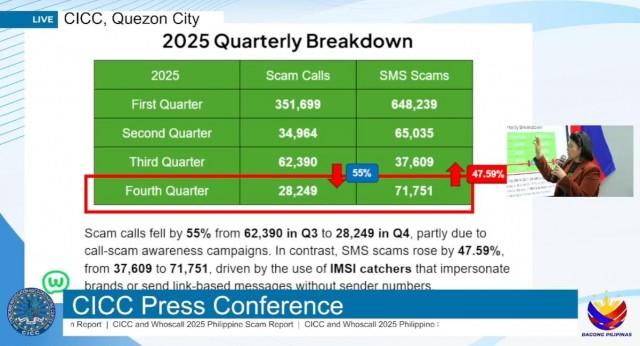
This is attributed to the use of an international mobile subscriber identity (IMSI) catcher that impersonates brands or sends link-based messages without sender numbers.
However, SMS scams had a downward trend in the three quarters of 2025.
Risky URLs
Whoscall PH also showed that risky URLs—suspicious links in the scam texts that lead to false websites if clicked on—had a steady upward trend throughout 2025, from 13,602 in Q1 to 49,431 in Q4.
“This trend indicates that phishing will dominate the scam landscape in 2026, becoming more aggressive and widespread across all digital channels, including SMS, messaging apps, email, and other online platforms,” Whoscall PH said.
"Loans and rewards" links made up 63% of the risky URLs in the fourth quarter of 2025, with 31,142 reported cases.
This was followed by:
- Collections/harassment scams: 9,936 (20.1%)
- Travel scams: 3,954 (8%)
- Others (Telemarketing Delivery Scams): 4,103 (8.3%)
- Gaming: 297 (0.6%)
Migriño also presented results from Scam Vault PH, a community-driven platform that allows users to report scams. In the period from June to December 2025, the platform received 155 reports of SMS or instant messaging scams, 188 social media scams, and 28 malicious URL or phishing link reports.
Scam Vault PH is operated by Scam Watch Pilipinas in partnership with Gogolook Philippines, the Cybercrime Investigation and Coordinating Center, and the Philippine National Police Anti-Cybercrime Group. — BM, GMA Integrated News

