

 GMA Brandtalk
 Tracking
 Archives

Advanced ube propagation techniques developed amid rising global demand
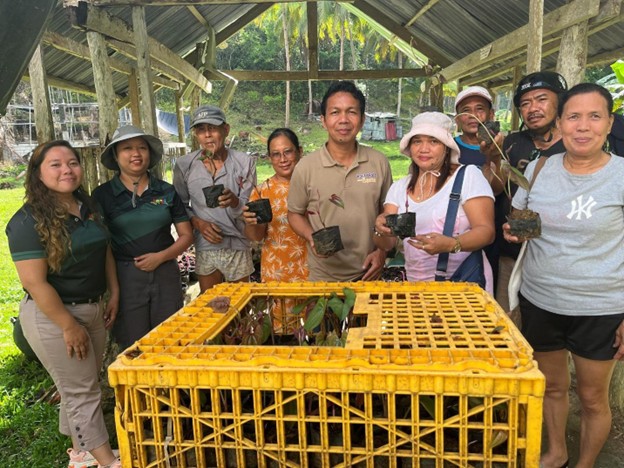
Researchers have developed an advanced technique to help farmers improve ube (purple yam) production and meet growing global demand for the root crop.
The Philippine Root Crop Research and Training Center of the Visayas State University (VSU-PhilRootcrops) and Bohol Island State University (BISU) led the development of advanced methods training for Bohol ube farmers.
The training includes the minisett method, an agricultural rapid propagation technique specifically used for yams, which involves cutting a healthy mother tuber into small pieces.
Marlon Tambis, PhilRootcrops director, explained that farmers can only make seven to ten planting materials from one kilogram of ube, which has a sweet and nutty flavor, using traditional methods for planting.
However, through the minisett propagation technique, farmers can produce more than 30 high-quality planting materials.
The process involves preparing the small ube tubers in a seedbed for germination.
Tambis said their team is crafting protocols for the tissue culture method, which could also help produce more quality planting materials.
“Tissue culture will also be a big help later because we are also reproducing it now. We haven't released it yet this year, but we target producing millions of ube planting materials next year from the tissue culture. We haven't released it yet because we are still establishing hardening protocols,” Tambis said.
He explained that hardening is a crucial step in growing tissue-cultured ube, as it determines whether the plant is ready for field transfer.
Tissue-cultured plants are produced in the laboratory under artificial conditions and undergo incubation and hardening before field transfer, Tambis said.
Dwindling production
Ube has gained fame in Europe, Australia, and the United States, with some restaurants and cafes adding it to their menus. In New York, an Ubeland food festival was held to honor ube delicacies.
However, there has been a continuous decline in local ube production.
Citing the Philippine Statistics Authority (PSA), the DOST said that the Philippines produced 14,000 metric tons of ube in 2020, a decrease of more than 50% from 30,074 metric tons in 2006.
According to the DOST, Bohol has historically produced the most ube in the Philippines, making up 35% of the nation's total output, yet difficulties still exist.
“First is the lack of planting materials. Based on our scoping studies, their production practices are really not very scientific. So, there is a low adoption of necessary recommended practices or S&T (science and technology)-based practices, which we need to address to improve the yield,” Tambis said.
His team also identified ube varieties appropriate for year-round planting since it is considered a seasonal crop.
These varieties are Baligonhon, Inoringnon, Kabus-ok, Zambal (VU2), and Ubi Kinampay, which grow in other provinces.
“So far, we have shown that we also have a breaking of dormancy and propagation protocol in months when it doesn't really grow naturally. And so far, we have demonstrated that [to farmers],” Tambis said.
Funded by the Department of Science and Technology-Philippine Council for Agriculture and Aquatic Resources Research and Development (DOST-PCAARD), the training was carried out through the project titled “Enhancement of Ubi Production through Trials and Demonstrations of S&T-Based Farm Practices to Support Industry Development in Bohol.” — VBL, GMA News

