

 GMA Brandtalk
 Tracking
 Archives

Filipino students score another podium finish in int'l space robotics contest
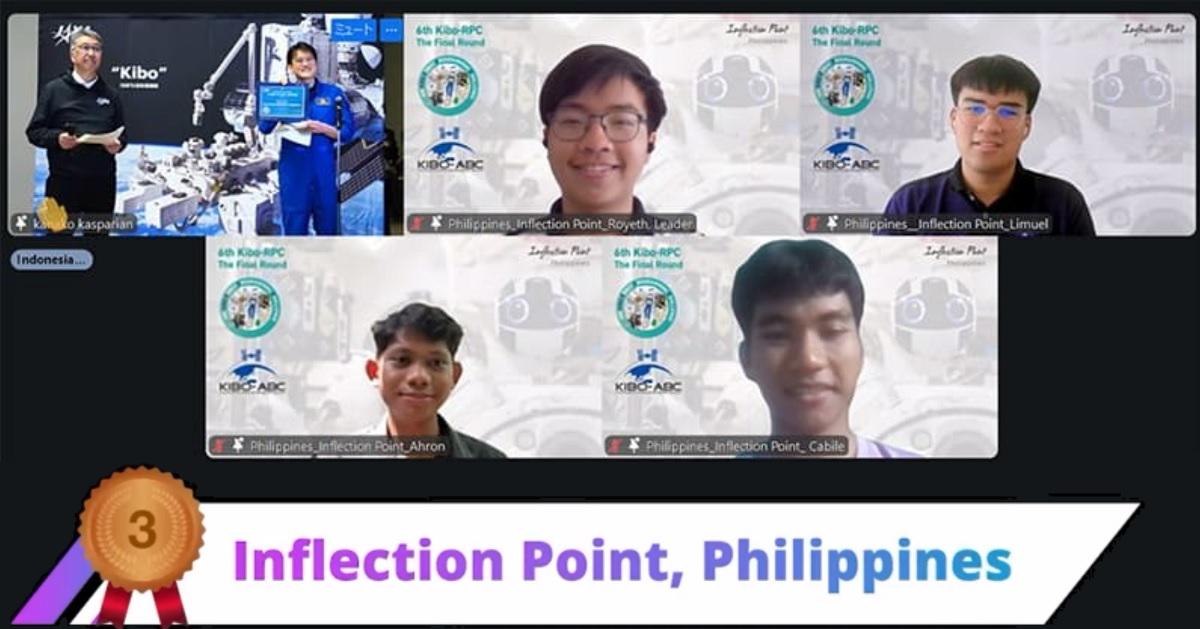
A team of aerospace engineering students from Batangas State University (BatStateU) has once again brought pride to the Philippines after securing third place in an international space robotics competition that challenged participants to program a robot aboard the International Space Station (ISS).
The Philippine Space Agency (PhilSA) announced Thursday that Team Inflection Point placed third in the final round of the sixth Kibo Robot Programming Challenge (Kibo-RPC), an international competition organized by the Japan Aerospace Exploration Agency (JAXA) in cooperation with the United States’ National Aeronautics and Space Administration (NASA).
The achievement marks the team’s second straight podium finish in the competition after placing second in 2024, when they became the first Philippine team to participate in and win at the Kibo-RPC.
Composed of third-year aerospace engineering students Howell Dela Cruz, John Royeth Samson, Ahron Martinez, Benedict Lontok, Andrew Cabile, and Amer Panganiban, Team Inflection Point represented the Philippines after emerging as the country’s top-performing team during the preliminary round, where they bested 26 other local entries.
During the finals, the students’ computer program commanded NASA’s Astrobee, a free-flying robot operating inside the Japanese “Kibo” module aboard the ISS. Teams from across the Asia-Pacific region were evaluated based on image recognition accuracy, mission completion, and speed.
According to PhilSA, the competition drew 738 teams from 37 countries and regions, including 25 participating through the United Nations Office for Outer Space Affairs’ international slot.
NASA astronaut Christopher Williams executed the teams’ programs aboard the ISS during the final round held on February 28, 2026. Team Inflection Point successfully completed four of the five assigned tasks and scored 216.8 points out of a possible 300.
Their score was just 1.6 points behind second-place finisher Team Automen of Malaysia, which scored 218.4 points. Team iTron of Taiwan topped the competition with 269.9 points.
PhilSA said one of the new features introduced this year was the “Oasis Zone,” which offered bonus points but also imposed time penalties depending on the route chosen, requiring teams to balance speed with strategy.
The Kibo-RPC is an educational program that trains students to develop software for robots operating in space. Participants program Astrobee to perform missions inside the ISS, helping them develop skills in robotics, programming, and engineering while simulating the challenges of working in a microgravity environment. Organizers said the challenge also aims to prepare the next generation of engineers who could contribute to future space missions and robotic operations.
As the Philippine member of the Kibo-ABC program, PhilSA spearheaded the local selection process for this year’s competition. The agency said the seventh Kibo Robot Programming Challenge is scheduled to open in July 2026. — Sherylin Untalan/BM, GMA News

