

 GMA Brandtalk
 Tracking
 Archives

PAGASA: AI-powered weather forecasts save lives faster, smarter
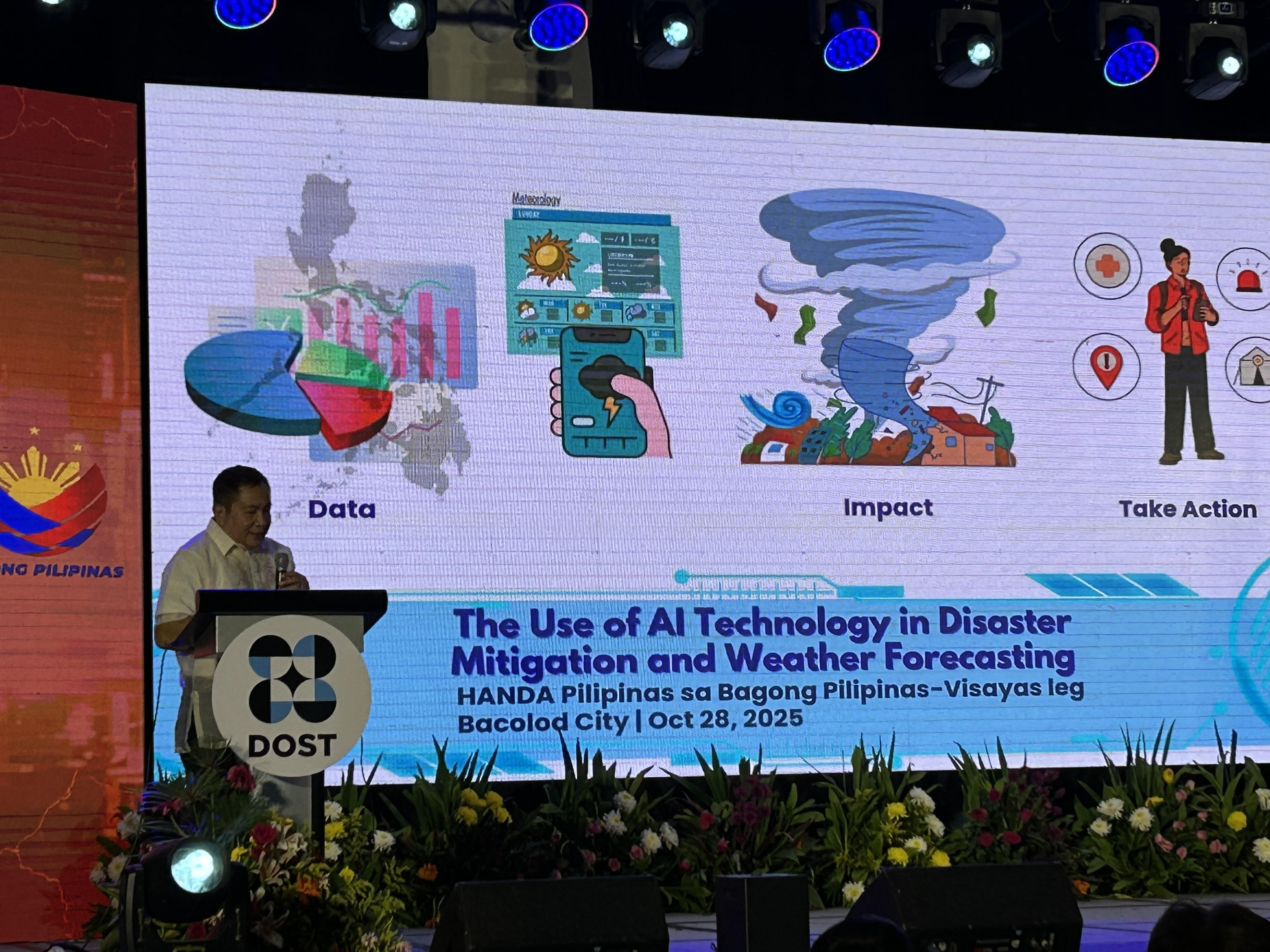
BACOLOD CITY – Although artificial intelligence and other digital innovations has vastly sharpened the science of predicting the weather, the state weather bureau is optimistic that AI won’t replace meteorologists anytime soon – and that AI remains their valuable tool for saving more lives.
At the HANDA Pilipinas 2025 Visayas Leg, Dr. Nathaniel Servando, administrator of the Philippine Atmospheric, Geophysical, and Astronomical Services Administration, emphasized AI’s key role in creating timely, reliable, impact-based weather forecasts for a country that is hit by around 20 tropical cyclones each year.
He said AI has the capacity to refine forecasting reliability and address issues that often occur in traditional forecasting.
“We in PAGASA acknowledge gaps in traditional forecasting, including uncertainty, short lead times for extreme events, like flash floods, and local scale variability weather systems that affect smaller areas. It’s difficult to predict kasi short din lang yung lead time (because the lead time is short) and of course, the duration,” Servando said.
He went on: “Artificial intelligence offers a sharper edge of refining forecasting reliability through diverse data resources including satellite, radar, ground stations, and environmental sensors.”
Even with the push to tap AI and other advanced technology in weather forecasts, Servando stressed that AI is far from taking over the duties of human meteorologists honed by years of experience.
“With these advancements, it is important to note that AI does not replace meteorology or expertise of our meteorologists. It augments them by processing vast, noisy data sets, and produces timely, interpretable guidance for decision-makers. Meaning, AI will not replace our jobs in the future,” he said.
Instead, AI is seen as refining weather forecasts and guiding decision-makers in improving evacuation timing, agricultural planning, and critical infrastructure protection, Servando said.
“We also need robust infrastructure to produce sufficient computing resources and more importantly, storage capacity, ongoing manpower for capacity building among our data users and effective strategies for introducing AI technologies to the public,” he said.
Project Gabay
He made the remarks as the state weather bureau promoted its “AI4RP: Weather Forecasting for a Resilient Philippines” during the HANDA Pilipinas 2025 Visayas leg here.
Project Gabay or the AI4RP initiative explores the use of AI systems to process weather forecasting data into insights that will enable local communities to respond to hazards faster and smarter.
“This enhancement represents our commitment not to only improve accuracy but also ensuring that information reaches those who need it, particularly the communities in forms they can understand and act upon. The project actually started in 2024 and aims to develop high resolution accurate weather forecasting model using artificial intelligence-driven atmospheric science technologies in the Philippines,” Servando explained.
The AI-based model is equipped to recognize and learn weather patterns from historical data sets and generate forecasts faster.
Like other AI systems, the model requires training, but it is self-correcting and self-improving for better accuracy and reliability.
“Through the ongoing PROJECT GABAY or AI4RP efforts, we are verifying the potential use of artificial intelligence-based weather forecasting models by increasing the horizontal resolution from three kilometers to two kilometers, extending lead time from two days to 14 days, and one of the advantages is reducing the run time from three hours to 15 minutes – meaning the AI technique doesn’t require so much computation, mabilis ang pagproduce ng outputs (it produces outputs faster),” Servando added.
However, PAGASA’s expanded use of AI in its mandate also needs the collaboration and support of the local community to ensure that the smarter forecasts save more lives and property in times of weather disturbances.
“Technology alone is not enough…. The success of our warning systems depends on partnerships, trust, and action. Collaboration with local government units, communities, and various stakeholders is very important in translating forecasts into life-saving decisions,” Servando said.
He went on: “By combining scientific rigor with practical guidance, AI can help us anticipate hazards, accelerate responses, and support communities before, during, and after events, ensuring timely actions at all levels… We invention-empowered, informed communities that can act quickly and safely. This endeavor requires all of us, researchers [and] communities, that can act quickly and safely.” — JMA, GMA Integrated News

