

 GMA Brandtalk
 Tracking
 Archives

Suzuki Cup: How the Azkals became contenders
When the draw was made for the Suzuki Cup group stage, it couldn’t have been worse for the Philippines.
The Azkals would be up against Thailand and Vietnam, the traditional big two of Southeast Asian football, as well as the top qualifier from the qualification stage. That turned out to be Myanmar, who had improved so much that by the time the tournament came around all four teams were the top four of the region’s rankings.
Group of death
Things didn’t start well for the Azkals as they went down 2-0 against Thailand in the opening forty five minutes of the campaign. Some sublime passing and movement from the Thais simply cut apart the Azkals defense, which couldn’t cope. Questions were raised about the team's aging defense.
The second half, however, showed marked improvement. Despite the rest of world believing that the Azkals didn’t have the fitness to keep up with anyone, it turned out that their conditioning was perhaps better than any other team in the group, fact that became one of the team's strengths. Of course that was no accident, their stamina the result of preparation and hard work at the training ground.
With Patrick Reichelt coming on for James Younghusband, his pace down the wing caused problems for the Thais, and his smart movement gave him room to burst down the line and center the ball for Paul Mulders to pull a goal back.
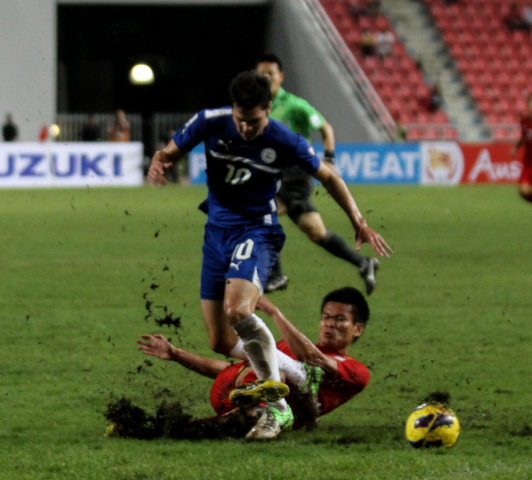
Much has since been said of Thailand’s tactics in time wasting and tackling, but judging by the football that was played, Thailand still deserved the win. To come so close may have been disappointing, but a 2-1 loss to the best country in Southeast Asia, who were also playing on home soil, isn’t such a bad result.
Rewriting history - games of two halves
The loss gave the Azkals no room for complacency in the next games though. Had they lost to Vietnam or Myanmar, there would be no repeat of their 2010 heroics, no semifinals stint, and no home game redemption for the PFF.
The first halves against Vietnam and Myanmar were almost identical. Neither team got a foothold on the game or created a clear goal-scoring opportunity.
The second halves, however, were a different story. The fitness of the Philippine squad meant they could maintain a higher tempo and get that extra half a yard, while their deep bench offered a wealth of options. The technical quality that has developed since 2010 also meant that they could create chances with some sublime movements.
Angel Guirado’s chipped through ball for Chieffy Caligdong was sublime, and Chieffy’s finish was clinical, as he gave the Philippines the win over Vietnam. Jason De Jong’s floated through ball was perfect, as was Phil Younghusband’s first touch, which opened up the space for him to run into and put the Azkals ahead against Myanmar. And Angel Guirado’s strength was such an asset, as he ran from his own half, shielding the ball against a defender the whole time, before waiting for the goalkeeper and smartly reversing the ball past him. In short, all of the Philippines’ goals were from open play and were created by them.
All four of the Azkals’ goals also came in the second half. Three of the four were scored by substitutes, and two were created by substitutes. The Philippines beat all three teams in the second half, even Thailand, as the War Elephants scored both their goals in the first half, while the Philippines scored in the second.
The Azkals’ progression under Weiss
Before the hiring of head coach Michael Weiss, the Azkals were a traditional underdog team, defending deeply and playing the long ball up top. It was a system understandable given the resources available, the development of football in the country at the time, and the expectations. It also enabled the country to take a few big scalps in the process, including the Philippines’ first ever win against Vietnam.
Since Weiss took over, the German has transformed the team from underdogs to contenders. To do that, the mentality had to change, from a team looking to upset the other, park the bus for the draw while hoping to catch a late winner, to a team looking to dominate from the start.
Weiss can be credited with much of that transition. The shift from the long ball to creating the chances with smart passing and the fitness of the players to last the ninety minutes has been the staple of his regime. His shift to the 4-2-3-1 formation and the 4-4-1-1 line-up during the Suzuki Cup were part of that, as the Azkals stacked the midfield with quality players.
This wasn’t the first time that the Azkals were drawn in a group of death either. In the Challenge Cup, the Philippines had to face the past three winners of the tournament in the group stage, before meeting Turkmenistan, the fourth best team in the competition, in the semis. For the Azkals to beat two former Challenge Cup champions and finish third overall turned more than a few heads.
Year-by-year improvement
That progress is perhaps best shown in Elo Ratings. By the end of 2011 and Weiss’ first year in charge, the Philippines were the most improved country in the world. After these recent results in the Suzuki Cup, the Philippines are the most improved country in the world for 2012 too. That kind of progress is, in short, remarkable. It may very well be the first time a country has been the most improved in back-to-back years.
That kind of progress cannot be placed entirely on luck. With sixteen wins, ten draws, and nine losses, the Azkals have won 46% of their games under Weiss, drawn 28.5% and lost 25.5%. In 2011, this included impressive victories over Nepal, over Bangladesh to assure qualification for the Challenge Cup, and over Sri Lanka in World Cup qualifying. That year, the Philippines recorded five wins, five draws, and four losses against international opponents.
2012 however, was the year that it all came together. To finish third in the Challenge Cup after being the only team to make the final stage after qualifying from both rounds of qualification was unprecedented. The country also ended it’s 99-year drought for a football trophy by winning the Peace Cup in September.
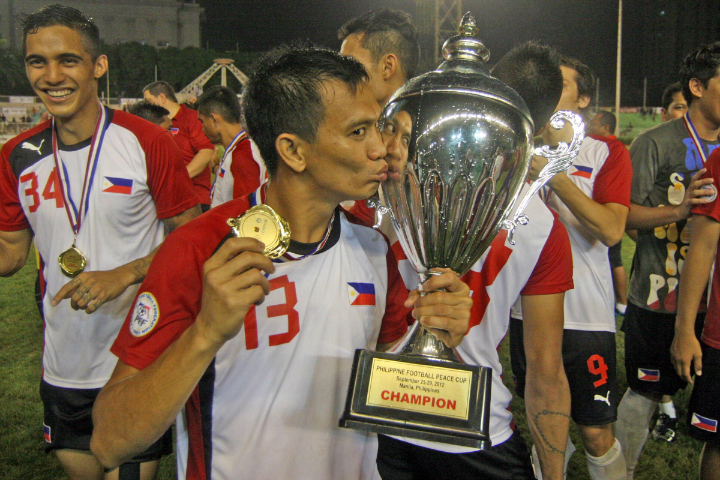
But this Suzuki Cup run is the one that gives the most hope, as it’s against the country’s biggest rivals in the region. To qualify from the group of death, with only the nation’s first-ever win over Myanmar in their thirteenth attempt, after defeating the region's top-ranked side Vietnam for only the second time, no one in Southeast Asia can consider the Philippines as rank underdogs anymore.
In 2012, the Philippines played more games than perhaps any other country. Of the 21 international matches they played, the Azkals won eleven (52%), drew five (24%) and lost five (24%). If you compare that record to the English Premier League, for example, the Philippines would be sitting in third place, challenging for the title, as only Manchester United and Manchester City would have a better ratio.
Singapore in the semis
The Philippines will now be up against Singapore in the semifinals of the Suzuki Cup. In their second stint in the Suzuki Cup semifinals, they will finally have a home game. The record looks good in recent years, especially as the Philippines beat Singapore 2-0 at the Jalan Besar Stadium and then 1-0 in Cebu, over the last few months.
However, the semifinals of a major competition is a whole different thing. Singapore has already beaten the reigning Suzuki Cup champions Malaysia 3-0, in Kuala Lumpur, so you can expect a much bigger fight.
In front of a full crowd, the team will be cheered on by their own fans this time in the semifinals, as they look to go one step further than they’ve ever been before. The Azkals have already made so much history over the last two years, but this Saturday, they will have the chance to make more. - AMD, GMA News

