

 GMA Brandtalk
 Tracking
 Archives

Numerophilia: San Mig Coffee's postseason awakening
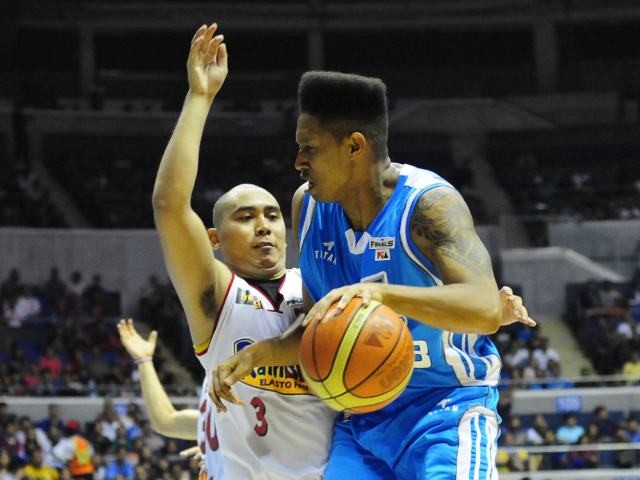
When the Philippine Cup elimination round ended, the focus wasn’t on San Mig Coffee at all. They had labored through a conference battling injuries to several key players early in the conference (PJ Simon, Joe Devance), resulting in a 1-5 record that had them backed them into a corner. Not that they were in unfamiliar territory; they’ve plowed through an entire PBA season (2012-13) with starting records of 2-2, 1-3 and 1-3, but 1-5 is a different thing.
The Mixers maintained their idea as a defense-first team (93.6 points per 100 possessions in their first six games, 2.4 points above average at that time) but their offense – missing several important cogs – sputtered to the tune of a league-worst 86.9 points per 100 possessions – 9.0 points below average.
However, it was déjà vu when the team started getting healthy and resumed clicking. SMC won six of their last eight games, and rode a four-win streak into the quarterfinals. This has become common for the Mixers, who feel more like diesel than coffee – they start out really cold, then slowly reach maximum output, given enough time.
Over that eight-game stretch, San Mig Coffee returned to its roots – a solid to strong defense (+2 above average) and an offense that’s just enough to make the defense stand out. For a group that’s been together for so long, getting re-acclimated was never the problem. It was always about whether health would allow them to find success in the playoffs.
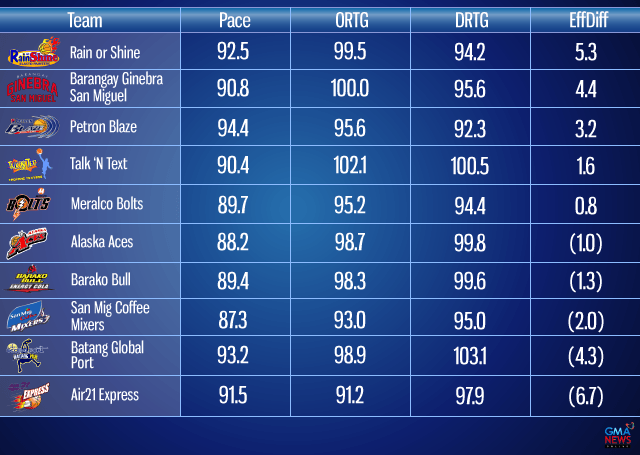
The San Mig Coffee Mixers had woeful numbers following the elimination round.
This year though was different. With a postseason field that included Barangay Ginebra, the Petron Blaze Boosters, the Rain or Shine Elasto Painters and the Talk ’N Text Tropang Texters, the opposition was tougher. The numbers said that those four squads had better differentials, usually a reliable indicator of postseason strength, than the Mixers’. In fact, the Mixers even finished the elimination round with a negative differential. That however turned out to be fool’s gold. As said, diesel gets better as the engine heats it up. When the chips were down, the Mixers played on par, if not better, than the teams above them.
Read how the Elasto Painters and the Mixers contrasted come the Finals:
The turtle and the rabbit - RoS versus SMC in the Finals
It’s always been the case that the team that executes their gameplan will get the upper hand. This becomes more evident when two teams that are complete contrasts meet.
On one side, the Tim Cone-led San Mig Coffee Mixers are a turtle-speed, defense-first team. They’ve always been at or near the bottom in terms of pace (85.8 possessions per 48 minutes in the PHL Cup). By funneling you to help defenders, the Mixers force opponents into tough shots or turnovers. They understand that they’re a weak offensive rebounding team, so instead of trying to win possession battles in the air (rebounds), they’ll try to win battles on the ground (turnovers) and generate easy scoring opportunities.

The great thing about Tim Cone’s strategy is that it’ll grind opponents down. On defense, one will be hard-pressed to find an open shot when the team can’t even get into sets, thanks to Mark Barocca and Justin Melton hounding the ball handler from the inbounds pass. That’s an invaluable asset that gives the defense some cushion by reducing the time a team can use to get into their sets, thus reducing the amount of time the defense has to work.
When their opponent does get into their sets, they’ll likely be stymied by the Mixers’ speed and tenacity. No one doubts Pingris and Barocca, but Rafi Reavis, Ian Sangalang and Melton all played huge minutes for the Mixers down the stretch. Offensively, the Mixers might not have the same punch as a Talk ‘N Text or Globalport, but they know how to move and they’ll work to find an open shot.
In some small way, playing offense for them isn’t just about scoring the most points in the fewest possessions. Sometimes, it’s also about making your defense better by tiring your opponents out and preventing fastbreaks. San Mig Coffee always ranks among the lowest in terms of fastbreaks attempted against them. In this past conference, they gave up the fourth fewest in the eliminations round and third fewest in the playoffs.
Much has been said about Rain or Shine’s share-the-wealth, run-and-gun style. They’re fiery, persistent and always pushing the ball up the court. They rank among the league’s fastest teams (third highest pace, averaging 92.5 possessions per 48 minutes) and are the third-best offensive team and the second-highest in terms of fastbreak points scored. If they can’t get points off run outs, they’ll use their size and their versatility to shred you to pieces. They have bigs who can consistently hit from outside, and guards that can post up and work the ball screens, resulting in mismatches.

The Finals were played at San Mig Coffee’s pace – 85.5 possessions per 48. And what was once an efficient offensive attack from Rain or Shine became nothing more than ordinary against the Mixers (95 points per 100).
People will always remember the points and the highlights, the and-one’s and the long bombs (and of course the infamous walkout). But really, SMC’s best plays weren’t the timely baskets made by Barocca, Yap or Simon. It was the fact that they made the extraordinary into ordinary. With the exception of the Ginebra series (where they had a hard time containing Ginebra’s inside-out attack), the Mixers were a grind-it-out, muck-it-up team that was able to win the crown even against the best offensive teams.
As they say, offense may win you games, but defense wins championships. - AMD, GMA News
Nico Baguio holds a Masters Degree in Mathematics from the Ateneo de Manila University. He's currently a writer for SBNation's The Bird Writes and runs a website that focuses on using advanced statistics on the local hoops scene, HumbleBola. You can email him at contact@humblebola.com and also follow him on Twitter.

