It was like September 2009 all over again, that unforgettable disaster when tropical storm Ondoy (Ketsana) dumped a record amount of rainfall in Luzon and left more than 400 people dead in its flooded wake, many of them in low-lying areas of the Marikina Valley. But last week, when a similar catastrophe inundated many parts of Metro Manila and nearby areas, the residents of Marikina knew better, thanks to the lessons from Ondoy.
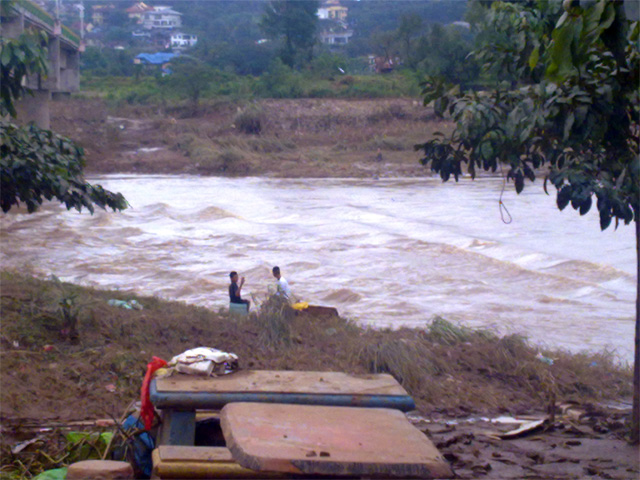
The strong current from the Marikina River creates waves at the Tumana river, a testament to what residents of Barangay Tumana and their communities had to endure during the torrential rains.
As soon as the city's sirens rang out last August 7, and the water started creeping towards their riverside community, 44-year-old Margie Manuel and her husband Omar scrambled with their children to the nearby church. The four-story building in Barangay Tumana, one of the hardest hit communities in the floods, would be their refuge for the next few days. Because of the pre-emptive evacuation of residents in vulnerable areas, there were no deaths in Marikina this time around, says Julie Borje, head of the city's Manpower Development Training Office. In contrast, 35 Marikina residents were among the 53 bodies found within the city -- some had been washed down from neighboring Rizal province -- when Ondoy struck in 2009. "Most certainly, nakatulong si Ondoy kasi mas nasanay na kaming basahin ang bagsak ng ulan," says Borje. "Pre-emptive evacuation included not only those affected by flooding, but also those people in areas where there is a possibility they would later be affected by flooding. So ngayon, nasa binti pa lang, lumilikas na iyong iba." She said about half of the residents were brought to evacuation centers before the Marikina River swelled to alarming levels. Unlike Ondoy, which dumped a month's worth of rain in six hours and caught many people by surprise, Borje says people had more time to flee this time around due to the more gradual increase in the water level in low-lying areas. "Iyong ragasa ng tubig nitong bagyo ay hindi katulad nung sa Ondoy na flashflood, kung saan malaking population sa vulnerable areas ay unaware. At least now, we had a chance to move out people in those areas," she said.
Camote patch in Tumana Margie says they did not want a repeat of Ondoy when, without warning, the river quickly swelled and they had no time to seek higher ground. The flash flood forced them to climb up the roof of their makeshift shanty in Tumana and wait things out, without food for days, while waiting for the floodwaters to recede. This is what it’s like at the Tumana River, one of the tributaries of the Marikina River, Margie tells GMA News Online: on their side, which is lower than the opposite riverbank, heavy rainfall can easily swallow everything along its path, including the family’s only livelihood - a humble camote patch on the riverside. The city of Marikina - with a population of almost half a million - sits quietly on a valley between the mountains of Sierra Madre and Quezon City. But whenever there’s heavy rainfall, the waters rush down from the mountains of neighboring Rizal province and into the Marikina River, then on to the Pasig River before draining out to Manila Bay. In the 1980s, the Manggahan floodway was built to divert some of the water directly into Laguna Bay, but informal settlers along its banks have clogged the waterway. "Nagtatanim lang naman kami ng gulay. Eh ayun, inabot din ng tubig so wala din. Baka sa November pa kami makakapagtanim niyan, kapag mas siguardo nang wala nang baha," says a frustrated Margie as she looked at her submerged vegetable garden, from which she used to pick camote tops that she sold at the market. When the waters finally receded, Margie knew what to expect: flotsam and debris left by the floods, shattered wooden walls and roofs, piles upon piles of garbage, thick mud invading their homes, and shanties brought down to the ground - a scene not so different from the sight that greeted her after Ondoy.

With barely any rest, local authorities get back to business once more - shifting from rescue operations to clearing operations to clean up the mess left by the monsoon rains.
Evacuees more cooperative What changed this time, however, is the newfound instinct of Margie and other residents to immediately run for safety, knowing that their lives are more important than any of their possessions. Local government officials made the same observation, saying the residents' willingness to cooperate with the government this time around was palpable. “Now, everything is under control. From the Ondoy experience, medyo takot na ang mga tao, mas madali na silang pakiusapan ngayon na lumikas palayo sa bahay nila,” said Beth Novio from the city government's Manpower Development Training Office, who helped take emergency calls and coordinate with rescue teams.
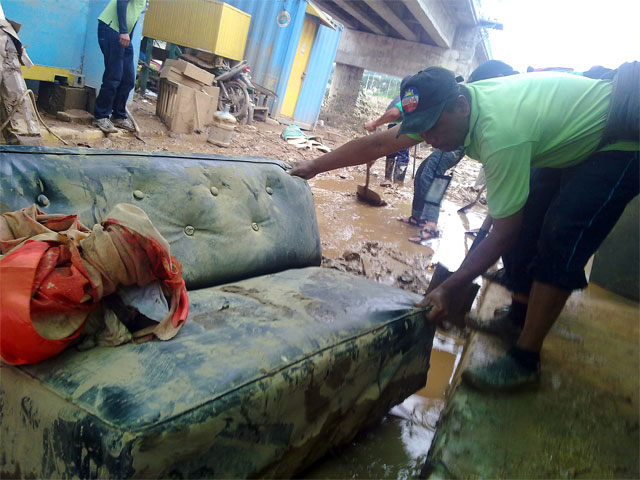
Nothing is spared by the swollen Marikina River, even this sofa that had to be pulled out of the house and left to dry under the sun, which, unfortunately, did not come out for several days last week.
The torrential monsoon rains that soaked Metro Manila and surrounding provinces last week drove almost 50,000 Marikeños out of their homes and into 22 public schools-turned-evacuations centers, as well as gymnasiums, and churches. Day Two of the monsoon rains, last Wednesday, found local rescuers scouring vulnerable communities like the wealthy Provident Village near Marikina's city center for trapped families. During Ondoy's rampage in 2009, the subdivision made headlines when photos of its multiple-story houses almost completely engulfed by the Marikina River and bodies found lying on the muddied streets emerged. Geologists have warned that Provident Village, like many areas in Marikina, sits on a floodplain and is not suitable for human habitation because it serves as a catch basin for heavy rainfall. But residents like Ronald Ramirez, who experienced Ondoy’s nightmare, are bent on staying on despite a repeat of Ondoy’s destructive floods in last week’s monsoon rains. “I love Marikina Provident and I want to go back," Ramirez, a sales agent, told GMA News Online. Instead of moving out, many homeowners and their hired workers simply tidied up the place when the floods subsided. Shovels, mops, water hoses, and rags in hand, they were ready to start all over again. "Oy! Tuluy-tuloy lang! Wala munang chismisan," one homeowner, shirtless and muddied, chuckled as he scooped up thick mud from their front yard using an improvised wooden rake.
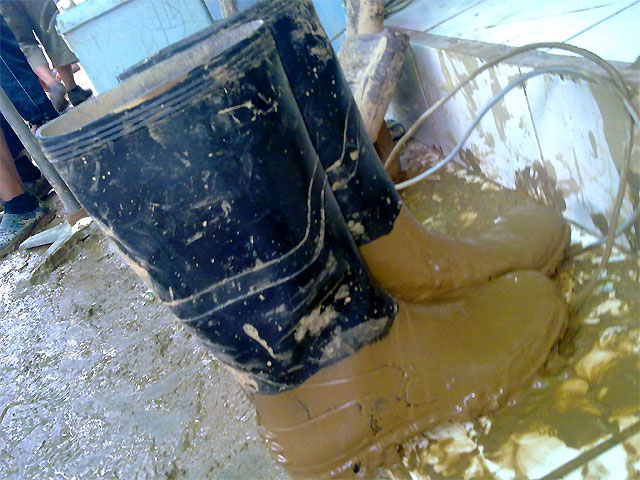
These boots were made... for wading in thick muck and for navigating the flooded streets of Marikina, the country's footwear capital.
Ondoy more treacherous While both Tumana and Provident Village suffered the same destructive floods from last week’s monsoon rains and Ondoy, some residents say Ondoy was much more treacherous. "Mas matindi pa rin iyong Ondoy. Naanod talaga dati ang bahay namin. Mabilis kasi ang pagtakbo ng tubig noon. Wala lahat ito, wash-out lahat iyan," says Margie of Tumana. "Hindi kami nakapaghanda noong Ondoy. Hindi kami nakaaalis. Paano kami makakaalis noon, eh naandiyan ang tubig,” said Margie, pointing to her ankles. “Maya-maya nandito na,” she adds, pointing to her waist, then her head: “Maya-maya, andito na. Ang bilis!" Yolita Catican, 60 years old, who lives not too far from Margie's shanty, agreed that Ondoy was more frightening. Just the same, the monsoon rains brought them almost the same kind of headaches: two of her neighbor's children just got out of the hospital after getting struck by dengue at the height of the flooding. Making things worse, Yolita says, is that disaster assistance has yet to reach their community. "Mas maganda na ang baha, basta may pagkain," she said while briskly pumping water out of a well.
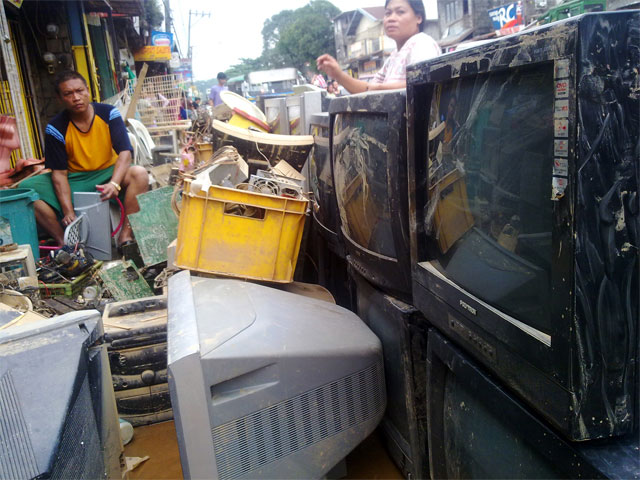
Resourceful residents attempt to turn garbage into cash, one of them trying to salvage electronic parts from soaked television sets and computer monitors.
White cloth for Ramadan Amer Makaurum, an imam at Tumana's Muslim community, wants something more important for their mosque than relief goods. "Puting tela. Kahit pitong rolyo lang ng puting tela para sa aming moske," Makaurum repeatedly tells GMA News Online, while calmly seated outside their mosque along Singkamas-Kanan Street. Like the rest of the Muslim world, the mosque in Tumana will be observing Laylat al-Qadr next week, then Eid-al-Fitr the week after that – rituals where the rolls of white linen cloth are most needed – as part of the holy month of Ramadan. Maurum's simple plea and Margie's resilience show that despite the deluge, the floods have failed to dampen their spirits and deep spirituality. In fact, the next time another deluge of similar magnitude hits their community, Margie knows exactly what to do. "Kapag bumaha pa uli, eh di takbo na naman kami!” she says. “God will provide. Hindi naman tayo pababayaan ng Panginoon. Habang may buhay, mas importante ang buhay na mailigtas.”
– YA, GMA News 

 GMA Brandtalk
 Tracking
 Archives


