

 GMA Brandtalk
 Tracking
 Archives

'Very unhealthy' air logged in parts of Visayas amid Indonesia haze on Friday
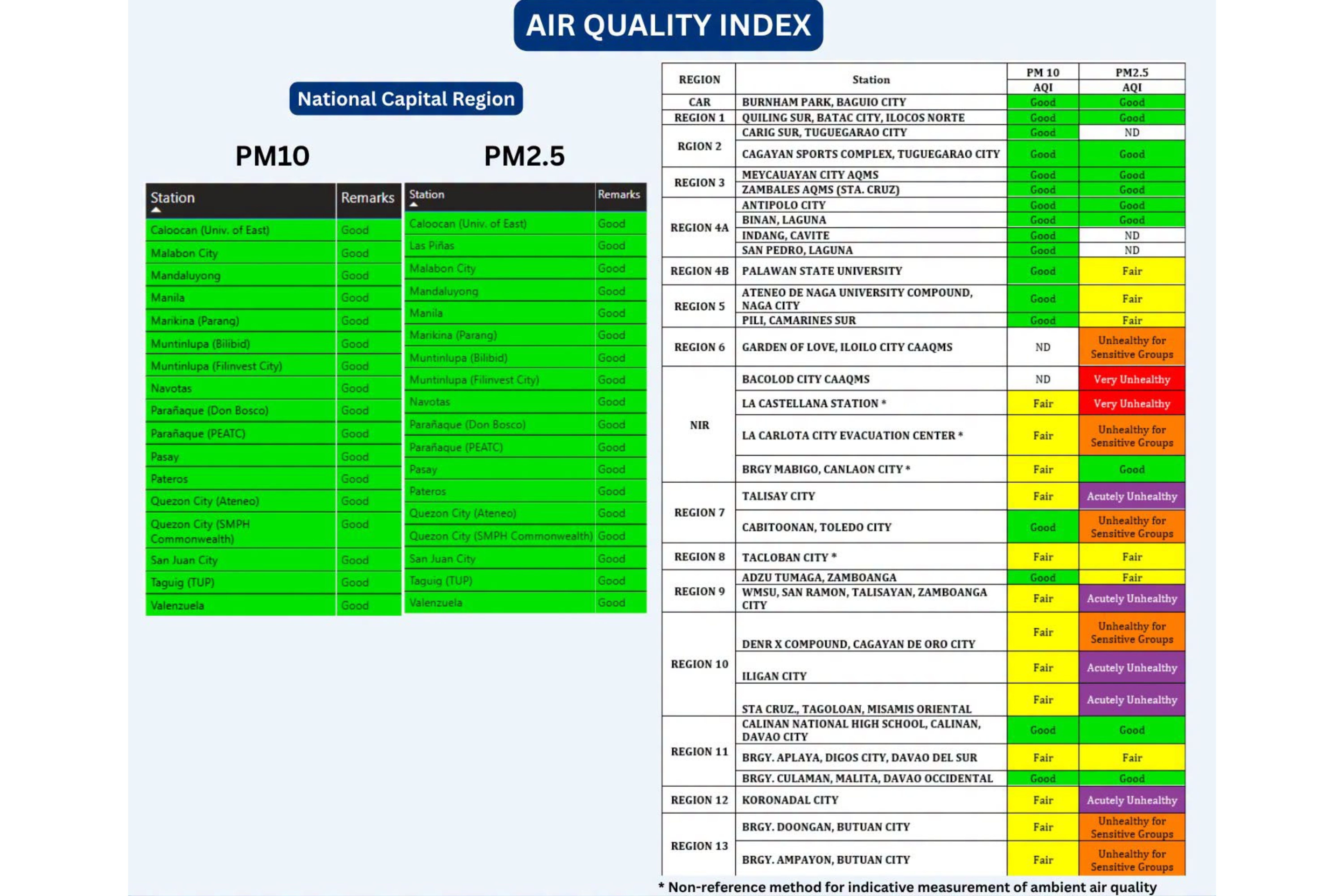
Amid haze originating from Indonesia, parts of the Visayas and Mindanao recorded high concentrations of fine particulate matter 2.5 (PM 2.5), with "very unhealthy" and "acutely unhealthy" air quality logged on Friday morning, September 4, 2026.
According to the latest monitoring report from the Department of Environment and Natural Resources – Environmental Management Bureau (DENR-EMB) as of 8:00 a.m., "very unhealthy" air quality was recorded at two monitoring stations in the Negros Island Region:
- Bacolod City CAAQMS
- La Castellana Station
In areas flagged with "very unhealthy" air, pedestrians are advised to avoid heavy traffic zones. Individuals with heart or respiratory conditions, such as asthma, should stay indoors, rest, postpone non-essential trips, and voluntarily limit motor vehicle use.
Meanwhile, “acutely unhealthy” air quality was recorded in the following areas with their respective AQI:
- Talisay City
- WMSU, San Ramon, Talisayan, Zamboanga City
- Iligan City
- Sta. Cruz, Tagoloan, Misamis Oriental
- Koronadal City
In areas with "acutely unhealthy" air, the general public is advised to limit outdoor physical exertion, while individuals with heart or respiratory diseases should stay indoors and rest. Non-essential travel should be postponed, vehicle use restricted, and industrial operations may be curtailed.
Air quality rated as "unhealthy for sensitive groups" was also logged at several monitoring stations across the Visayas and Mindanao:
- Garden of Love, Iloilo City CAAQMS
- La Carlota City Evacuation Center
- Cabitoonan, Toledo City
- DENR X Compound, Cagayan De Oro City
- Brgy. Doongan, Butuan City
- Brgy. Ampayon, Butuan City
People with respiratory conditions, such as asthma, in these areas are advised to limit outdoor exertion.
The US Environmental Protection Agency (EPA) said PM2.5 is a fine inhalable particle with diameters of about 2.5 micrometers or smaller. It is 30 times smaller than the average human hair, which is about 70 micrometers in diameter.
PM2.5 is either directly emitted from sources like roads, fields, and smokestacks, or formed in the atmosphere through chemical reactions involving pollutants from vehicles, power plants, and industrial facilities.
The US EPA notes that while particles under 10 micrometers can penetrate deep into the lungs—and even enter the bloodstream—smaller particles like PM 2.5 pose the greatest overall risk to health.
Local government units earlier advised residents to wear face masks and to lessen or avoid outdoor activities.
The DENR-EMB previously explained that the haze affecting parts of the country consists of smoke generated by forest fires in Kalimantan, Indonesia, which is being carried over by the Southwest Monsoon (Habagat). —VAL, GMA News

