

 GMA Brandtalk
 Tracking
 Archives

Prosecution warns against acquittal by default if absent senators allowed to vote
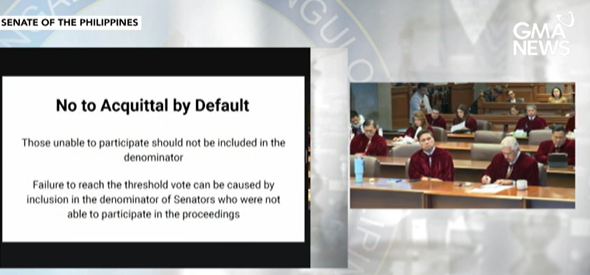
The House prosecution panel on Wednesday argued that the conviction of Vice President Sara Duterte should be based on two-thirds of all members of the Senate who are present in the proceedings, saying that including absent senators could result in acquittal by default.
House prosecutor and Akbayan Representative Chel Diokno made the argument during Day 29 of the impeachment trial of the Vice President, noting that lowering the base number of all 24 senators will reduce both the numbers needed to convict and the numbers needed to acquit.
“A situation na may senador na hindi nakapag-oath for whatever reason o kaya illegally prevented from performing a senator's job…lahat nakakulong at suspended sa katungkulan dahil sa utos ng batas. Each of them cannot hear the evidence, deliberate, and vote. Their inability to participate is beyond dispute. And yet, if the denominator is fixed at 24, conviction would always require 16 votes. Absurd po ito,” Diokno said.
(There’s a situation that a senator fails to take oath as a senator-judge or illegally prevented from performing his job…a situation when senators are all detained, suspended, due to lawful orders. It would be absurd to include them.)
“Yes, the Constitution deliberately makes conviction harder by imposing the two-thirds requirement. But making it harder is not the same as making it depend on senators who are not judges or who are incapable of acting as judges. That would be tantamount to an acquittal by default, a failure to arrive at the threshold number caused not by the judgment of the incapacitated senators, but by their mere inclusion in the denominator,” Diokno added.
Article 11, Section 3 of the Constitution provides that “no [impeachable] person shall be convicted without the concurrence of two-thirds of all the members of the Senate.”
Duterte’s defense team presented their arguments next.
Both panels were given 15 minutes each.
This stemmed from Senator-judge Erwin Tulfo’s motion for reconsideration against Presiding Officer Chiz Escudero's ruling that the base vote to convict an impeached official is all 24 senators.
The 1987 Constitution states that "no person shall be convicted without the concurrence of two-thirds of all the Members of the Senate."
Senators Jinggoy Estrada and Rodante Marcoleta are detained on plunder and other related charges due to their alleged involvement in flood control and undeclared campaign donations, respectively.
Senator Ronald dela Rosa, on the other hand, is nowhere to be found amid a standing warrant of arrest issued against him by the International Criminal Court due to his alleged involvement in the drug war deaths.
Senator Loren Legarda, for her part, is on an extended medical leave abroad due to a lung ailment.
Last week, the impeachment court invited retired Supreme Court Chief Justices Artemio Panganiban, Reynato Puno, and Hilario Davide Jr. and Associate Justice Adolfo Azcuna as amici curiae or friends of the court.
Panganiban, Puno, and Davide said that the voting threshold should be based on the number of senator-judges who actively participated in the impeachment trial.
They said that 16 is not the threshold, given that the Constitution states a fraction, not a number, in determining the threshold for conviction. Likewise, the three said that allowing those absent to vote will be unfair, if not an injustice, to the Filipino people since an impartial judge needs to evaluate the evidence for them to be able to make a sound judgment.
However, Azcuna, one of the framers of the 1987 Constitution, offered a different view that the two-thirds concurrence requirement should relate to the entire membership of the Senate; hence, a conviction by 16 senator-judges is needed.
While Azcuna was the lone dissenter in changing the threshold, all the amici curiae agreed that the Senate impeachment court has the authority to determine the voting threshold needed for conviction because the Constitution provides that the Senate has the sole power to try and decide impeachment cases. —AOL, GMA News

