We use cookies to ensure you get the best browsing experience. By continued use, you agree to our privacy policy and accept our use of such cookies. For further information, click FIND OUT MORE.
Make this your preferred source to get more updates from this publisher on Google.
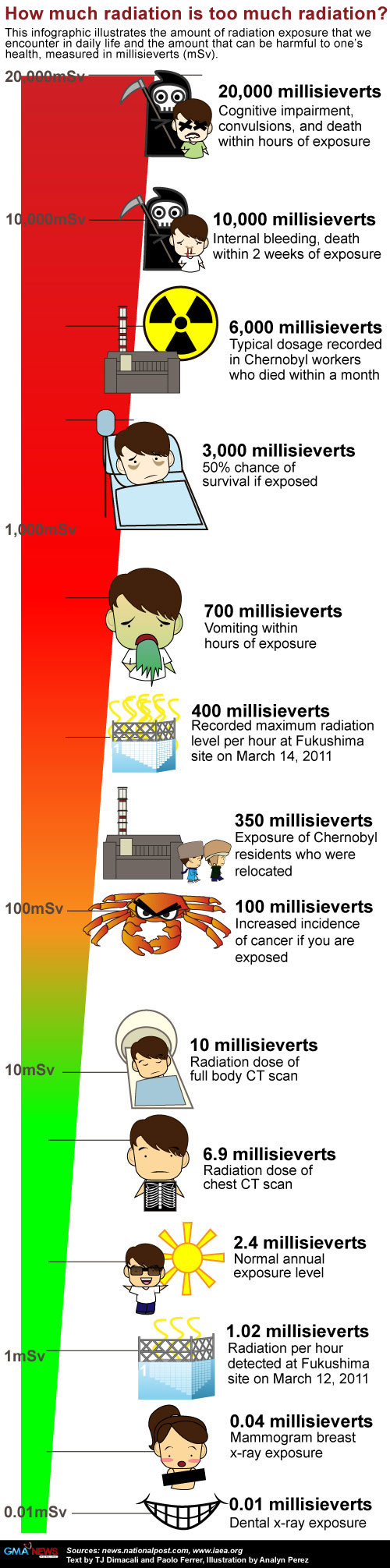
Click here for larger version The Japan earthquake and tsunami damaged many structures, including the Tokyo Electric Power Company’s nuclear power facility in Fukushima Prefecture on the coast of northeastern Japan. In particular, the cooling facilities of Fukushima Daiichi nuclear reactors 1-4 have been damaged, making it difficult to close down the facilities entirely. Rumors quickly spread that the nuclear radiation leaking from these reactors would reach the Philippines, where a spurious text message on Monday, March 14, sowed panic and confusion on the matter. GMA News Online has created this document to answer some frequently asked questions and quell unfounded fears about the events currently unfolding in Fukushima, Japan. What is radiation? Radiation is energy given off by matter in the form of rays or high-speed particles. There are many kinds of radiation and not all of them are dangerous. Heat and light are actually types of radiation that humans can see and feel. However, there are other types that we can’t detect. One of these is particle or “nuclear" radiation, which is used in nuclear power plants. What is ionizing radiation? Nuclear radiation is a type of ionizing radiation, which is invisible and passes through matter. We use ionizing radiation like x-rays and gamma rays all the time for medical purposes. However, large doses of ionizing radiation passing through living tissue can affect natural biological processes. Exposure to large doses can be harmful to one’s health. The effect of radiation exposure is dependent on three factors:


 GMA Brandtalk
 Tracking
 Archives