The year 2011 has been a year of devastating "storms," not only because of deadly cyclones like "Sendong", but also because of the turmoil in the political arena. In this year’s tumultuous political climate, the House of Representatives launched two of the most explosive disturbances to hit the country's legal institutions. Its latest political move came like a swift, strong gale. For the first time in the country’s history, the lower chamber impeached the head of the judiciary: Chief Justice Renato Corona. What made the move even more noteworthy is the fact that it was accomplished in less than a day, five hours to be exact.
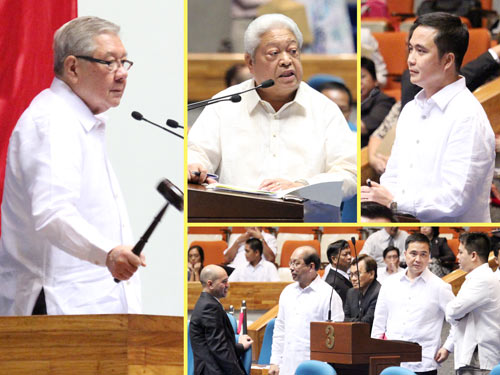
The House of Representatives made history this year by impeaching two officials appointed during the past administration: former Ombudsman Merceditas Gutierrez and Chief Justice Renato Corona. Photo taken from www.congress.gov.ph
A total of 188 administration allies literally lined up in a caucus to sign the complaint aimed at
toppling Corona from his post, based on allegations of betrayal of public trust, culpable violation of the Constitution, graft, and corruption. House Speaker Feliciano Belmonte Jr. himself admitted that he and his colleagues took the turbulent path when they decided to impeach Corona last December 12. However, he justified the move by calling it an exercise of the chamber’s exclusive power to hold top government officials accountable for their actions. “Undoubtedly, we are navigating a stormy sea in our voyage towards rebuilding our nation and our institutions. Overcoming this tempest requires from each of us a mature and disciplined engagement, for us to canalize our differences in affiliation and ideology within the means and processes provided for in the Constitution,” he said in his adjournment message delivered two days after the House impeached Corona.
Ombudsman's impeachment This was not the first time this year that the House rocked the country’s political scene through an
impeachment proceeding. Last March, then Ombudsman Merceditas Gutierrez also found herself in the eye of a storm when the chamber, in an overwhelming 212-46 vote with four abstentions, voted to impeach her for allegedly sitting on high-profile cases involving the past administration. However, Gutierrez’s trial was aborted when she decided to
resign a few days before she was scheduled to face the Senate impeachment court. The targets of the House’s two historical impeachment moves this year had one thing in common: they were both appointees and perceived to be close allies of former President Gloria Macapagal-Arroyo—herself a member of Congress representing Pampanga’s second district.
Whirlwind of events Mrs. Arroyo, who wanted to have a low profile while she is in the House, was caught in a whirlwind of events this year that ultimately led to her arrest and detention. It all started when the former President was hospitalized last June for a
pinched nerve in her spine. She later underwent three surgeries, and was also diagnosed with bone mineral disorder and hypoparathyroidism. In November, Mrs. Arroyo wanted to go abroad to seek medical help for her ailments. However, the Department of Justice (DOJ) placed her on the Immigration watch list for a string of plunder charges she is facing for alleged anomalies during her term. The political drama heightened when the Supreme Court, composed mostly of justices appointed by Mrs. Arroyo when she was president, granted her plea for a temporary restraining order (TRO) that would stop the DOJ from implementing the watch list order. The government, however, insisted on
barring the former President from leaving the country, based on suspicions that she will flee from the charges against her. A few days later, the Commission on Elections filed an
electoral sabotage case against Mrs. Arroyo. The former president was immediately arrested and remains under government custody at the Veterans Memorial Medical Center in Quezon City.
Jailed in Hong Kong Aside from Mrs. Arroyo, two other congressmen also got caught in tempestuous winds this year after facing cases in courts. Resigned Ilocos Rep. Ronald Singson is currently imprisoned in Hong Kong after he was convicted for drug possession in the Chinese territory last February. Police forces, meanwhile, are still hunting down incumbent Dinagat Island Rep.
Ruben Ecleo Jr., who is facing graft charges.
Legislative work While the House and its individual members dealt with personal and political storms this year, they did manage to perform their primary mandate: crafting laws for the country. Since the start of their terms, the House members were able to enact seven national laws, including four of the government’s priority legislations. These four laws are:
- Republic Act 10150 (Extending the Implementation of the Lifeline Rate)
- Republic Act 10149 (Government-Owned and –Controlled Corporations Governance Act 0f 2011)
- Republic Act 10153 (Synchronization of the Elections and the Term of Office of the Elective Officials of the Autonomous Region in Muslim Mindanao with those of the National and other Local Officials)
- Republic Act 10151 (Rationalizing the Nightwork Prohibition on Women Workers)
The chamber also managed to pass the P1.816-trillion budget for 2012 in record time last October. In the budget for next year, the House chose to leave untouched allocations for the administration’s flagship projects, like the P39.4 billion funding for the conditional cash transfer program and the P22.1 billion counterpart funding for public-private partnership projects.
Uncertain fate of some House bills Although the House acted swiftly on some administration-backed measures, the fate of some key legislation remain as uncertain as the weather. House Bill 4244 or the controversial
reproductive health bill, for example, has been undergoing plenary debates for 10 months. The House leadership is still noncommittal as to when the measure will be put to a vote. Another important measure that has been gathering dust at the committee level is the Freedom of Information Bill. A consolidated form of the bill has been pending before the House committee on public information since February, but the panel’s leadership has yet to include it in the agenda for discussion and approval.
The way the wind blows For the House opposition, it is clear who determines which way the wind will blow in the lower chamber: President Benigno Aquino III. “There is no debate that the power of Congress has diminished now. We are being dictated upon by the executive,” incoming House Minority Leader Danilo Suarez said in a phone interview. He also alleged that the President, who chairs the ruling Liberal Party, had a hand in the impeachments of Gutierrez and Corona, as well as the way bills are prioritized in the lower chamber. “That’s just the way it goes. They have the numbers,” he said, echoing what opposition legislators have said of the relationship between the House and other previous presidents. Suarez expressed the hope that the House will make more independent decisions next year, considering that its members only have a year and a half left before their term ends. “Our performance is not dismal, but it’s not impressive too. We hope that we can recover next year and come up with good measures for the country,” he said.
- VVP/YA/HS, GMA News 

 GMA Brandtalk
 Tracking
 Archives


