We use cookies to ensure you get the best browsing experience. By continued use, you agree to our privacy policy and accept our use of such cookies. For further information, click FIND OUT MORE.
Make this your preferred source to get more updates from this publisher on Google.
Official data on grade level repeaters and licensure examinations show that some Filipinos are a persistent lot against all odds—mainly financial constraints—when they seek to better their lives through education. There were 477,676 repeaters in the country’s public elementary and secondary schools in School Year (SY) 2010-2011, according to Department of Education data gathered by GMA News Research. That number of repeaters represents a nearly 25 percent increase from six school years previous in SY 2004-2005 when repeaters were fewer—though still many—at 382,878 warm bodies. Percentage-wise, the repeaters in 2010-2011 were 2.57 percent of total public school enrollment of 18.59 million. In the new school year starting June 4, the DepEd expects about 21 million students. If the repeater rate holds steady at 2.57 percent, the public school system can expect about 537,600 to retake lessons they ought to have passed before. Approximately half a million students in grade school and high school are caught in a vicious cycle of poverty.
Repeat rates among young boys in grade school are significantly higher than for their female cohorts.
When the repeater data from 2001 to 2009 compiled by the World Bank are plotted on a graph, it is clear that the repeater rate (yellow line in the graph above) has stayed above two percent ever since Year 2002. It spiked in 2007, was arrested in 2008, but moved up again in 2009. The problem is worse among male students and high school students whose repeat rates are higher compared to the female and grade school counterparts.
Repeat rates are higher in high school than in grade school and much higher among the teenaged boys in school at 4 percent.
Last April, researchers of the government think tank Philippine Institute of Development Studies (PIDS) said "although gross enrollment rate has been remarkably high in recent years, dropout and repetition rates still remain high as reflected in the low primary education on time completion rate of 75 percent."
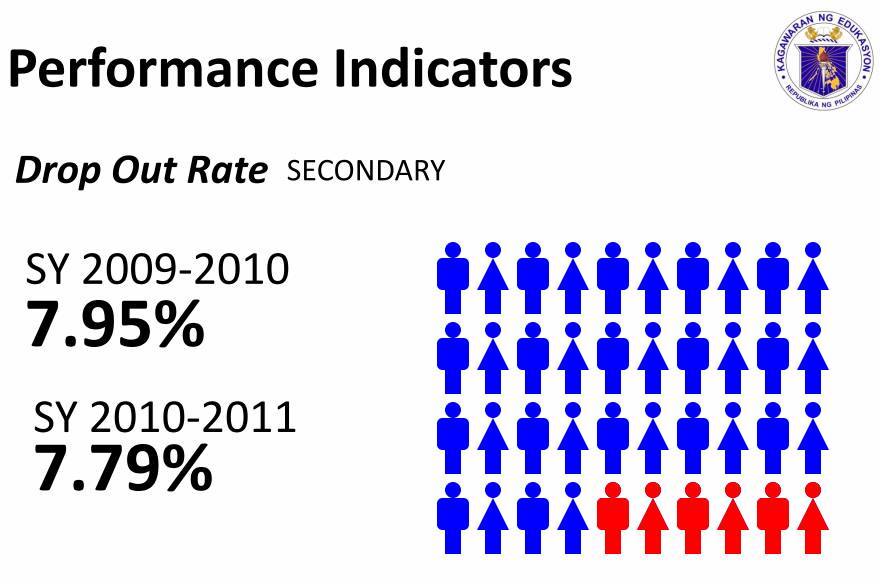
The dropout rate is close to eight percent in public high schools, the Department of Education says.
"Moreover, learning outcome continues to be alarmingly low as reflected in students’ poor performance in the National Achievement Test. Functional literacy rate among ten-to-fifteen-year-old children is also low at only 62 percent," the PIDS experts also said.
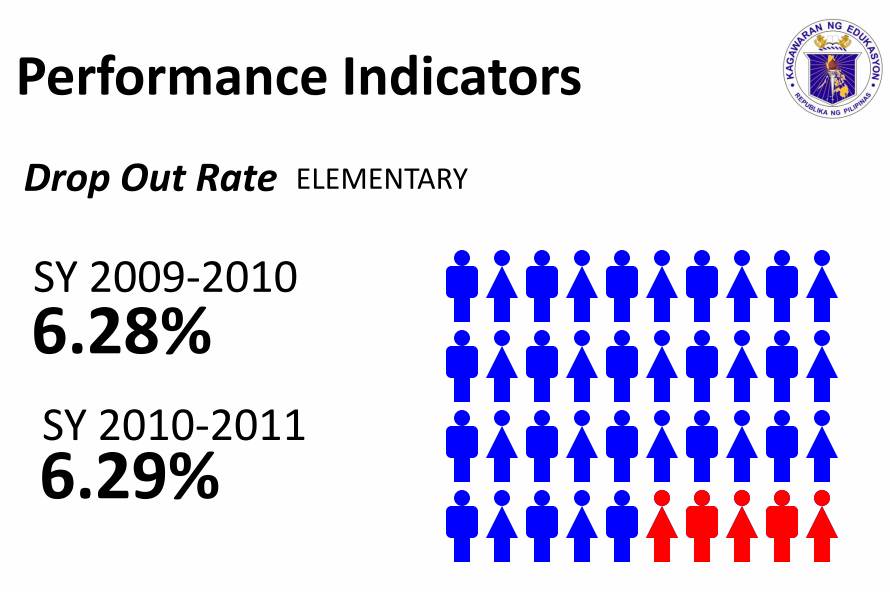
The dropout rate in public elementary schools is a little above six percent, according to the Department of Education.
‘Readmission has little positive effect’ “One extensive critical review of about 50 studies on public school education (Barsaga, 1995) described dropouts as coming from low-income families whose parents had little or no education, and who were unemployed or had jobs that gave them little or irregular income,” wrote Fe Josefa Nava of the University of the Philippines College of Education in the Education Quarterly in December 2009. Nava said the Barsaga study “also identified reasons for dropping out such as poor health due to malnutrition, distance between home and school, lack of interest, and teacher factor. It concluded that the education system then was ―socially selective since most dropouts were from socio-economically disadvantaged backgrounds.” Nava also cited another study, Finnan & Chasin, 2007, which said, “many repeaters eventually drop out at a later time. Re-admission seems to have little positive effect on achievement.” In his 2012 State of Basic Education report, DepEd Secretary Armin Luistro noted that the dropout situation remains a serious problem—involving six percent of total elementary enrollment in the public system and nearly eight percent in public high schools. Back in October 2011, Luistro said at least 46,000 students were saved from leaving school because of its Dropout Reduction Program (DORP). The DepEd said the DORP save students from dropping out of the rolls “because of financial problems, peace and order issues, and physical handicap, family and health concerns, among others.” Repeaters among college graduates The repeater problem persists even after some students hurdle college—when some graduates take the licensure examinations of the Professional Regulation Commission (PRC). The PRC exams were designed to determine the fitness for public practice of graduates of professional degree programs In the PRC exams for certified public accountants, 1,007 of the 1995 who passed in May 2012 were repeaters. Some 2,803 repeaters took the CPA board and 1,454 of them failed. In the nursing board exams, 7,994 of the 37,513 who passed in July 2011 were repeaters. Failure was the fate of 25,730 repeaters. After spending thousands on college and basic education, most repeaters are unable to realize the value of the money they spent by hurdling the PRC exams. Household spending on education The first Consumer Finance Survey of the Bangko Sentral ng Pilipinas (BSP) released in April 2012 learned that in 2008 only 5.5 percent of the budget of Filipino households were spent on education. "Food and beverage consumed outside the home" were a higher priority at 6.6 percent of the household expenses. A breakdown of the responses on education spending revealed that 35.1 percent spent zero on education while 41.8 percent said they spent P5,000 or less on schooling costs. According to the more comprehensive Family Income and Expenditure Survey (FIES) of the National Statistics Office, Filipino household spending on education in 2009 was only 4.3 percent. Among the poorest 30 percent of households, education spending was only 1.2 percent, while for the upper 70 percent—lower middle income to the richest—education had 4.6 percent. The 2009 FIES also showed that the poorest 30 percent spent more on alcoholic beverages and tobacco (2.7 percent combined for these two items) than they did on education. In contrast, the upper 70 percent’s spending on alcohol and tobacco was only 1.3 percent of their total expenses. — Earl Victor Rosero/HS, GMA News


 GMA Brandtalk
 Tracking
 Archives