

 GMA Brandtalk
 Tracking
 Archives

ADVERTISEMENT
Filtered By: Topstories
News
Ghost campuses loom for colleges in 2016 when K-12 students enter grade 11
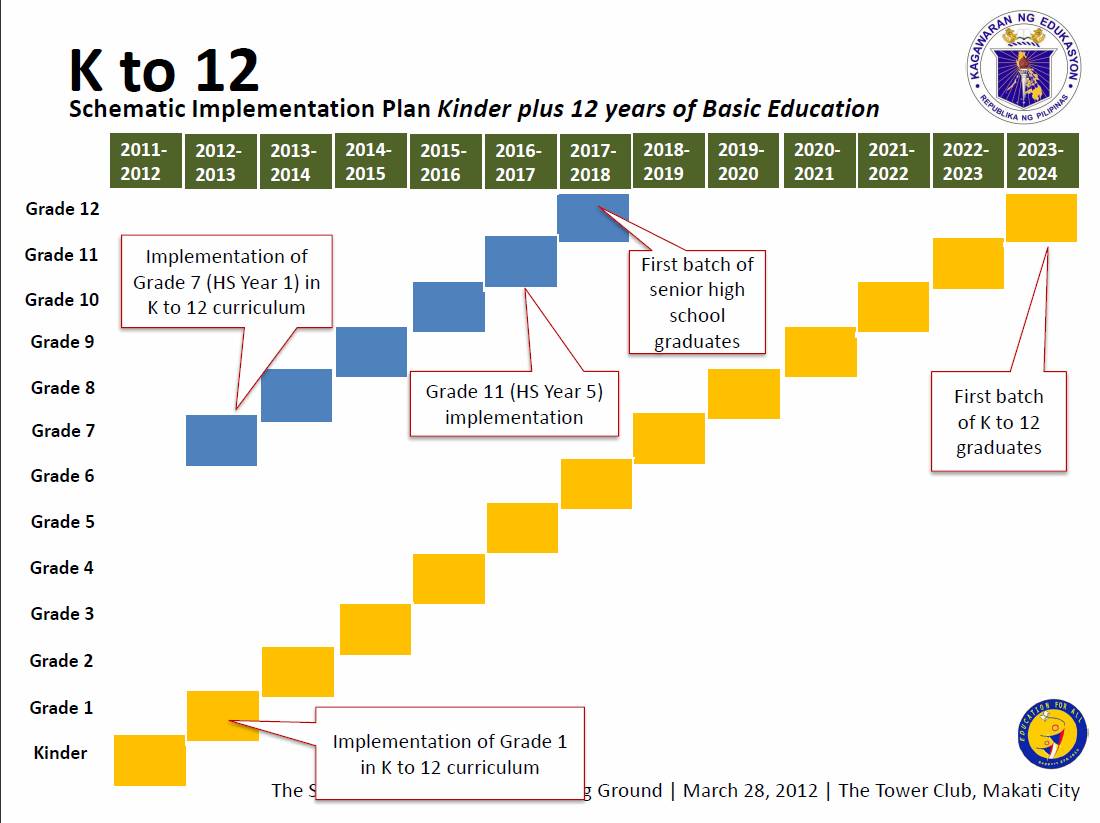
[First of a three-part series on K to12] Empty classrooms and lonely campuses, that's what lies ahead for many colleges and universities when "senior high school" goes into effect in 2016 under the new K to 12 educational system. Over a million students then will be in grade 11, when they would have been enrolled as college freshmen. The financial losses from the enrollment drop could be in the billions of pesos if countermeasures are not put in place before 2016, according to the Philippine Association of Colleges and Universities (PACU). Some education experts say that the impact could drive some schools out of business. Education Secretary Armin Lusitro noted that some tertiary schools, like the local government-sponsored University of Makati, have already started offering senior high school and changed their curriculum to adapt to K-12. Private colleges and universities which are sustained almost purely by tuition fees will be in peril unless they make similar adjustments when the pool of incoming college students dries up in four years. Or they could seek government subsidies to accommodate public school students in grades 11 and 12 while the DepEd builds new classrooms. Private college officials already note the impact of declining enrollment in recent years. “Enrollment share of the private schools has fallen from 80 percent to 85 percent of the total higher education population in the 1980s to the roughly 60 percent today mainly because of the lower tuition offered by the state universities and colleges (SUCs) and the local universities and colleges (LUCs),” PACU executive director Greg Pascua said in an interview with GMA News Online. He said the enrollment drop in the private colleges could be much more when the K-12 transition years set in, but "could be averted or cushioned if all education sector stakeholders work to put in place the necessary measures.” Pascua revealed that the billions in potential losses were quantified in a study the PACU recently commissioned to determine the financial impact of K-12 on college enrollment in the transition years. He said the study has been completed and the detailed findings may be released in time for the PACU national conference on June 30. According to the Commission on Higher Education, there are 1,604 private colleges and universities nationwide with aggregate enrollment of about 1.7 million. There are 534 SUCs and 93 LUCs and their combined student population is about 1.1 million. 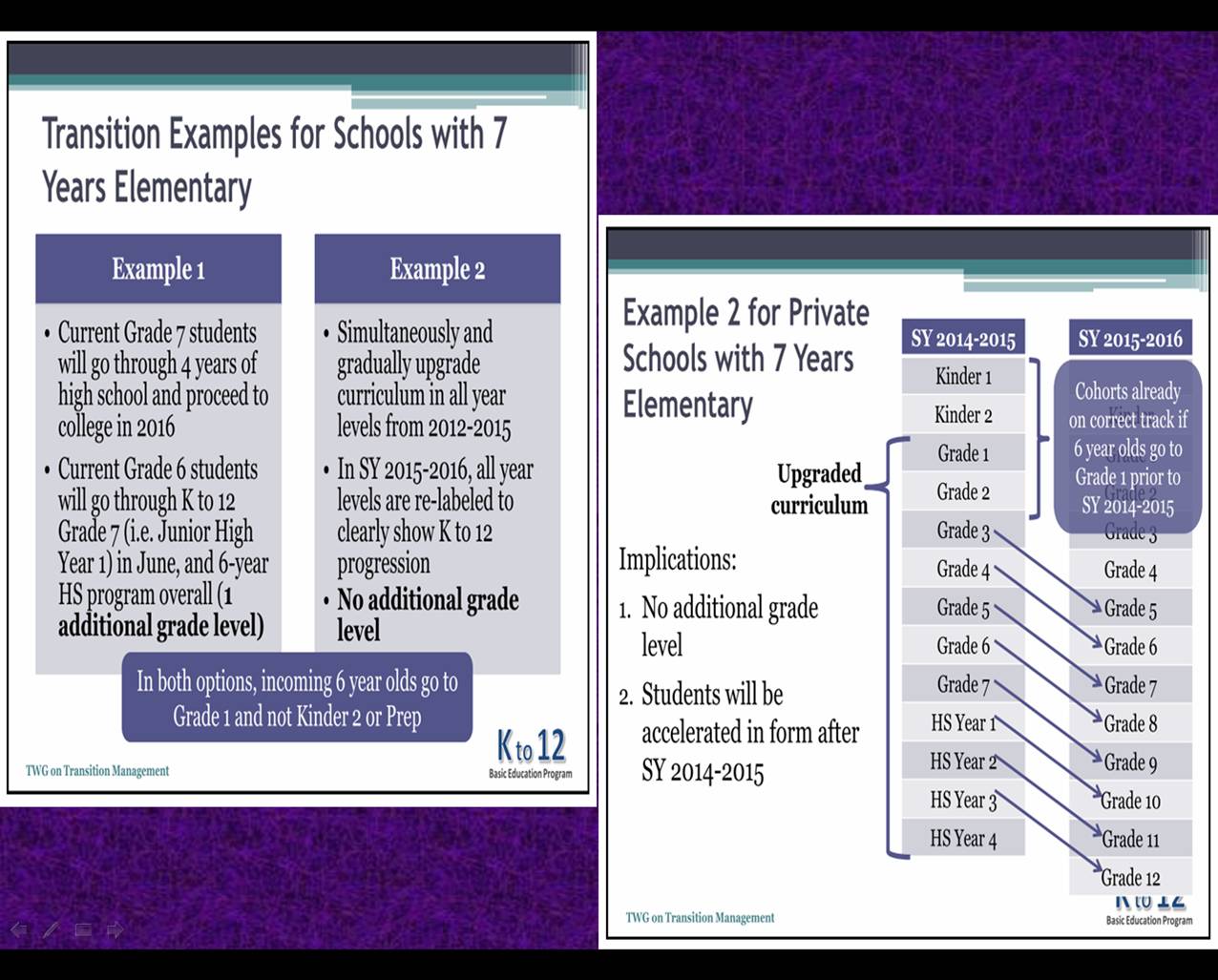 Two million students lost from college enrollment In a report presented to the Catholic Educational Association of the Philippines (CEAP) K-12 Summit last January 12, Department of Education Undersecretary Francisco Varela said the enrollment growth scenario for the first year of senior high school in 2016 is from 1.08 million to 1.201 million students. Then in 2017, enrollment will roughly double to 2.06 million to 2.324 million because two years of senior high school will be running simultaneously. These figures represent enrollment that colleges would not be able to capture if transition measures are absent. In a phone interview with GMA News Online, DepEd Assistant Secretary Toni Umali said that in areas where the DepEd will not have enough facilities in public schools, “senior high school students will study in the facilities of the private schools.” Umali is the DepEd official tasked to head the technical working group on K-12 transition management. Umali, in his presentation to the CEAP, said some schools will either pilot test or implement senior high school and serve as models for other schools in their geographical areas. He also explained that there are some students who will enroll in college in 2016. He said students in the schools who are in elementary Grade 7 now, will go through four years of high school and then proceed to college in 2016. Not zero enrollment DepEd Secretary Armin Luistro, in an interview with GMA News Online last Friday, said "[the K-12 program] will not result in zero enrollment because of the private schools and those with two years preschool and Grade 7." Two years of preschool, seven years of grade school and four years of high school totals 13 years of basic education, which is equivalent to the total 13 years of K-12. In another report at the CEAP summit, Don Brodeth of the Taft Consulting Group said that “if DepEd will take five years to build enough classrooms for senior high school and if private high schools will absorb their own students plus at least 50 percent of the senior high students of public schools, private high school enrollment will jump by 6.4 million.” That would lead to an increase in cash flows of at least P34.4 billion for the private high schools, according to Brodeth’s calculations. He also explained that senior high school would be a “large positive for the profitable high schools, but problematic for mission schools.” Brodeth said K-12 will serve as an opportunity for “introspection” so they could contemplate their future as a result of the K-12 system.
  Remedies PACU’s Pascua said most PACU member-schools can implement the senior high school curriculum, but laws must be enacted that will allow college faculty to teach the senior high school subjects without having to go through the licensure examination for teachers. Otherwise, many college faculty may face unemployment and school administrations can expect labor unrest. Another measure, he said, is for the national government to increase its funding for the Education Service Contracting (ESC) scheme and the Government Assistance to Students and Teachers in Private Education (GASTPE). Pascua explained that it is through GASTPE and ESC that the government subsidizes the school fees of public school students who enroll in private schools. He said these financing mechanisms work well and need a big budget boost to accommodate the senior high school enrollment surge in 2016 to 2018. Pascua emphasized that most of the transition measures need decisive action from Congress. He noted that in the past weeks, the congressional committees on education have been meeting with the education sector stakeholders so that “bills on K-12 could be refined and mapped out for passage” soon after Congress reconvenes in July. Public opinion of K to 12 In a news release issued Sunday, June 17, the DepEd has noted a shift in Filipinos’ opinion or perception of the impact of senior high school based in a survey conducted by the Social Weather Stations (SWS) from March 10 to 13 this year. The DepEd noted that the number of Filipinos who “believe more students will finish senior high school under K to 12 because it is equivalent to two years of college or post secondary courses at a high school rate” now stands at 59 percent—up from 48 percent last December. “The March 2012 Social Weather Survey was conducted from March 10-13, 2012 using face-to-face interviews of 1,200 adults in Metro Manila, the Balance of Luzon, Visayas, and Mindanao with sampling error margins of ±3% for national percentages, ±6% for area percentages,” the DepEd said. — with Amanda Fernandez/Earl Victor Rosero/HS, GMA News
Students in Grade 7 today who take 4 years of high school may enter college in 2016, according to the Department of Education.
The Department of Education expects senior high school enrollment in SY 2016-17 at 1.08 million to 1.201 million and in SY 2017-18 at 2.06 million to 2.324 million.

