We use cookies to ensure you get the best browsing experience. By continued use, you agree to our privacy policy and accept our use of such cookies. For further information, click FIND OUT MORE.
Make this your preferred source to get more updates from this publisher on Google.
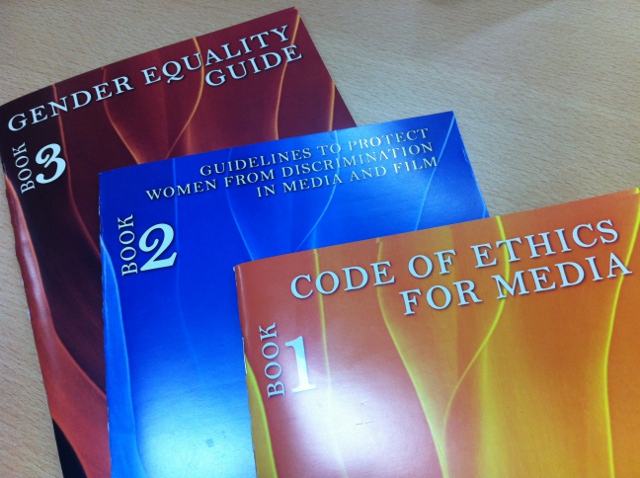
The government has launched three documents expected to ensure gender equality in Philippine media reporting and the production of gender-sensitive media content. The Gender Equality Committee (GEC) on Friday launched three books with titles: "Code of Ethics for Media," "Gender Equality Guide," and "Guidelines to Protect Women from Discrimination in Media and Film."
Gender equality guidebooks. Photo by Kimberly Jane Tan
The GEC is composed of the Presidential Communications Operations Office (PCOO), Philippine Commission on Women, National Telecommunications Commission, Movie and Television Review and Classification Board, Film Academy of the Philippines, Film Development Council of the Philippines, Optical Media Board, National Commission for Culture and the Arts, and Center for Media Freedom and Responsibility. The GEC was created under Republic Act 9710 or the Magna Carta for Women, which PCOO Sec. Herminio Coloma Jr. said was also the basis for the creation of the three gender equality guidebooks. "Sa araw na ito ilulunsad natin ang tatlong dokumento bilang pagtalima sa tadhana ng batas. Ang pangunahing layunin natin ay ang pagkakaroon ng gender fair media," he said in a video message played at the launch of the documents held at the National Telecommunications Commission in Quezon City on Friday. Under the three guiding documents, PCOO Lesley Jeanne Cordero said media companies and other institutions are encouraged to uphold the dignity of women and highlight their contribution through mass media. She said media companies are also expected to have gender sensitive management, training, production, information dissemination, and programming. On the other hand, schools of journalism and communication are also expected to develop gender-fair policies and instructional materials to eliminate gender bias and discrimination. But Cordero admitted,"Ang pinakamahirap sa lahat ng tasking natin it is not the crafting of the three guidebooks... [but] how as a team we can monitor or evaluate the implementation of these documents," she said. "Akala natin tapos na yung trabaho, hindi pa, nagsisimula palang tayo," she added. Cordero, however, said that the documents are only a guide to media companies. "There are existing laws... we can use, so these [guidebooks] will serve as encouragement and a tools to make people aware there are existing guidelines that they can use if they want to have self-regulation in their respective media organizations," she said in an interview after the launch. Section 16 of RA 9710 states that the government the "shall require all media organizations and corporations to integrate into their human resource development components regular training on gender equality and gender-based discrimination; create and use gender equality guidelines in all aspects of management, training, production, information, dissemination, communication, and programming; and convene a gender equality committee that will promote gender mainstreaming as a framework and affirmative action as a strategy, and monitor and evaluate the implementation of gender equality guidelines." Section 14, Article II of the 1987 Philippine Constitution likewise states that "the State recognizes the role of women in nation-building, and shall ensure the fundamental equality before the law of women and men." — LBG, GMA News


 GMA Brandtalk
 Tracking
 Archives