

 GMA Brandtalk
 Tracking
 Archives

ADVERTISEMENT
Filtered By: Topstories
News
Homeless but not totally: An urban poor family copes via mobile lifestyle
Losing a home is a life-changing experience. Vendor Natalia Lucas can call herself overqualified as she lost her home more than once.
Selling food and cellphone credits on a side street near the GMA Network Center, 62-year-old Natalia recalled her homeless days.
On December 1, 2005, her birthday, her shanty in Barangay Sacred Heart, Quezon City, was demolished.
A businesswoman by trade, Natalia soon found herself another home: a vacant store along Timog Avenue in Diliman pawned to her for P50,000. A month later, the money she invested in that store vanished when that too was demolished.
A businesswoman by trade, Natalia soon found herself another home: a vacant store along Timog Avenue in Diliman pawned to her for P50,000. A month later, the money she invested in that store vanished when that too was demolished.
She found another one soon after, this time in Barangay South Triangle, But that was short-lived. Some weeks after she moved in, that house burned down.
For Natalia, everything had a reason: "Ang naisip ko na lang noon, palagi namang may way si Lord eh, palagi naman siyang may magandang dahilan. Anuman ang frustration sa amin, makakaya ko yun, binigay Niya yun eh," Natalia said.
No house, but got wheels
Natalia did not own a house, but she had a fleet of around 10 vans she rented out to tourists and production crews.
In the face of the emotional and financial burden of losing a home three times in a row, she had an idea.
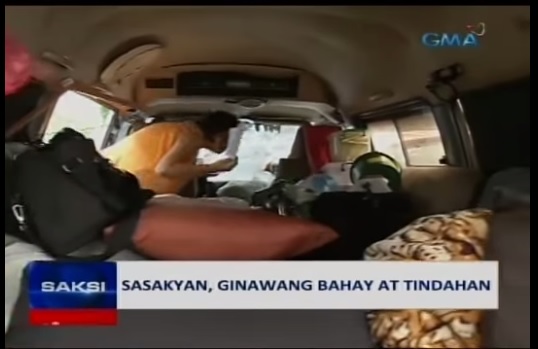
Beginning with a trusty AUV, she removed the car seats and rearranged the interior to form a bed, adorning it with pillows and blankets for her husband and children. She collected her and her family's clothes and placed these in an old empty paint bucket.
Pails also kept her important documents, such as birth certificates and bank passbooks. Another AUV kept the wares of her mobile store.
She and her family take baths at a nearby bus station at P20 a bath.
The side street where she parked her two AUVS are now lined with stalls and a mobile kitchen for quick snacks such as pares and arroz caldo. Her vehicles, though stripped and rearranged, are still functional.
"Dito kami nagtitinda, tapos 'pag mamamalengke, dala (namin) yung van, babalik na naman ulit kami dito. Alam naman ng barangay na nasunog ang bahay namin kaya pinapayagan kaming tumira dito, tsaka nagpaalam ako sa may-ari ng building na dito muna kami sa gilid magtinda."
It had been close to a decade since she called Samar street her home, her store, and the network's employees, who affectionately call her "Marimar", her friends.
"Masaya naman dito, wala ka namang atraso kaninong tao, wala kang ginagawang masama. Di naman nakakatakot kasi wala ka namang inagrabyadong tao...Pagka-inaantok ka di matulog ka, pag may kumatok, 'paload,' gigising ka," she said.
Her livelihood in the area earned her enough to send their three children to school and begin mortgage payments for a "real" house. But even if she did have one, Natalia said, she would still go back to sleeping in her car.
"Dito pa rin kasi hinahanap ng katawan ko," Natalia said. "Kahit na pumunta kami sa probinsya, kamag-anak ko, hindi kami natutulog sa bahay pinupuntahan namin. Dito talaga sa sasakyan."
Repurposed buses
Natalia's ideas of repurposing her vehicle into a home reflects a similar idea proposed in the US state of Hawaii.
Hawaii's state government recently said it plans to convert decommissioned public buses into a trailer-park style home for the homeless.
Under the trailer-park style layout, a fleet of buses would be designed and repurposed with a special roles: sleeping quarters, dining area, and recreation center.
But is this idea doable in the Philippines, a country with a sizeable and increasing number of informal settlers in Metro Manila alone?
According to the National Housing Authority (NHA), most recent July 2011 data, there are around 584,000 informal settler families in Metro Manila alone.
Half of them reside on privately-owned lots, 159,000 live on government-owned lots while a little over 100,000 settled on danger zones such as waterways and faultlines.
NHA-NCR Group Manager Engr Victor Balba says the repurposed bus idea, while new to the bureau, is good in theory but because of scarcity of available land in Metro Manila, it may have problems if it is to be implemented.
Balba said that while Metro Manila has available lots, these are owned by private entitites and command high prices than those off-city, or in areas outside of the National Capital Region.
Even if the NHA attempts to match the going offers for these lots, Balba says, the bureau may not be able to immediately hand over payment because of audit regulations, a move that may imperil any deal.
"We're doing all that we can para mabili natin iyan. Kaya (lang), pag bibili ng private property ang gobyerno, andaming requirements kasi siyempre we are governed by auditing rules and regulations. And also the payment ng property, di naman pwedeng i-cash kaagad yan kasi dadaan ka sa COA. Compared sa private, pag sinabing ganyan ang presyo, babayaran ka ng buo, talo ka na kaagad, maski pareho kayo ng inooffer," Balba said.
But the Land Transportation Franchising and Regulatory Board said that while no one has formally proposed a similar idea to the agency, both the LTFRB and bus operators have broached the idea in "exploratory talks."
"Meron ding ibang mga operator na dinodonate ito (decommissioned buses) sa mga government units kung may magrerequest sa kanila bilang pangserbisyo sa kanilang constituents," LTFRB's Arnel del Rio said.
Under current LTFRB regulations, a passenger bus is required to have its franchise dropped and substituted by a more recent model if it is 15 years and older.
The phased-out bus may still be registered but only as a private service vehicle or stored in the operator's fleet for parts. — ELR, GMA News

