

 GMA Brandtalk
 Tracking
 Archives

Are you for or against the K-12 education program?
Three years after President Benigno Simeon Aquino III signed the law mandating the adoption of the K to 12 program in Philippine schools, the program remains highly contested, especially by youth and student groups.
Although Aquino signed into law Republic Act No. 10533 or "Enhanced Basic Education Act of 2013" only on May 15, 2013, the K to 12 program was implemented much earlier, in 2011 when universal kindergarten was offered.
However, the full implementation of the K to 12 program will only happen this year when school starts on June 13.
The Enhanced Basic Education or K to 12 Program includes:
- at least one year of kindergarten education;
- six years of elementary education; and
- six years of secondary education (four years of junior high school and two years of senior high school education).
Aquino said the landmark piece of legislation that institutionalized 12 years of basic education has placed the Philippines at par with global educational standards.
Before the K to 12 program was implemented, the Philippines was the only country in Asia with a 10-year basic education or pre-university school program.
However, K to 12 opponents said the program posed financial problems to low-income families.
Anakbayan National Chairperson Vencer Crisostomo said “Allowing K-12 to continue is like tolerating crime. This is not the change hoped for by many who voted for Duterte. Ang K-12 ay pabigat at pahirap sa ordinaryong pamilyang Pilipino."
Sarah Elago, who is set to represent the Kabataan party-list in the 17th Congress, said the quality of instruction under K to 12 program has not improved.
"With the severe lack of facilities and teachers, the practice of shorter hours of instruction is set to continue in the decades to come," she said.
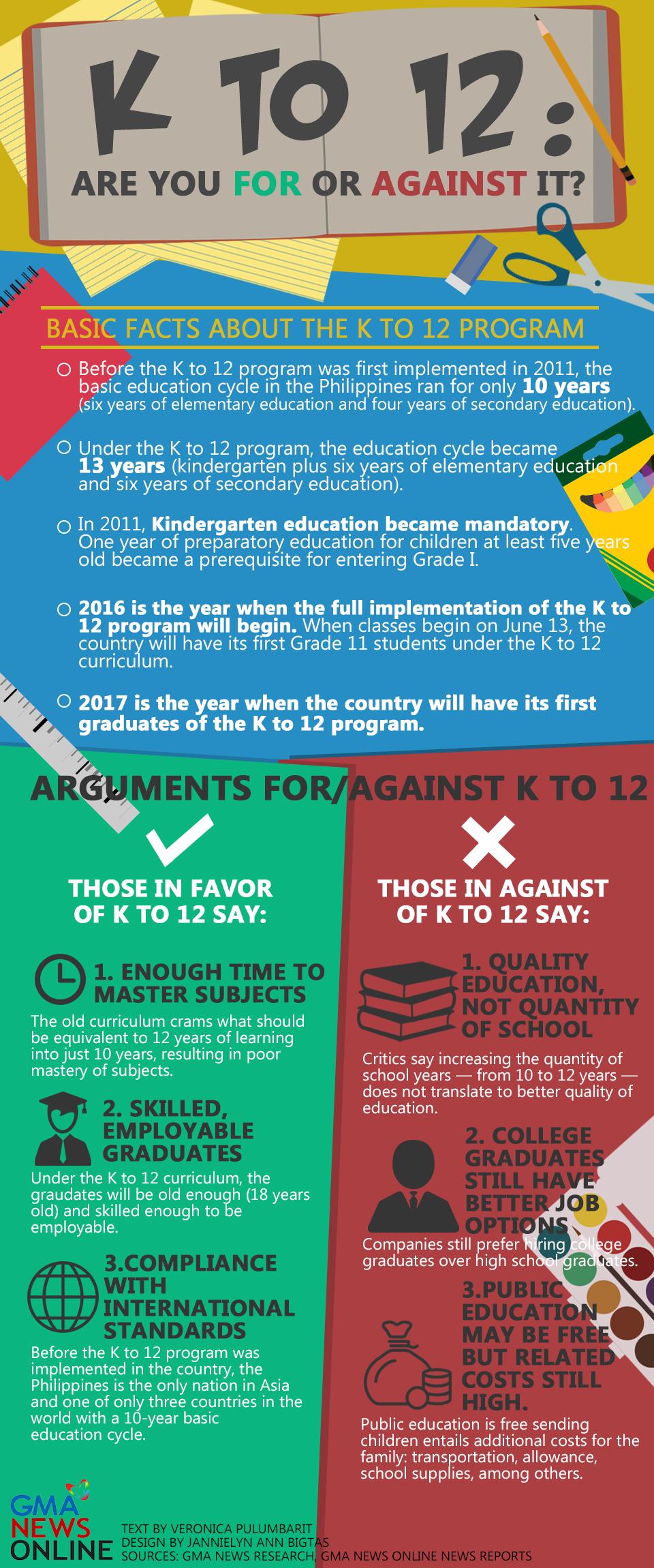
—Veronica Pulumbarit and Janniely Ann Bigtas/NB, GMA News

