

 GMA Brandtalk
 Tracking
 Archives

Over 60 percent of Filipinos favor reimposition of death penalty —SWS
Over 60 percent of Filipinos are in favor of the reimposition of death penalty on heinous crimes related to illegal drugs, the latest Social Weather Stations survey said.
Respondents were asked the question, "Do you approve or disapprove of the proposed law that will reimpose the death penalty on heinous crimes pertaining to illegal drugs?"
The First Quarter 2017 Social Weather Survey results, first posted on BusinessWorld, showed that 61 percent strongly or somewhat approve of the death penalty (36 percent of respondents "strongly approve" while 24 percent "somewhat approve"). On the other hand, 23 percent showed disapproval, yielding a net approval score of +38, classified as "good" by the SWS.
Sixteen percent "strongly disapprove" and 7 percent "somewhat disapprove" of the reinstatement of capital punishment.
However, 16 percent were still undecided on the matter.
The poll also found that stronger support was highest in Metro Manila with a +58 "very good" approval score, in which 75 percent approve while 17 percent disapprove.
It was followed by Balance Luzon at +39 percent "very good" with 63 percent approval and 24 percent disapproval. Mindanao registered a +35 (53 percent approve, 17 percent disapprove) classified as "very good", and Visayas at "moderate" +25 (56 percent approve, 31 percent disapprove).
Approval for the proposal was highest among the class ABC which scored +62 (76 percent approve, 14 percent disapprove) "very good" rating. Class D was at "good" +40 (62 percent approve, 22 percent disapprove), and class E at moderate +21 (50 percent approve, 29 percent disapprove).
Metro Manila, Luzon, Visayas and Mindanao all had 300 respondents each, SWS said.
The survey was conducted from March 25 to 28 using face-to-face interviews with 1,200 adults nationwide.
Sampling error margins are ±3 percent for national percentages, and ±6 percent for the National Capital Region, Balance Luzon, Visayas, and Mindanao.
Knowledge of the proposal
In the same survey, SWS also found out that only 48 percent of Filipinos have either "extensive or partial but sufficient knowledge" about the death penalty proposal. The 48 percent is broken down into 13 percent having "extensive knowledge" and 35 percent having "partial but sufficient knowledge."
Fifty-two percent, meanwhile, have either "little or almost no knowledge." This is broken down into 43 percent with "only a little knowledge" and 10 percent admitting to "almost nothing or nothing."
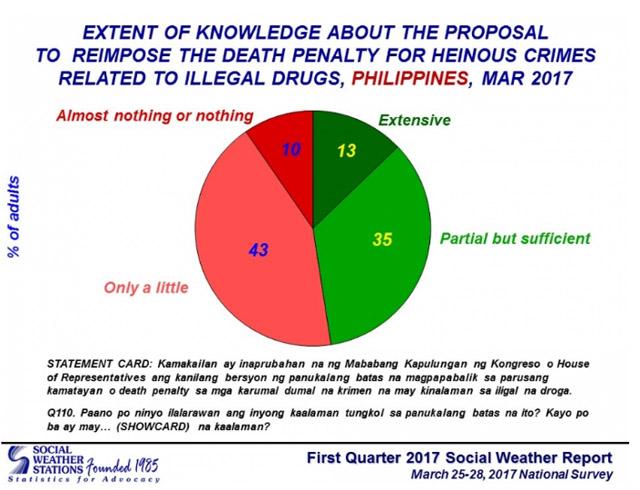
The respondents were asked, "Recently, the Lower House of Congress or House of Representatives approved their version of the proposed bill to reimpose the death penalty on heinous crimes related to illegal drugs. How would you describe your knowledge regarding this proposed law? Do you have knowledge?"
Among those with "extensive knowledge" of the proposal, there was a "very good" +59 (78 percent approve, 19 percent disapprove) approval rating of the death penalty proposal.
Those with "partial but sufficient knowledge" yielded a "very good" +51 (70 percent approve, 18 percent disapprove) for the proposal.
Respondents with "only a little knowledge," had a "good" +30 (54 percent approve, 25 percent disapprove), and those with "almost no knowledge," gave a "neutral" net zero (33 percent approve, 34 percent disapprove).
In early March, the death penalty bill or House Bill No. 4724 sailed past third and final reading at the House of Representatives with 217 affirmative votes.
The bill seeks to reimpose capital punishment on seven drug-related crimes, including:
• importation of dangerous drugs;
• sale, trading, administration, dispensation, delivery, distribution and/or transportation;
• maintenance of a den, dive or resort for drug activities;
• manufacturing of dangerous drugs;
• cultivation or culture of plants classified as dangerous drugs, or are sources thereof;
• unlawful prescription of dangerous drugs; and
• criminal liability of a public officer or employee for misappropriation, misapplication, or failure to account for confiscated, seized, or surrendered dangerous drugs.
The bill will next have to hurdle the Senate, in which it is expected to have difficulty in securing passage. —KG, GMA News

