

 GMA Brandtalk
 Tracking
 Archives

Duterte’s promises and his first year in office: The economy
Apart from promising to get rid of crime and illegal drugs in three to six months, presidential candidate Rodrigo Duterte vowed to rid the government of corruption during the same time frame. "We cannot go for economic growth" as long as there are still corrupt and incompetent officials in government, he declared.
Duterte also targeted "endo," or practice of hiring workers under an employment contract that falls short of the mandated six months to qualify for regularization – a situation that does not require an employer to provide an employee with the mandated socioeconomic benefits of employment.
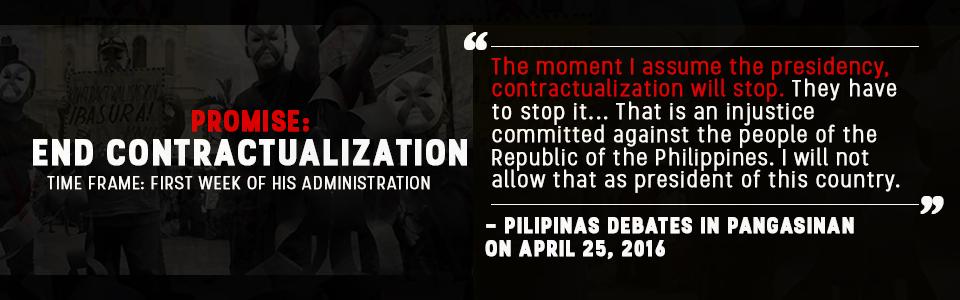
During the PiliPinas debates, Duterte said he would "immediately" stop contractualization and that he would tell both chambers of Congress, "'I need it first week of my administration'. Ganoon lang. Gawin ninyo. That's the President ordering everybody."
In August 2016, Duterte said during a press conference in Malacañang that he would be "unforgiving" to companies engaged in endo. "You will not only lose your money, you will lose your plants."
Ten months into the Duterte administration, the Department of Labor and Employment (DOLE) issued Department Order 174 on March 16, 2017, banning the practice of "repeated hiring by contractor or subcontractor of employees for short duration," also known as "endo."
Still, the order did not effectively ban hiring for seasonal employees, project hires, or probationary employment.
"The Department Order 174 issued by the Department of Labor and Employment, regulating the contracting and subcontracting of employees, is a fulfillment of the campaign promise of the President," Presidential Spokesperson Ernesto Abella said the next day.
But labor groups urged the President to come up with a separate order which would effectively ban all forms of endo.
"It [Department Order 174] will perpetuate and further proliferate the existing unperturbed race to the bottom for millions of contractualized workers once it becomes operative two weeks from now,” Associated Labor Unions-Trade Union Congress of the Philippines (ALU-TUCP) spokesperson Alan Tanjusay said.
The President has not yet acted on this request.
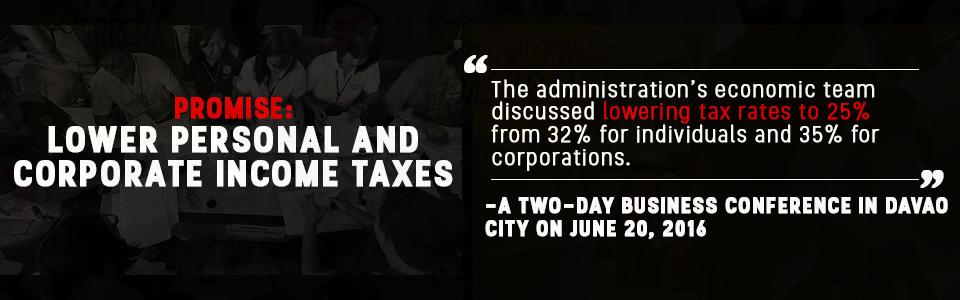
On May 29, 2017, Duterte certified as urgent the bill that encompasses the first package of the Comprehensive Tax Reform Program.
It was approved on third and final reading by the House of Representatives on May 31, 2017.
Under the House-approved version of the bill, those earning P250,000 or less each year are exempt from paying the income tax, while those earning between P250,000 to P400,000 will pay a 20 percent tax on earnings beyond the P250,000 threshold .
A higher tax rate will be imposed on the so-called “one percent” of taxpayers, or those earning more than P5 million a year. They will have to settle P1.45 million, plus 35 percent of the amount above the P5 million mark.
The bill also raised the threshold for taxing the 13th month pay and other benefits to P100,000 from P82,000.
"We expect to be steering the Philippines towards the golden age of infrastructure and will propel economic growth within the next five years," Presidential Spokesperson Ernesto Abella said after the passage House Bill 5636 was passed.
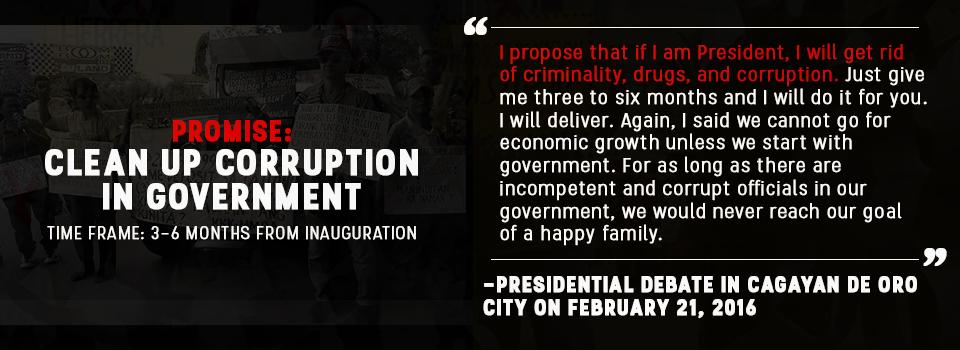
A wave of firings and resignations from the agencies Duterte called out as being "corrupt" occurred in the first 12 months of his presidency. Among those sacked was former Interior Secretary Ismael Sueno during a Cabinet meeting on April 3, after allegations of corruption were hurled against him.
In a Senate hearing on February 15, 2017, Internal Revenue Commissioner Caesar Dulay said some 300 employees of the agency also resigned on the heels of a crackdown on corruption.
Duterte also fired 92 other employees of the BIR and the Land Transportation and Franchising Board (LTFRB) in March, also on allegations of corruption.
"Duterte's remark that he fired 92 government officials this month underscores that there are no sacred cows in the Duterte administration," Presidential Spokesperon Ernesto Abella said at that time.
In May 2016, the Duterte identified the BIR, the Bureau of Customs and the Land Transportation Office as the most corrupt government agencies .
Whether this exodus of officials will result in a less corrupt government remains to be seen.
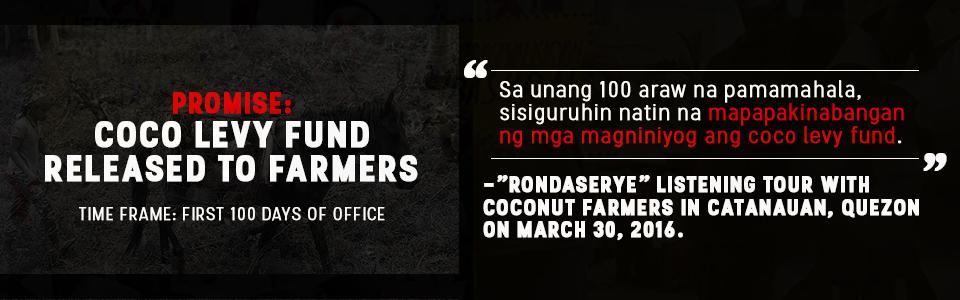
One year into Duterte's presidency, the coconut levy funds remain undistributed in favor of farmers.
"So far ay wala pang nadi-distribute. It's about P75 billion held at the National Treasury because of the order of the Supreme Court na kailangan ng law to release the funds. That is the status so far of the coco levy funds," Philippine Coconut Authority Administrator Avelino Andal told GMA News Online.
The fund is now with the Bureau of the Treasury and cannot be distributed without a congressional approval or new law to that effect.
Senator Francis Pangilinan is pushing for the passage of a coco levy fund bill on its third and final reading.
"Umaasa tayo na ma-ipasa natin ang Coco Levy Trust Fund measure sa third and final reading bago matapos ang first regular session ng Kongreso sa Hunyo," Pangilinan said in a statement on March 9.

The National Irrigation Administration (NIA) started implementing free irrigation services to farmers at the start of 2017, setting aside the service fees embodied in Republic Act No. 3601.
The NIA has stopped collecting irrigation service fees (ISF) starting January 1, 2017 as the Congress allowed the agency to set aside P2 billion from the P3.3 trillion national budget to cover the service fees.
With the P2 billion allottment covering the operating requirments of the NIA, it no longer needs to depend on the ISF collections.
Republic Act 3601 authorized the NIA to collect irrigation service fees from farmers and farmers' associations.

So far, the government has not made any significant announcement regarding the campaign promise to subsidize the PhilHealth premiums of farmers, transport workers, and market vendors.
GMA News Online is trying to get updates from PhilHealth, but calls and text messages to the PhilHealth officials remain unanswered as of this posting. — Jon Viktor Cabuenas and John Ted Cordero/BM/VDS, GMA News

