

 GMA Brandtalk
 Tracking
 Archives

Residents fear worse travails may come after Marawi war
MARAWI CITY - Stuck on a straw mat with clothes in plastic bags to mark her family's tiny spot in a basketball court teeming with hundreds of displaced residents, Emma Mambalawag complains that life in the evacuation camp is nearly unbearable.
She and her husband, Camal, have to line up daily for food and water rations doled out by the government and non-government organizations like the International Committee on the Red Cross.
The 36-year-old mother of four said it’s a struggle to maintain personal hygiene in an emergency shelter at Saguiaran town in Barangay Poblacion with nearly 1,500 people but only has about 12 toilets. The lack of privacy is a constant problem and Mambalawag is worried that her children and her husband may get sick soon.
Seven days after moving into the shelter, Mambalawag gave birth to a baby boy she named Mohammad Hussein, now one month old.
“Life is so hard here. We all sleep so close to each other, side by side. I fear for my children’s health, especially my new-born son,” she told GMA News Online.
“There is lack of clean water, we eat the same unhealthy food of canned sardines and instant noodles, and share the bathrooms with hundreds of others. I don’t know when this will end.”
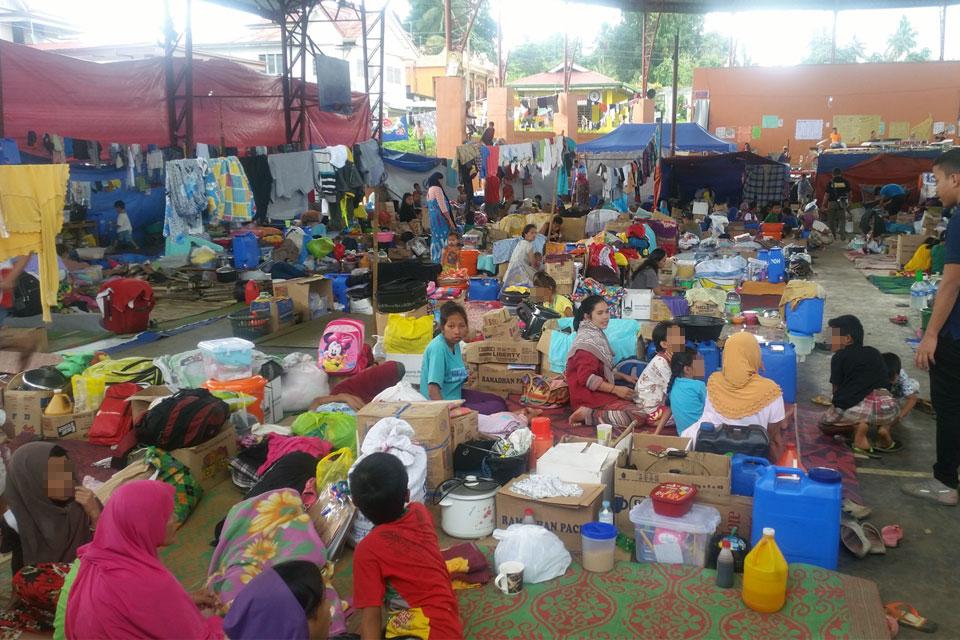
Aid volunteer Amer Sanggacala, a student from Marawi's Mindanao State University, says the help being provided to the Internally Displaced Persons (IDPs) is limited by the availability of government funds and donations from NGOs.
"It's heartbreaking to see them in this condition but we also depend on the assistance of the government and donors," Sanggacala said.
But Mambalawag expects much worse when the 42-day fighting in this southern Philippine city, her hometown several kilometers north of her emergency shelter in Saguiaran town, finally comes to a halt.
Initial images of the extent of devastation in once-idyllic neighborhoods in her city by Lanao Lake show a wasteland of burned and bombed-out houses and streets littered with bodies and debris. Many mosques, the icon of Marawi with their minarets lining its skyline, have been damaged in the heavy exchanges of fire.
While they struggle each day in the squalor of the overcrowded evacuation camp, Mambalawag and other IDPs, widely called here as "bakwit," worry how they can rebuild their homes and lives when they finally return to Marawi.
"How can we rebuild our houses when we have lost everything?" asks Mambalawag, wondering where her husband, who used to work as a construction worker, can find work in a city, where the commercial district has been destroyed by more than a month of heavy gunfire, shelling and airstrikes.
“We don’t know what awaits us when this war is over. Did our house burn to the ground? Is it still there? Will we get back our old jobs? Life will never be the same for us,” she said.
Marawi's public markets, groceries and hardware stores have been destroyed or looted and it would take sometime before they can be repaired, replenished and reopened so basic commodities like food, water, medicine, fuel and construction materials would have to be bought, if there's money, from outlying municipalities or in Iligan city, about 30 kilometers away, Mambalawag said.
Mambalawag blamed the ISIS-backed militants for her and her family’s miserable condition.
“We were living a quiet and normal life. Why do they have to destroy our city, our home? Many people have died, including children. They have no mercy,” she said.
For 22-year-old Abdul Jalil, who lives in Barangay Emie Punud in this city, the war is like a “bad dream.”
“I don’t recognize my city anymore as what I have been seeing on TV. I have lived here all my life, grew up here. It’s so sad to see it destroyed,” he said.
Jalil’s neighbor, storeowner Amina Batugan, 62, said she hopes the conflict in Marawi would soon end so that they could all return to their normal lives.
“This is taking too long. There is so much senseless killings,” Batugan said as she complained that the long-drawn out conflict has taken its toll on her small business.
“I can’t believe this city was attacked because all these years fierce fighting only happened in the mountains,” she added.
Batugan was one of the thousands of civilians who fled the violence in Marawi, but returned home, along with her family to guard her home against looters.
GMA News Online spoke to Batugan as Philippine Air Force helicopters flew overhead. She said they still often hear gunfire and explosions from airstrikes and live in constant fear of stray bullets but insist they'd rather stay home than return to the evacuation center. Much of the neighborhood where they returned last May 27 and nearby communities still resembled a ghost town with their abandoned homes and empty streets.
After the war, Batugan’s son, Raisomel, 42, and his wife Rasmia, 45, and other displaced residents said they expect danger and tensions to linger, with booby traps and unexploded bombs littering the communities.
“Is it safe for us to go back? What is our guarantee that there will be no more terrorists there once this war ends?” asked Rasmia, who used to own a cosmetics shop in downtown Marawi, one of the hardest-hit areas by the fighting.
Many families have lost parents, children, siblings, businesses and properties in the conflict and may exact retribution through "rido" against clans or families, which have been linked to the attackers.
"Rido" pertains to a long tradition in Mindanao, where clans settle grudges and scores by force in running battles that sometimes last for years. Such clan wars have affected entire towns and displaced hundreds of residents in the past before troops could pacify the feuding families, specially those with sizable private armies.
Most of more than 200,000 residents abandoned Marawi and fled to evacuation camps or temporarily lived in with relatives in nearby municipalities after militants mainly belonging to the so-called Maute and Abu Sayyaf armed groups laid siege on the Islamic city last May 23 by occupying buildings and houses in several barangays east of Agus River, which cuts through Marawi.
The gunmen also blocked roads and bridges and displayed black flags in scenes that resemble the attack by Islamic State militants in Syria and Iraq. President Rodrigo Duterte cut short a visit to Russia, where he declared martial law across Mindanao for 60 days, before abruptly flying home to deal with the crisis.
Thousands of soldiers and policemen have been sent to Marawi to crush the siege. The military said 322 militants, 84 soldiers and policemen and 39 civilians have been killed so far while 1,716 trapped residents have been rescued by the military, Lanao del Sur provincial and Marawi City teams and volunteers.
Duterte said his administration has appropriated P20 billion and is organizing the Task Force Bangon Marawi, a multi-agency coordinating group, to rehabilitate Marawi after the conflict.
Other officials, however, said the extent of devastation has yet to be assessed amid the ongoing fighting and Marawi's recovery may require a much larger funding.
"The amount of 20 billion pesos has already been allocated to ensure that this happens. More funds will be added, if necessary," Duterte said in a speech last June 27 during the Eid'l Fitr celebration.
"Meaningful and long-term support will also be made available with the help of our partners in the private sector and the international community."
"Rest assured that the entire nation is beside you during this challenging period in your lives. We will be with you as you rebuild your homes and localities, and as you realize your dreams for a better life," he said.
Duterte said he has discussed the need for recovery funds with Finance Secretary Sonny Dominguez. "I said, I need a big amount because I will rebuild Marawi. I need to rebuild Marawi, because if not, I will remain forever the villain."
Many evacuees in Saguiaran like Pangilamun Paniorotan, a 65-year-old carpenter and a father of five, recall their experiences on the day when they ran for their lives as the shootings and explosions started to erupt here.
They say the near-death experienced often flashes back in their mind like a nightmare.
“We were trapped for four days in Marawi and I saw men in black shirts brandishing big guns. My family and I were very scared so when we had the chance, we escaped. We managed to bring just a few clothes which we squeezed in a very small bag,” Paniorotan said.
“What kept me strong for my family was my faith and we made it here,” he said in the evacuation camp, which used to serve as the town’s gymnasium.
Despite all the dim scenarios ahead, Mambalawag says she and her husband muster courage to survive for their children, who will inherit the new Marawi that stands to be rebuilt after the war.
"When we see our newborn son and our other children, they give us a reason to move on and bear all these problems." — RSJ, GMA News

